







Kids love good stories. They can be fascinated, moved, and inspired by a made-up poem or story that helps them learn how to dream and think and imagine themselves doing amazing things. Those who writes stories for children get letters from parents or the kids themselves. Taken together, such testimonies present a resounding story of its own: Every child should have easy access to stories that they love.
I was a short story writer before finding my voice as a writer for kids in 1969 with "The Boy with a Drum" (rat-a-tat-tat-a-tat-rum-a-tum-tum). I still hear from fans of that one. A recent example: “Your book made our daughter bounce to the beat …She was only 6 months old …and she bounced and she bobbed in the rhythm of your book.”

When Mary Schweyer
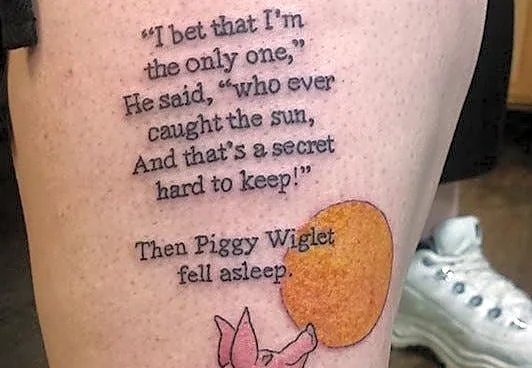
Cocker was a little girl, she and her four sisters would sit around their grandmother’s knees to hear their favorite story — "Piggy Wiglet and the Great Adventure." Mary grew up to be a teacher in a vocational school in Ohio. She uses Piggy Wiglet in her lessons on “identity.” The tattoo on her leg is the last stanza of the story as well as Piggy himself.
A boy in Germany loved "The Book of Giant Stories" so much that when he grew up and became a composer; he wrote for permission to write an overture inspired by the stories. "Little Turtle’s Big Adventure" gave courage to a little girl in Missouri who was miserable after her family moved to a new neighborhood. When read how a little turtle found a fine new home after his pond was destroyed, she told her mother, “If a turtle could be happy in a new home, I can be, too.” Soon after that, she was.
Lately I worry that we are not putting enough stories into the hands of children. Reports on what is being stressed by publishers vary widely, but some note that children show an increasing preference for informational reading, and that is driving a trend toward highly illustrated nonfiction picture books. Many books of fiction feature short texts, even books with no text, and large, bold pictures.
I’ve asked a few librarians and teachers what they are observing these days. They said:
“Attention spans (of children) grow shorter and shorter and not just the kids we see. We are still a library that reads actual books and we do not use screens to show the book in our programs. My favorite memories are teachers reading to the class, even in 6th grade.”
“I have noticed a lack of student interest in fiction titles. Students do not have the attention span to 'stick with' a fiction story long enough to allow their imaginations to expand and enjoy the possibilities. I have experienced a dramatic increase in graphic novel requests. What I wonder is if they are truly reading the text or simply looking at the pictures.”
“When my son was in kindergarten, I was disappointed by the lack of read-alouds being done in the classroom. His teacher didn’t read to them in school but gave them animated videos to watch. I worry that technology is taking away from that feeling of having a book in your hands or gathering around and listening to a teacher or librarian read a story.”
“Kids LOVE a good story! And especially one they can emulate! I think back to stories I read as a kid, books that I could ‘insert’ myself into! Those stories stayed with me long after the books were back on a shelf. Kids can learn as much from a good fiction story as they can from nonfiction.”
“The pure joy of reading is not as prominent a feature in curricula these days. People are missing the charm of children's literature that exists just to be a beautiful, well-told tales that create a sense of possibility. We can't go anywhere we haven't already been in our imaginations. And those early books help us go there before we go there.”
In January 2025, The Nation's Report Card showed continued declines in reading for U.S. students, compounding a decline in the nation’s reading scores that started prior to the pandemic. In 2024, average reading scores on The Nation’s Report Card declined by 2 points for both 4th and 8th grade students compared to 2022. This steepens the 3-point decline seen in both grades between 2022 from 2019. No state saw gains in reading in either grade compared to 2022. No. State. How is this possible?

Michael Shaw, retired Professor of Literacy Education St. Thomas Aquinas College, used to say that although he was a fluent reader and loved to read, his brain shut down when faced with an instruction manual. He used himself as an example of what can happen to kids when we give them reading material that is foreign to their interest and understanding. Some of the best books I’ve ever read were nonfiction. But nothing else quite takes the place of a good story that grips the reader’s attention and finds its way into the bloodstream of their imagination. A story sticks with us, becomes part of us, guides us, inspires us.
Children learn what we teach them, what we show them, what we expect of them. It is imperative that we not squeeze the joy out of reading for the sheer magic of it.
David L. Harrison is a Springfield author and former Missouri Poet Laureate who has published more than 100 books for young people and educators. You can find more on his website, davidlharrison.com, and reach him by email at davidlharrison1@att.net.
This article originally appeared on Springfield News-Leader: What kids miss when we squeeze the joy out of reading | Opinion