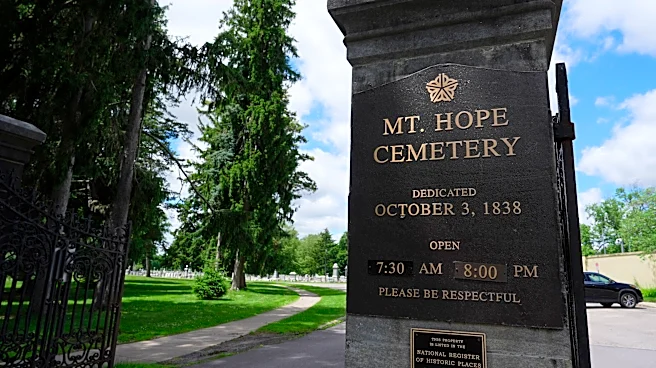

Mount Hope Cemetery is more than a final resting place for generations of Rochester residents. The 196-acre cemetery is also the burial site of people whose lives helped shape American history — from social
justice advocates and inventors to entrepreneurs, entertainers and war heroes.
Susan B. Anthony and Frederick Douglass spent some of their most productive years in Rochester, and their graves remain among the cemetery's best-known landmarks. Anthony is buried in Section C, Plot 93, while Douglass is in Section T, Plot 26.
But their stories are just part of the history found throughout Mount Hope, which was dedicated in 1838. It was the country's first municipally owned cemetery designed in the style of a Victorian garden.
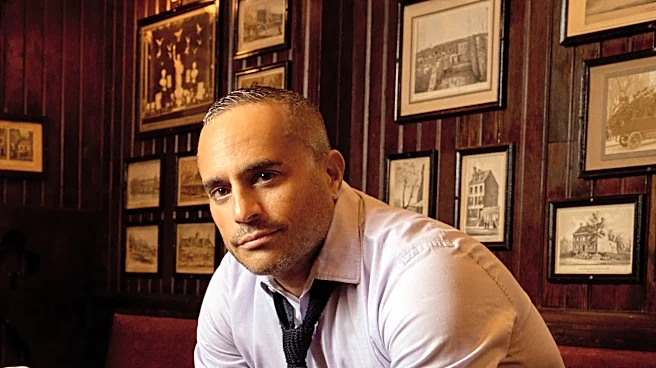
"The more research I do, the more I find out about the importance of Rochester on a nationwide basis," said Christopher Grooms, a Portland, Oregon, native who has lived in Rochester since 2017. Grooms is a cemetery tour guide and member of the volunteer organization Friends of Mount Hope Cemetery.
Here are some of the lesser-known stories connected to people buried at Mount Hope.
Henry Augustus Ward: Naturalist, businessman and P.T. Barnum's taxidermist
Born in Rochester in 1834, Henry Augustus Ward developed an early fascination with the natural world and a love of adventure.
After attending Harvard University and the Paris School of Mines and traveling the world, Ward founded Ward's Natural Science Establishment in Rochester in 1862. The company supplied scientific collections, fossils and taxidermy specimens to universities and natural history museums around the world. It still exists today as Ward's Science and is headquartered in Henrietta.
Ward also taught for a time at the University of Rochester and became the go-to taxidermist for P.T. Barnum, the famed circus impresario. Ward even preserved the remains of Jumbo, Barnum's legendary elephant.
Ward died in 1906 at age 72 and is buried in Section G, Lot 76. His grave marker is topped by a 5-ton, jasper-flecked boulder he found in Canada and was designed by renowned Rochester architect Claude Bragdon.
The children of 'Buffalo Bill' Cody
During the 1870s, Western showman William F. "Buffalo Bill" Cody made his home in Rochester.
Cody was performing at an opera house on South Avenue when his wife, Louisa, told him she was tired of traveling. He rented a house at 10 New York St. for her and their children.
In 1876, while Cody was performing in Massachusetts, his 5-year-old son, Kit Carson Cody, developed scarlet fever. He died two days after his father returned to Rochester and was buried at Mount Hope Cemetery.
The family left Rochester the following year, but Cody returned to bury two more of his children there: daughter Orra Maude Cody, 11, in 1883 and Arta Lucille Cody Thorp, 37, in 1904.
The three graves are in Range 2, middle section, southwest corner.
Malcolm E. Gray: A pioneer of the five-day workweek
In January 1922, Malcolm E. Gray, founder of Rochester Can Co., became the first U.S. business leader to establish a five-day workweek, according to cemetery research.
The idea was based in part on Rochester perfume manufacturer Christian Alfred Wright, who had his employees work Monday through Friday and half a day Saturday rather than a full Saturday shift.
Gray took the concept further, giving his employees two full days away from work to spend with their families or however they chose.
In 1926, Henry Ford adopted a five-day workweek for his employees, and the schedule soon became standard across many skilled trades.
Gray died in 1932 at age 65 and is buried in Lot 319, Range 6.
George Baldwin Selden: Early gasoline-powered automobile inventor
Henry Ford wasn't the only Rochester-area figure involved in the early automobile industry.
George Baldwin Selden, a Clarkson native, received a patent in 1895 for a gasoline-powered automobile. He later licensed the patent to automobile manufacturers around the country.
Ford was among those who challenged Selden's patent. After Ford Motor Co. launched in 1903, Selden sued Ford for patent infringement in a legal battle that lasted eight years.
Ford ultimately prevailed after a judge ruled that Selden's patent covered vehicles using the specific engine he had designed, rather than all motorized vehicles.
Selden's father, Henry R. Selden, was also a prominent figure. A New York lawyer, he served as Susan B. Anthony's defense attorney during her 1873 trial for voting illegally.
Henry Selden died in 1885 at age 79. George Selden died in 1922 at age 75. Both are buried in Section C, Lot 108.
Thomas Byrne Dunn: Creator of Sen-Sen breath mints
Long before Tic Tacs, there was Sen-Sen.
Thomas Byrne Dunn, who was born in Providence, Rhode Island, moved to Rochester as a boy. After finishing school, he founded the T.B. Dunn Co., a perfume manufacturer.
In 1895, the company began producing Dunn's licorice-flavored Sen-Sen, which was marketed as a "breath perfume" designed to mask the smell of cigarettes and alcohol.
The product became a major hit and a pop-culture reference, appearing in the 1943 novel "A Tree Grows in Brooklyn," the song "Ya Got Trouble" from the Broadway musical "The Music Man" and Billy Joel's 1983 song "Keeping the Faith."
Sen-Sen was discontinued in 2013.
Dunn also served in the New York state Senate and U.S. Congress. He died in 1924 at age 71 and is buried in Range 5, Lot 7, in a mausoleum that once contained a Tiffany Studios stained-glass window.
During the 1970s, Dunn's descendants removed the panel, titled "The Sunset Scene." It became part of the permanent collection at the Memorial Art Gallery, where it is currently displayed in the first-floor Brush Gallery.
Edward R. Crone Jr.: Inspiration for 'Slaughterhouse-Five'
Mount Hope is also the final resting place of a Rochester-area man who inspired a character in Kurt Vonnegut's celebrated 1969 novel "Slaughterhouse-Five."
Edward R. Crone Jr., also known as Joe, grew up in Brighton and graduated from Brighton High School in 1941. He and Vonnegut met while serving in the 106th Infantry Division during World War II's Battle of the Bulge.
Both men became prisoners of war and witnessed the 1945 firebombing of Dresden, Germany, which killed as many as 25,000 people.
Vonnegut later told Democrat and Chronicle reporter John Reinan that Crone inspired the character Billy Pilgrim, the novel's protagonist who becomes "unstuck in time."
Crone died in captivity in 1945 at age 21. His remains were eventually returned to Rochester and buried in Range 4, Lot 116.
During a 1995 visit to Rochester, Vonnegut visited Crone's grave.
Tamara Mikosz: Movie star and Resistance fighter
Tamara Mikosz, a Polish film star of the 1930s, came to Rochester after World War II.
"She was a classic Hollywood movie star — Joan Crawford, but in Poland," Grooms said.
When Germany invaded Poland, Mikosz, her husband and daughter went underground and joined the Resistance. After the war, the family spent time in a refugee camp before immigrating to Rochester in 1950.
Mikosz worked as a receptionist and interpreter at the George Eastman Museum. Despite interest from Hollywood, she chose to remain in Rochester.
"She was a movie star, she was rich," Grooms said. "Hollywood was trying to get her to go out there," but she declined.
Mikosz died in Rochester in 1981 at age 61. She is buried in Range 10, Lot 214, with her husband, movie producer Walter Mikosz. Their daughter, Irene, died in 1994.
Reporter Marcia Greenwood primarily covers the grocery business and consumer-focused grocery news, as well as retail development, openings and closings. Send story tips to mgreenwo@rocheste.gannett.com. Follow her on X @MarciaGreenwood.
This article originally appeared on Rochester Democrat and Chronicle: Famous people buried at Mount Hope Cemetery in Rochester