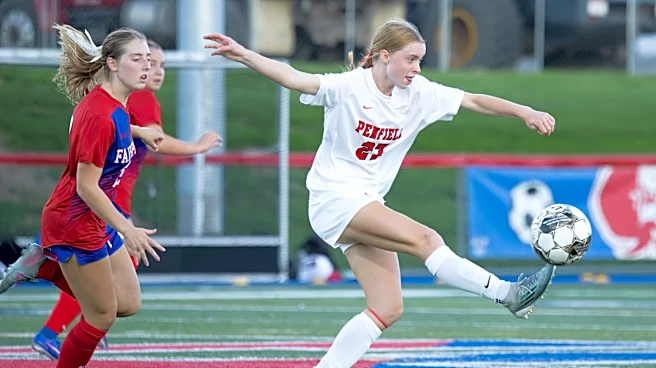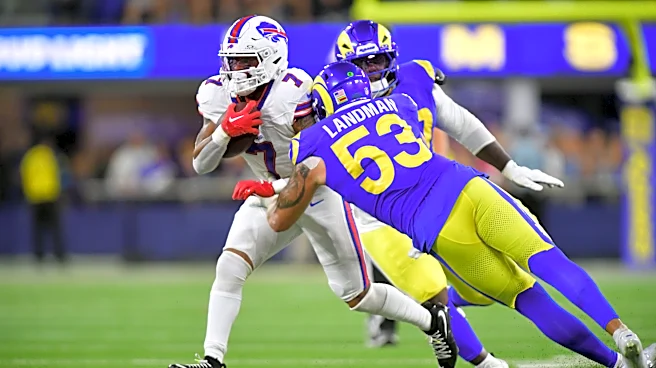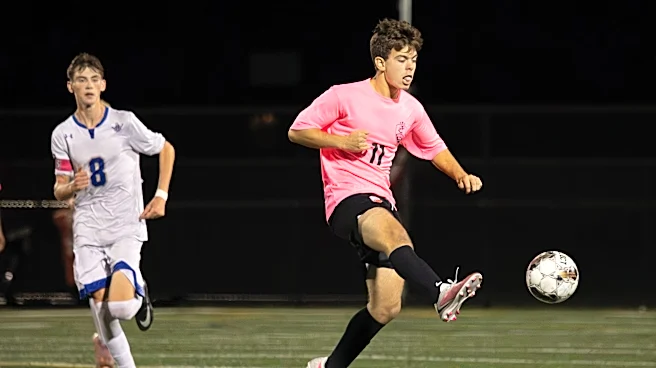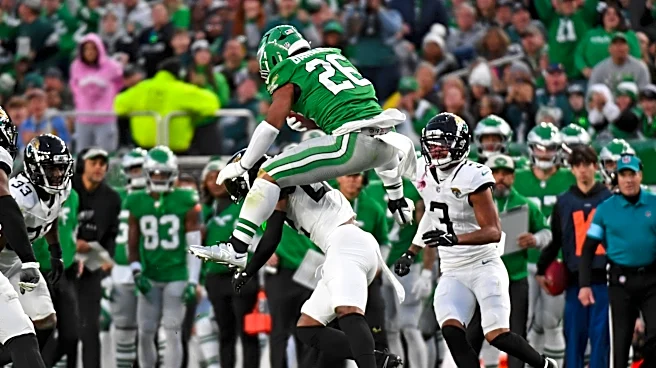





Spare time is a foreign concept for Hudson Reed.
Two to three soccer games per week. A football game. A dozen hours of practices between the two teams. Weekend trips to Buffalo to work with an individual kicking coach. Two teams worth of off-field gatherings. All on top of school work.
That's life for a dual-participation athlete.
"It's definitely busy, but if you're gonna play two sports you really have to have a passion for both and enjoy what you're doing," Reed said. "You have to find a place for both teams. Both teams show love and appreciation for me, and I think that helps me push through even when I'm tired."

Reed is part of a contingent of Section V athletes that embrace such a grind. While it would be a stretch to call dual participation
a popular trend, the practice has become more common in recent years, particularly among soccer players who kick and punt for football teams.
There are hurdles. The student-athlete must designate which is their primary sport versus secondary, which determines which team takes precedence if there's a game conflict.
While school athletic offices have a say in schedule creation and try to avoid either-or situations, overlap is inevitable. That was the case on Sept. 25, a Friday night when Honeoye Falls-Lima's football team was on the road at James Monroe High School while the soccer team took on Batavia High at home.
Because Reed lists football as his primary sport, the soccer team was left without its starting goalkeeper. In this instance, HF-L managed a scoreless tie.
"There's challenges with it, and challenges for the kids on the team. There's this player, while you guys come to practice every day, this player is at practice, just not ours. It's a psychological thing that needs to be communicated too," Cougars soccer coach Mike Merrill said. "It gets kind of tricky, but Hudson does a good job with it."
Reed has about 10 years of soccer experience compared to only three for football. Yet it's with the latter that he sees a future. Reed spent the summer before his junior year traveling to various kicking camps and was able to show off his leg to the coaching staff at the University of Buffalo.
His previous two years of dual participation, Reed listed soccer as his primary sport. But no more.
"Hudson's leg strength has gotten immensely better since last year. I could definitely see him kicking at the Division I level," HF-L football coach John Russ said. "The sky's the limit for him as long as he keeps working hard, and I know he's gonna do that."
Dueling opinions on dual participation
Asked what caused increased interest in dual participation, experienced parties point to the truncated sports seasons during the 2020-21 academic year. Because of the COVID-19 pandemic,New York state pushed some fall sports like football and volleyball to spring.
Faced with dwindling participation, football coaches turned to unlikely sources to fill their roster. No longer restricted by seasonal conflict, for one year at least, soccer players were a natural fit for specialist positions.
"Kicking is a learned skill," Greece Athena football coach Michael Husdan said. "Soccer players have been doing it their whole life."
In reality, the sea change came about a year before the unique "Fall II" spring football season. March 11, 2020, the same day the World Health Organization declared COVID a global pandemic, Section V officials met in person for the monthly athletic council meeting and voted to approve dual participation.
Other areas around New York state have followed suit. Sections III (central New York), VI (western New York), VIII (Nassau County), IX (Orange, Sullivan and Ulster counties) and XI (Suffolk County) allow it in some form or fashion (Section XI permits dual participation for schools with enrollments under 499).
Sections I (Dutchess, Putnam, Rockland, Westchester) and X (St. Lawrence area) do not currently allow dual participation. Sections II (Capital District), IV (Southern Tier) and VII (Champlain) did not respond to information requests.
The Democrat and Chronicle contacted several Section V athletic directors to gauge the frequency of dual participation since 2020. Among the responses, dual participation is most frequent at CG Finney. According to athletic director Joe Marchand, the Falcons have about five student-athletes per year utilize dual participation.
Pittsford and Rush-Henrietta have had around a handful in the last five years. Canandaigua counted one.
Wayne athletic director Anthony Carusone said his school district has had six dual athletes, including two soccer players turned football kickers. In one instance, though, the arrangement only lasted a few weeks. "It became too much for the athlete," Carusone said in an email.
Waterloo similarly tried the last two seasons, but the experiments ended prematurely due to conflicts and injuries.
Even with rule approval, there are limits. In the Pittsford and Victor school districts, dual athletes can partake with the caveat that one sport must be considered individual (i.e.: swimming or track and field). At those schools, the "team" sport must be the primary sport.
There needs to be a positional fit, too. The commitment for a starting quarterback who also plays midfield in soccer, for example, is thought by some a hypothetical burden too great to bear.
"If it's a major starter on both teams, it would be an issue. We haven't really had to deal with that," HF-L's Russ said. "If we had an All-American quarterback and an All-American soccer player, I'm sure we'd make it work."

Fútbol to football
Prior to this season, Jacob Fisher had no experience in tackle football. A midfielder and striker for Greece Athena's varsity boys soccer team, Fisher's football exposure was limited to recreational flag.
Yet he took note when former soccer teammate Landon Ambeau also kicked for the Trojans' varsity football team the last few seasons.
"He was the one that actually convinced me to do it. He said it was a lot of fun and I should try it," Fisher said. "I was like, I might as well, it's my senior year. We went to the turf once and he was showing me. It was obviously a little different than a soccer ball, but not anything crazy. I figured with a little practice, I could get better at it."

Webster Schroeder's Alex Bonacci, similarly, had never played football, let alone kick one. Soccer, as the Warriors' top goalkeeper, was his No. 1 priority.
He too took on the challenge of kicking this season. Schroeder had previously used student-athletes cut from the soccer team to kick for football, but Bonacci is the first to play both at the same time.
"It was during our summer workouts in the mornings. Our strength and conditioning coach asked if anybody was interested in being a kicker," Bonacci said. "'Sure, I'll give it a shot.' I thought I'd be good and it was something new."
In season, communication between coaches is key. If Schroeder's football and soccer teams practice at the same time, coaches Mike Stumpf and Dave Urbanski meet beforehand to arrange when Bonacci will be needed for special teams periods.
The same goes for Fisher at Athena. If practicing with soccer but needed for a kicking drill, he'll depart for a brief spell, same cleats and all, to help.
"(Mike Husdan) and I have been together the last five years that we've been supplying a kicker for his football team. We have the relationship already and it's kind of a well-oiled machine," Athena soccer coach Nick Defendorf said. "We set parameters with Jake and those that have done it in the past, that it's a commitment. It's not, I had soccer practice and I'm a little tired so I'm gonna skip football or vice-versa. I give credit to him and those that came before, they show up every day."

Both Bonacci and Fisher downplayed the adjustment period required to kick a football versus a soccer ball. Bonacci, a goalkeeper in soccer, has taken endless goal kicks and is accustomed to winding up from a stationary position. Fisher, a field player who's constantly in motion when contacting the ball, has had few issues.
"Over the years playing soccer, you learn how to strike a ball well," Fisher said. "Even though it's a different type of ball, it translates."
"It was different at first, because we're encouraged to kick off tees in high school. I'm used to kicking off the ground. Sometimes you're too high or too low. That was really the big adjustment," Bonacci said. "The motion and everything else is pretty similar. It came pretty easily."

Kicking it down the road
While the soccer player-turned-kicker remains rare in Section V, the phenomenon has gained steam at the professional and college level.
Few are better than Dallas Cowboys kicker Brandon Aubrey. Before the three-time All-Pro was nailing 60-yarders on the gridiron, he was a first-round pick for Major League Soccer's Toronto club. Current pro placekickers like the Las Vegas Raiders' Matt Gay and the Detroit Lions' Jake Bates made the transition from soccer to football in college.
Jamie Pucci is a Rochester-based example. The 1994 Webster high school graduate was an all-county-caliber soccer player andset records at St. John Fisher. Once his college soccer eligibility expired, Pucci tried his leg for the Cardinals' football team and parlayed that experience to a brief career in the International and Arena football leagues.
"If you give a kid an opportunity, you might uncover a gem," said Schroeder's Urbanski, who was a high school soccer teammate of Pucci's. "If the kid is an exceptional athlete and the coaches are willing to work with it, why not?"
"You have the rise in social media too. People are putting out trick shot kicking videos and things like that, and soccer players are doing that stuff," Athena's Defendorf said. "The rule brought to light that kids can do it."

Bonacci and Fisher are both seniors, and both consider college soccer their top priority. If approached about taking on kicking responsibilities at the next level, both would consider it.
Well before then comes another potential conflict. Section V's Class AA boys soccer championship, which both Greece Athena and Webster Schroeder hope to reach, is scheduled for Friday, Oct. 30.
The same night, if all goes well, Athena and Schroeder's football teams could be suiting up for section semifinal games. Their kickers can't be two places at once.
Such a situation puts a smile on the coaches' faces.
"It's a position we're happy to start with," Urbanski said.
Added Mike Stumpf, "It means we're both advancing."
Justin Ritzel is a sports reporter for the Democrat and Chronicle, with a focus on Section V athletics and high school trends.
This article originally appeared on Rochester Democrat and Chronicle: Fútbol to football: Why Section V is turning soccer players into kickers