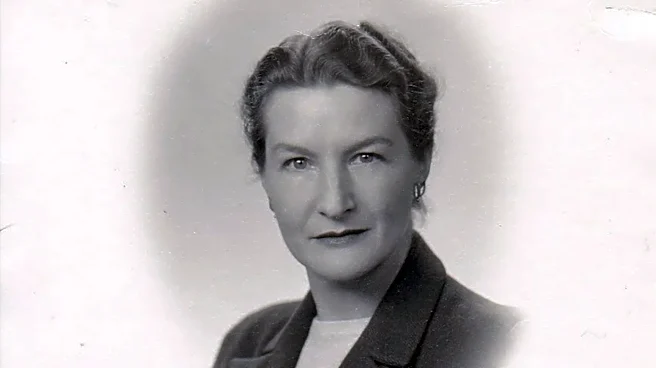









Eleven women, whose contributions in topics such as education, activism, medicine and science shaped society today, have been inducted intothe National Women's Hall of Fame.
The ceremony took place Thursday evening, Sept. 24, at the George Eastman Museum in Rochester.
The National Women's Hall of Fame is the nation's first nonprofit organization that recognizes and celebrates the achievements of American women. The Hall was founded in 1969 in Seneca Falls, New York, a village considered to be the birthplace of the American women's rights movement thanks to the women's rights convention held there in 1848.
Over 300 women have been inducted into the Hall, including artists, educators, activists, athletes, business leaders and others who have made
their mark and shaped the world.
The selection process is highly competitive as nominees are evaluated based on several criteria such as their impact, the significance of their accomplishments and the duration over which they have achieved success.
The evening began with a reception where attendees could network with each other over light refreshments and also enjoy the beauty of the George Eastman House on the museum site.
Dr. Elizabeth Lorde Rollins, daughter of Audre Lorde, attended the ceremony and represented her mother. Rollins said her mom would have loved being inducted into the National Women's Hall of Fame.
"She was a poet, an activist and her words really are still being used by people who fight for their rights everywhere, so I'm very proud of what she accomplished in her professional life," Rollins said.
After the reception, guests were invited to join in the Dryden Theatre for the induction ceremony where inductees were recognized for their work and received an official medallion. For historical inductees who are deceased, the Hall designated a representative or family member to accept the medal on their behalf during the ceremony.
A little bit about the 2026 Inductees

Virginia Hall Goillot is known as one of World War II’s most remarkable heroines who served as a World War II spy. The Gestapo dubbed her the “Limping Lady,” a nickname born from the hunting accident that led to the amputation of her left leg below the knee.
After facing discrimination in the state department, she turned to France, where she became an ambulance driver on the front lines as Hitler invaded, earning attention in her hometown papers.
When France fell, Goillot made her way to London, where British intelligence recognized her determination. By 1941 she was back in France working with the French Resistance to run clandestine cells and, eventually, serving as a radio operator which was one of the most dangerous roles in the field.
After the war, Goillot joined the newly formed CIA as its first female operations officer and one of only six women in senior clandestine roles. She later became one of the agency’s first female career staff members, retiring at sixty.

Edith Louise Starrett Green is recognized for her work in American education and expanding opportunities for women. She was a ten-term member of the U.S. House of Representatives from Oregon who became an influential architect of federal education policy. Her work helped pass landmark legislation—earning her the nicknames “Mrs. Education” and “Mother of Title IX.”
She began her career as a teacher during the Great Depression, later turning to radio and public advocacy before entering politics. Green was elected to Congress in 1954 making her the first woman to win a seat on her own. She rose to prominence on the House Education and Labor Committee.
Green helped author landmark legislation, including the National Defense Education Act, the Higher Education Act and the Elementary and Secondary Education Act, expanding access to education nationwide. She also championed the Equal Pay for Equal Work Act of 1963, advancing workplace equity for women.
Her most enduring achievement came with Title IX, the 1972 law prohibiting sex discrimination in federally funded education programs.

Harriet Jacobs is deemed one of the most important writers of the antebellum African American and American women’s literary tradition.
Jacobs was born into slavery in 1813 in Edenton, North Carolina where she endured years of physical and sexual threats. She made a daring bid for freedom by hiding for nearly seven years in a crawl space above her grandmother’s home to protect herself and secure her children’s future.
She escaped to the north in 1842 living as a fugitive while working, raising her children and building ties within abolitionist circles. With the support of Lydia Maria Child, she published her pathbreaking personal narrative, Incidents in the Life of a Slave Girl, becoming the first formerly enslaved African American woman to publish a full-length autobiography.
During the Civil War, Jacobs was known as a tireless advocate and relief agent for those who had escaped bondage. She traveled in 1862 to Washington, D.C. and Alexandria on behalf of William Lloyd Garrison’s The Liberator, returning in 1863 with aid from Quaker networks. There, she partnered with Julia Wilbur to challenge military authorities and advocate for humane conditions, including protesting plans to house orphans in a smallpox hospital. In 1864 she co-founded the Jacobs Free School with her daughter.
Jacobs moved to Cambridge, Massachusetts a decade later where she managed boardinghouses and built a multiracial community of care; she later opened a charitable boardinghouse in Washington, D.C.

Dr. Georgeanna Emory Seegar Jones is recognized for turning the hope of parenthood into reality for countless families and, in the process, shaped an entire field of medicine. Jones was born in Baltimore in 1912 and trained at Goucher College and the Johns Hopkins University School of Medicine.
By age 27, she was appointed director of the Johns Hopkins Laboratory of Reproductive Physiology and led the Gynecological Endocrine Clinic. Jones became one of the nation’s first specialists in reproductive endocrinology, identifying key causes of infertility and effective treatments while mentoring generations of physicians who further advanced the field.
In 1978, she joined Eastern Virginia Medical School where, with her husband, Dr. Howard W. Jones Jr., she founded the first in vitro fertilization program in the United States. In 1981, their work led to the nation’s first successful IVF birth.
Jones was the first woman president of the American Fertility Society. She also was named to the Society of Hopkins Scholars and recognized as Woman Scientist of the Year by the Medical College of Pennsylvania.

Jackie Joyner-Kersee is a six-time Olympic medalist whose career redefined excellence in women’s track and field. Across four consecutive Olympic Games, from 1984 through 1996, she captured three gold, one silver and two bronze medals, dominating the heptathlon and long jump. Her heptathlon world record of 7,291 points, set in 1988, still stands today. She also earned four World Championship medals.
Joyner-Kersee earned a bachelor’s degree from the University of California, Los Angeles and has been awarded 11 honorary doctorates degrees in recognition of her contributions to athletics, education and community service.
She founded the Jackie Joyner-Kersee Foundation in 1988 in her hometown of East St. Louis, Illinois which provides youth, adults, and families with transformative educational, athletic, leadership and health programs. The Foundation serves over 10,000 individuals annually and distributes more than 50,000 meals each year.
Its flagship initiative, the Jackie Joyner-Kersee Winning in Life® Program, instills values of responsibility, resilience and respect while providing STEAM education, literacy support, athletics, workforce readiness and life skills training.

Audre Lorde was known as a poet, essayist and activist whose work gave voice to the realities of race, gender, sexuality and power. Lorde was born in New York City in 1934 to Caribbean immigrant parents. She described herself as “Black, lesbian, feminist, socialist, mother, warrior, poet,” insisting that each identity was essential and inseparable.
Her poetry, including Coal and The Black Unicorn, confronted injustice while celebrating resilience, love, and self-definition. In essays, she challenged oppression and urged people to see difference as a source of strength. Her landmark essay, “The Master’s Tools Will Never Dismantle the Master’s House,” argued that real change cannot come from within the structures that sustain inequality.
In addition to writing, Lorde was engaged in movements for civil rights, feminism and LGBTQ+ equality. She taught at Lehman College and John Jay College, where she fought to establish a Black studies department, and later returned to Hunter College as the Thomas Hunter Distinguished Professor. In 1980, she co-founded Kitchen Table: Women of Color Press, creating space for voices long excluded.

Adele Smith Simmons is recognized as a leader in global philanthropy and public policy who has shaped institutions and initiatives that tackle some of the most complex challenges of our time, from climate change to human security. She rose to national prominence as president of the John D. and Catherine T. MacArthur Foundation from 1989 to 1999, the first woman to lead a major U.S. foundation.
During her tenure, she guided more than $1.5 billion in grants and helped redefine the Foundation’s focus on global security and sustainability, and human and community development. Her commitment to climate and sustainability has been a throughline, from helping establish the Energy Foundation to advancing the Chicago Climate Action Plan and convening cross-sector leaders to reduce emissions.
Simmons broke barriers in higher education as the first woman to serve as dean at Princeton University and later as the first female president of Hampshire College. Today she continues to foster global collaboration through her Simmons Center for Global Chicago and as president of Global Philanthropy Partnership.

S. Mona Sinha is the Chief Executive Officer of Equality Now where she leads worldwide efforts to reform laws that discriminate against women and girls, helping drive changes to more than 135 laws across the globe. With more than 25 years of experience spanning philanthropy, advocacy, and social enterprise, Sinha has worked alongside governments, nonprofits and grassroots leaders to turn bold ideas into measurable progress.
Over the course of her career, she has supported more than 90 organizations advancing social justice, strengthening movements and amplifying voices often left unheard. Sinha has served as Board Chair of Women Moving Millions and the Equal Rights Amendment Coalition. She continues to shape the global conversation through advisory roles with the Smithsonian American Women’s History Museum, Columbia University’s Tamer Institute of Social Enterprise and the Reykjavík Global Forum.
Her leadership has earned recognition from Forbes and Apolitical and has earned her the Ellis Island Medal of Honor.

Marie Tharp was working at the Lamont Geological Laboratory, now the Lamont-Doherty Earth Observatory at Columbia University, in 1948 when the seafloor was believed to be mostly flat and featureless.
Tharp and her colleague Bruce Heezen published the first map of the Atlantic in 1957 and her painstaking hand-drawn work revealed a seafloor shaped by canyons, ridges and mountains. Over time, she uncovered the mid-ocean ridge system, a continuous chain of undersea mountains stretching more than 40,000 miles around the globe.
Tharp and Heezen published the first complete world map of the ocean floors in 1977 and their work helped confirm plate tectonics. The discovery revolutionized our understanding of how nearly everything on the planet works. When she first identified evidence of seafloor spreading, it was dismissed as ‘girl talk.’
Today, Marie Tharp is recognized as the groundbreaking geologist and oceanographic cartographer she was. In 1997, the Library of Congress named her one of the four greatest cartographers of the 20th century.

Judith Viorst is best known for her beloved children’s classic Alexander and the Terrible, Horrible, No Good, Very Bad Day, she has also built a remarkable body of work spanning nonfiction, fiction, poetry and musical theater.
Viorst was born in 1931 and raised in New Jersey, she graduated from Rutgers University before moving to Greenwich Village and eventually settling in Washington, D.C., where she has lived since 1960. She built both a family, raising three children with her husband, political writer Milton Viorst, and a prolific writing career that explores the full arc of human experience. Viorst is also a graduate of the Washington Psychoanalytic Institute.
Her writing ranges from science books and essays to poetry collections that reflect on each decade from twenty to ninety, often with wit and candor. She has also collaborated with composer Shelly Markham on musical theater productions.
Her 2025 book, Making the Best of What’s Left: When We’re Too Old to Get the Chairs Reupholstered, continues that journey—an honest, often humorous reflection on aging, resilience and finding meaning in life’s later years.

Janet L. Yellen served as U.S. Secretary of the Treasury, Chair of the Federal Reserve and Chair of the White House Council of Economic Advisers—the only person to lead all three. She guided the nation through complex financial challenges as Treasury Secretary from 2021 to 2025.
She graduated from Brown University in 1967 and earned her PhD from Yale in 1971. Yellen began her career in academia, teaching at Harvard and the London School of Economics before joining the University of California, Berkeley, as Eugene E. and Catherine M. Trefethen Professor of Business and Professor of Economics.
Her Federal Reserve leadership is historic: she was chair from 2014 to 2018, vice chair from 2010 to 2014, and president and CEO of the Federal Reserve Bank of San Francisco from 2004 to 2010. She also chaired the Council of Economic Advisers under President Clinton and served on the Fed Board in the 1990s.
She has received numerous honorary degrees, is a member of the American Academy of Arts and Sciences and the Council on Foreign Relations, and served as President of the American Economic Association and Western Economic Association. Today, she is a Distinguished Fellow in Residence at the Hutchins Center on Fiscal and Monetary Policy at the Brookings Institution.
— Kerria Weaver works as the Government and You reporter for the Democrat and Chronicle, with a focus on how government actions affect communities and neighborhoods in Rochester and in Monroe County. Get in touch at kweaver@gannett.com.
This article originally appeared on Rochester Democrat and Chronicle: See which 11 trailblazing women are inducted into Women's Hall of Fame