





New Yorkers are set to gather Monday in Geneva to raise concerns about the potential development of artificial intelligence data-center operations at the Greenidge Generation site on Seneca Lake.
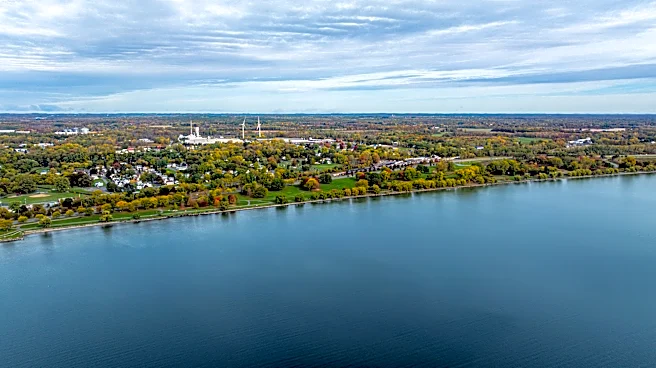
The facility is in the Yates County village of Dresden, in the town of Torrey. Greenidge Generation Holdings changed its corporate name to Vulcan Infrastructure and Power in July. The company operates power-generation and cryptocurrency-mining infrastructure at the site.
The company is pursuing AI and high-performance computing development in Dresden and has discussed 60 megawatts of grid-interconnection capacity to support those plans. The project remains in development.
State Sen. Kristen Gonzalez, D-Queens, is visiting communities across New York as
part of her “New York Fights AI Data Centers” tour. The tour includes 13 sites with active or proposed data centers and runs through Aug. 30.
Geneva rally planned Monday
Gonzalez is scheduled to hold a “Seneca Lake Fights AI Data Centers” rally and news conference at noon Monday at the Finger Lakes Welcome Center, 35 Lakefront Drive in Geneva.
The event is being held with Seneca Lake Guardian and the National Coalition Against Cryptomining. Gonzalez is also scheduled to join community members for a 3 p.m. boat ride on Seneca Lake, where participants are expected to view the Dresden facility from the water. The boat ride is invite-only but open to the press.
The tour is scheduled to continue Tuesday in Orangeburg, Wednesday in East Fishkill, Thursday in Albany, Friday in Lansing and Saturday in the Syracuse area.
What Gonzalez wants Hochul to sign
Gonzalez is urging Gov. Kathy Hochul to sign the Responsible Data Center Development Act, which passed both chambers of the state Legislature with bipartisan support in June.
The Assembly version of the measure, A11560, passed the Assembly and Senate on June 4. The Senate substituted the Assembly bill for Gonzalez's companion bill, S10642.
The legislation would establish requirements for public participation and transparency, energy efficiency, labor standards and benefits for communities that host large data centers. It also would require utilities to create separate electricity and water service classifications for qualifying large energy-use facilities.
The bill would impose a one-year moratorium on specified state Department of Environmental Conservation permits for new large data centers with peak demand of at least 20 megawatts. After the moratorium, the measure would require future projects to meet energy-efficiency standards, hold public hearings and undergo environmental-impact analysis.
New York already has a limited data center moratorium
Hochul signed Executive Order 62 on July 14, temporarily pausing certain state environmental permits associated with the construction or expansion of data centers capable of using at least 50 megawatts of electricity.
The moratorium applies to discretionary permits and other approvals issued by the state Department of Environmental Conservation. Projects whose DEC applications were deemed complete before July 14 generally are not covered, and the order does not suspend local government approvals.
The pause is expected to remain in effect while the state develops environmental standards and a regulatory framework for the industry, a process the governor's office said could take up to one year.
The governor's office said the moratorium is intended to protect ratepayers, the environment, the electric grid and communities while the state examines the potential effects of data centers on energy demand, water use, water quality and air quality.
“As data center development threatens to hike up utility bills, deplete our natural resources, and create uncertainty for New Yorkers, it’s my responsibility to take action and lead,” Hochul said when she announced the moratorium.
Vulcan pursuing AI development in Dresden
The Dresden facility has operated as a cryptocurrency-mining operation while also generating electricity.
In May, Greenidge said it had received a proposed interconnection agreement from New York State Electric & Gas for 60 megawatts of non-curtailable power. The company said the agreement, if completed, would advance its plans for AI and high-performance computing development at the Dresden site.
More recent company materials describe the site as having 64 megawatts of existing behind-the-meter data-center capacity that could transition from bitcoin mining to AI and high-performance computing, along with 60 megawatts of grid-interconnection capacity.
The company said its transition to Vulcan Infrastructure and Power reflects a broader strategy focused on power generation and digital infrastructure, including sites capable of supporting AI and high-performance computing workloads.
Opponents have raised concerns about the potential effects of additional data-center operations on Seneca Lake, noise, emissions, electricity use and surrounding communities. Those concerns are expected to be discussed during Monday's rally.
Proposed data centers could require nearly 12,000 megawatts
Gonzalez's office says 38 large data-center projects are proposed in the New York Independent System Operator's interconnection queue.
If all those projects were developed, they would require more than 11,900 megawatts of additional electricity demand, according to the senator's office. Hochul's executive order separately states that, as of May 2026, nearly 12,000 megawatts of data-center load requests were in the NYISO queue.
Gonzalez and environmental advocates say the growth could increase utility costs, strain the electric grid and increase demand for water and other resources.
The data-center industry has become a major economic-development and environmental issue as demand grows for computing power, particularly for artificial intelligence.
This article originally appeared on Rochester Democrat and Chronicle: New York AI data center fight comes to Geneva, Seneca Lake Monday