




The Rochester City School District is reopening a debate over whether police officers belong outside schools, questioning whether a nearly $1 million annual investment remains the best way to keep students safe.
The topic emerged at a series of late summer school board meetings, where several commissioners criticized the cost of the annual RPD detail and resurfaced concerns around how the police presence may impact students.
As a whole, the board agreed it is time to explore other security options.
An abbreviated contract passed in a 4-3 vote Aug. 18 after administrators said it would be difficult to mobilize alternative measures so close to the new school year. The district pledged to study and propose a new plan, with community feedback, before
the six-month RPD contract expires March 8.
"I don't know if that means not having police, but it certainly means that they should not be the only option," Board President Camille Simmons said in an interview. "Our students will inform how they will best feel safe. Our staff members will inform how they will best feel safe."
Contract renewal revives talk of school-to-prison pipeline in Rochester
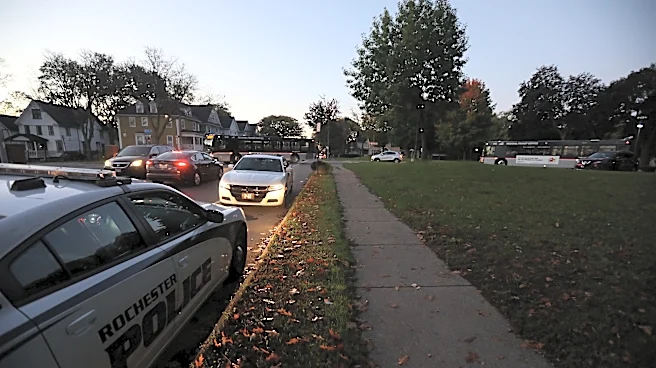
RPD began stationing officers outside five schools in 2023 after a student was nearly shot on the steps of Franklin High School. It marked a partial retreat from the district's decision in 2020 to remove school resource officers from its campuses over concern that students were being criminalized for relatively minor issues.
That worry ― often described as the school-to-prison pipeline ― was central in recent discussions about the contract for police to be stationed outside during arrival-dismissal times. Jenniyah Jones was one of several students who told board members they felt uncomfortable walking past police each day to attend school.
"We are not criminals," Jones said at a public hearing last month. "We shouldn't have to feel as if we're constantly being watched or feel like we are being perceived as a danger to the school."

Commissioner Kareem Ba McCullough said that tension is driven for some students of color by a historical mistrust of and negative experiences with police and should not be ignored. Still, as a former school principal, he acknowledged a strong security presence is necessary.
The district's security team said RPD helps with traffic control, community intel and provides immediate backup for serious incidents. Officers are no longer involved in student discipline, they said. We've asked the school district for data around schoolyard incidents that involve police.
Capt. Greg Bello said the police department considers the arrangement to be mutually beneficial: RPD believes it helps deter crime and allows officers to have more positive interactions with students. Bello said police only intervene when called upon by school staff, usually when weapons are found or a situation spills into the broader neighborhood.
"Our officers aren't there to arrest students," he said. "Fights are going to break out ― these are high schools. There are fights at every high school you go to, suburban schools included. ... That's handled by the school (security). Our goal is just to keep the students safe."
But McCullough believes that safety can be fostered internally with the proper training, staffing and investment in school culture ― though he cautioned against a hasty transition. He voted to approve the short-term contract with that in mind.
"That is a mind shift," McCullough said. "That is a capacity shift. It is also a learning shift that has to happen, and that doesn't happen within three- to six- months. So that's something that we have to talk about. We have to be realistic and mindful of what we are charging the superintendent to do."
RPD at city schools: $1 million price tag
The cost of the RPD contract raised another concern.
It uses officers assigned to an overtime detail, not a regular police beat. That ensures the officers won't be called away to another emergency, but it comes at a price: $120 per hour, per officer. That amounts to $868,000 for one school year, with another $100,000 budgeted in a separate contract for after-school events and sporting activities.
"That's $1 million overall for them to sit outside the school during arrival and dismissal," said Commissioner Isaiah Santiago, who led the dissenting faction of the board. "My argument is that there might be more effective ways for us to spend that money."
He called on the district to explore how those funds could be used for violence prevention programs, restorative practices and staff who would have direct influence on students.
"Part of the thought behind or the reason why RPD was engaged was for deterrence," Santiago said. "To me, deterrence has a factor of fear. And I just don't believe that our schools should be somewhere where our kids fear anything. The school-to-prison pipeline is a true thing and whatever we can do to prevent things of that sort and to protect our children is important."
Superintendent Eric Jay Rosser said his team has started reaching out to community organizations that could provide safety and security partnerships, but any new contracts would require a bidding process, background checks and school training. Those discussions will continue this fall and winter.
— Kayla Canne covers community safety for the Democrat and Chronicle with a focus on immigration, police accountability, government surveillance and how people are impacted by violence. Follow her on Instagram @bykaylacanne. Get in touch at kcanne@gannett.com.
This article originally appeared on Rochester Democrat and Chronicle: Police detail costs Rochester schools $1M. Is it working? | Exclusive