
If ever there were a time to change the name of Lake Ontario, it might have been during the War of 1812, a military conflict between Great Britain and the upstart United States that, two years into the fighting,
saw the White House set aflame.
The British Royal Navy controlled Lake Ontario and bombarded such familiar places as Charlotte, Pultneyville and Sodus Point, according to Preston Pierce, historian of Ontario County, whose northern border once reached this Great Lake.
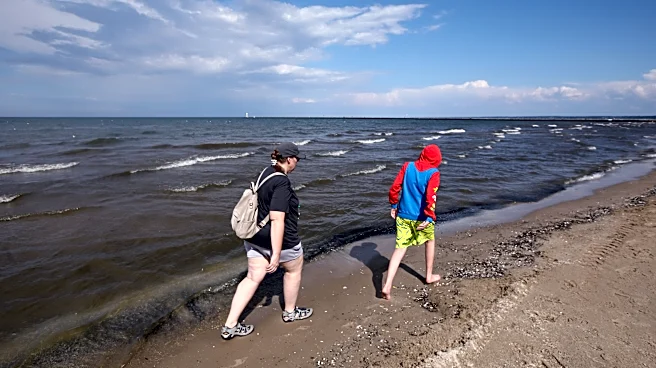
Lake Ontario's name is derived from an Indigenous word meaning "great lake" or "lake of shining waters." It was Lake Ontario before the war began in 1812, and it remained Lake Ontario after hostilities ended in 1815.
"There was no talk about changing the name. It was always Lake Ontario," Pierce said. "It's a good descriptive, native name. It's right in line with many of our other place names. Canandaigua comes to mind right away."
Lake Ontario or 'Lake America?'

President Donald Trump's move to rename Lake Ontario "Lake America," ostensibly over a tense trade dispute with Canada, which has a province named Ontario and the major city of Toronto on the lake's north shore, continues to be debated. Rep. Joe Morelle, a Democrat who represents parts of Ontario County in Congress, and others are trying to stop the change.
Trump's executive order directs the lake's name change, requiring federal agencies to use his chosen name on official maps, contracts and other documents. The order does not require New York state agencies, counties, cities and towns to immediately change signs, websites, brochures or marketing materials.
How does Ontario County fit into this? A bit of Ontario County history sets the stage.
Ontario County history
Ontario County was created Jan. 27, 1789, with the historic city of Canandaigua becoming its county seat.
Ontario, which was purchased in 1778 from Native Americans by Massachusetts speculators Oliver Phelps and Nathaniel Gorham, is known as the "Mother of Counties" in western New York, according to a historical account on the county's website. Several counties emerged from it as the original, much larger Ontario County was broken up.
But the history of "Old Ontario" goes back much farther.
The Seneca Iroquois, the "Great Hill People" and one of the six nations of the Haudenosaunee Confederacy, lived in what is now Ontario County hundreds of years before Christopher Columbus set sail, the county's history notes. They established their so-called "peace village" of Ganondagan, now a state historic site in Victor.
During the American Revolution, some Native Americans and British Loyalists used villages at Canandaigua, Honeoye, Naples and Geneva as staging areas for frontier raids. Gen. John Sullivan, acting on orders from Gen. George Washington, sent his forces in retaliation, according to the county's history. Many of Sullivan's troops later returned to live in the fertile Finger Lakes region, helping spur the growth of the county.
Why Ontario County? Good question.

At one time, Ontario County stretched from the south shore of Lake Ontario to Pennsylvania's northern state line.
And while Pierce has never seen an explanation that definitively establishes why Ontario County was given its name, the assumption has always been that it was named for the lake.
So, if it's possible for the lake to be renamed, could the county's name ever be changed?
Pierce has never heard of such a proposal and, for historical and practical reasons, knows of no good reason to change the county's name.
"First of all, it's the historical name. It's as good a name as anything else," Pierce said. "We don't touch Lake Ontario now, and we haven't since 1824, but it's the old historical name of the county."
That said, communities within Ontario County and nearby counties adopted new names over time. For example, Naples was first known as Watkinstown and then Middletown before the current name took hold.
Should a move to change Ontario County's name arise, what then? Pierce believes the state Legislature would have to act because it created the counties. But will it?
"I can't imagine how long it would take to come up with a consensus on what it would be changed to," Pierce said.
Canandaigua or Canada?
Speaking of Canandaigua, could its name — meaning the chosen spot or chosen place — be confused with Canada and further draw ire? Except for the occasional spellcheck flub, that's unlikely. But then again, who had a renaming of Lake Ontario on their bingo card?
City Manager John Goodwin said the city's name reflects the Haudenosaunee and Iroquois people who called Canandaigua home and that he is unaware of any attempts to change its name over time.
But, noting the city's location within the county and a city street named Ontario — and emphasizing that he doesn't want this to be considered a political statement — Goodwin said, "as far as we're concerned, it's still Lake Ontario."
By the way, the city considers Canada a friend, even if the relationship between the two countries isn't as strong as it once was.
"We have always welcomed our Canadian friends to shop, dine and explore the city of Canandaigua, and we'd really love to welcome them back," Goodwin said.
Like a lake-effect storm, perhaps this renaming controversy will seem like a major issue in the moment but blow away and be forgotten in due time.
As for the lake's name, Pierce is in favor of preserving history.
"I don't know of any good reason to change it," Pierce said. "As a historian, I'd be very loathe to change something that's been with us for good or for ill for 400-plus years."
Mike Murphy covers Canandaigua and other communities in Ontario County and writes the Eat, Drink and Be Murphy food and drink column. He can be reached at mmurphy@messengerpostmedia.com. Follow him on X at @MPN_MikeMurphy.
This article originally appeared on Rochester Democrat and Chronicle: Could Ontario County be renamed, too? Here's what history says | Exclusive