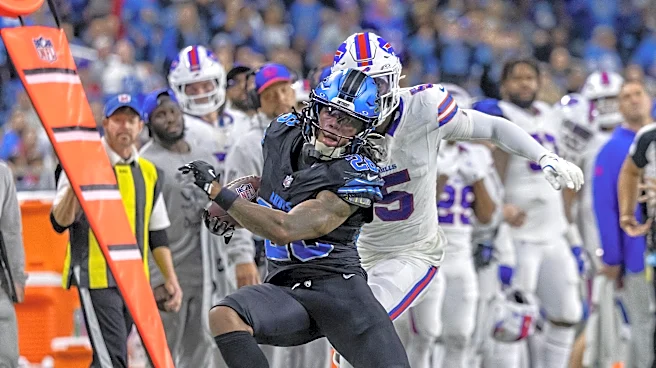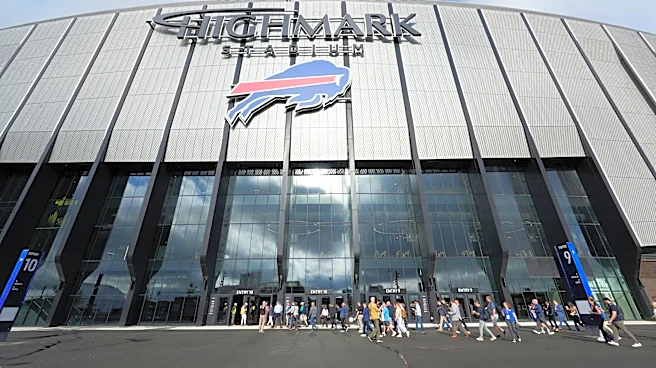




The Buffalo Bills have long been considered to be built on the identity of blue-collar workers.
In the team's early years in the 60s, many stadium seats were filled with those fresh off shifts at the steel mills, grain elevators and rail yards that put Buffalo on the map. In more recent years, it's been the broader working and middle-class workers behind the city's resurgence — from assembly-line workers and electricians to teachers and nurses —showing their support.
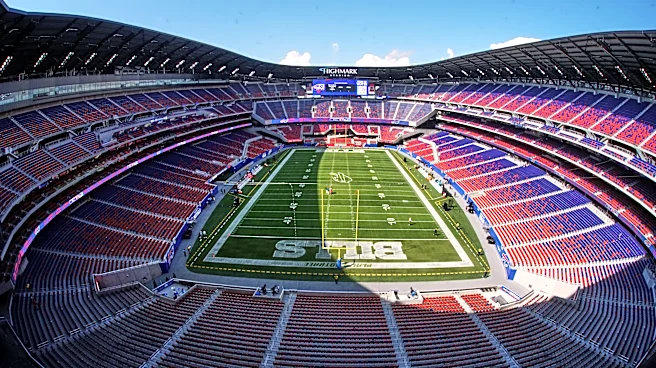
And the new Highmark Stadium wouldn't exist without them. It's something the team is acknowledging as they'll take the field donning special "Nickel City" uniforms inspired by that history and those who helped build the stadium at least once this season.
But with some single-game ticket
prices exceeding $400 in the nosebleeds, some are left wondering if the new $2.1 billion field is worth the cost, especially since it may price out those who have backed the team even in their worst of years. Add in the fact that local and state taxpayers funded $850 million of the project and those questions only get louder.
How much has been spent on the new Bills stadium?
A new Bills stadium build was initially expected to cost around $1.4 billion as outlined in a 2021 preliminary analysis report completed by construction engineering firm AECOM for the state's economic development arm, Empire State Development (ESD).
Cost overruns with projects like modern sports stadiums, however, are almost certainly to be expected and the Bills suffered around $700 million in extra expenses.
According to ESD, taxpayers are contributing $850 million to the project through the state's $600 million subsidy and Erie County's $250 million appropriation. More than $418 million of the state's share derives from funds withheld by the Seneca Nation during a dispute over a new casino gaming agreement, which were released in 2022. The team is on the hook for the remaining balance, including any construction overruns.
That initial project total swelled to nearly $1.7 billion by August 2023 and another $400 million in excesses were tacked on to the Bills' tab by November 2024, bringing the latest tally to approximately $2.1 billion, ESD recently confirmed.
Who do new sports stadiums benefit?

The new Highmark Stadium has been touted as a "historic investment" in western New York that will generate "thousands of good-paying jobs" by New York Gov. Kathy Hochul. And Erie County Executive Mark Poloncarz called it a "win" for taxpayers, the local workforce, the local economy and Bills fans during the stadium's ribbon cutting in late June.
That's not the reality, though, argues economist and emeritus Stanford professor Roger Noll, who is well-versed in the economics of sports stadiums.
"The short answer is that stadiums do not generate anywhere near enough revenue to justify their cost," he says.
It's why both Noll and Kennesaw State University economics professor J.C. Bradbury are outwardly against using public funds for sports stadiums. According to the 2021 AECOM study, $19.5 million of the more than $25 million per year the Bills generated through taxes was state income tax paid by players, coaches and staff. That won't change with the new stadium, Bradbury says.
"They go, 'Oh, well, there's going to be a lot of people spending their money at the stadium and it's going to translate into higher tax revenue,'" Bradbury said. "That's never happened in the history of stadium building."
It won't create new jobs, either, according to Noll, who says concession stand workers may be selling different, more expensive items but "they didn't grow in numbers." And you can forget about sparking any kind of local economic development, both experts say.
"No one is going to build a restaurant across the street from a generator of traffic that's only open something like 50 hours a year," Noll said.
Bradbury said teams benefit from the "novelty effect," or a surge in consumer demand resulting in greater attendance and spending, but it's just reallocated spending. Instead of paying for a movie ticket and popcorn at an Erie County movie theater, it's going to a Bills ticket and chicken wings at Highmark Stadium.
While the argument for these kinds of subsidies in the 1990s was that teams would leave the city they were currently playing in if they didn't receive financial support from taxpayers, Bradbury says that's not true and the Bills are the perfect example.
"They openly stated they were not looking to leave, and it made no sense to leave," Bradbury said. "There were no other markets offering a team, but they still got $850 million in subsidies anyway."
That doesn't mean it wasn't met with resistance. A Siena Research Institute poll published in April 2022 revealed a majority of New York voters disapproved the state's $600 million contribution to the new Bills stadium, especially upstate residents. But, as Bradbury points out, that's why many of these decisions aren't voted on by the public.
"The reason why you don't put this to a public referendum is that voters actually don't like it, but politicians really do," Bradbury said. Politicians personally benefit from supporting these projects, he added, because the stadiums themselves strengthen a bipartisan sense of community and are ideal places for them to be seen by their constituents.
It's also great for the team because the majority of the income generated by a stadium lands in the pockets of the players, coaches and team executives, Noll says. The team can then afford to pay the rising salaries of players, making the team more profitable.
Pat Garofalo, the director of state and local policy at the American Economic Liberties Project, calls it "a case of the public helping very wealthy individuals get a lot wealthier."
"The public doesn’t own this team. It doesn’t have a stake in this team. It doesn’t have a stake in the financial upside in the team, if there is some," he says. "And yet, you are seeing literally billions of dollars — public dollars, taxpayer dollars — that could be used to pay for anything poured into this private infrastructure.”
So, what do the fans think?

On the fan experience side, it's clear where the money was spent. Spacious concourses and merchandise stores on every level. A breathtaking, unobstructed view of surrounding Orchard Park with the downtown Buffalo skyline, a sliver of Lake Erie and, on clear days, the mist from Niagara Falls in the distance.
And for those forking over a bit more money, a dazzling chandelier in the shape of a loose outline of the Bills' charging buffalo in the new M&T Bank Lounge, heavily cushioned seats with a heating element you can control yourself in the Founders Lounge and a sleek field-level spot to watch the team run back to the locker room.
It was designed with Bills fans in mind, complete with details only a true Buffalonian would notice. A shiny red deli slicer in the Seneca Resorts & Casinos Field Club. Art installations from nonprofit textile arts center Stitch Buffalo and editorial cartoonist Adam Zyglis, which features depictions of Pinto Ron covered in ketchup and mustard and Bills Elvis in the M&T Bank Lounge.
Concession stands named after well-known places in the Buffalo area like Humboldt for the parkway designed in part by Frederick Law Olmsted and Black Rock after the historic neighborhood located in the northwest part of the city. There's also a bittersweet nod to the old Highmark Stadium — a set of worn blue seats from every section just inside the Charge Bar in the 100 level.
But some of those who would cherish those subtleties the most might not be able to afford to get in the door. Noll says there's been a shift in the makeup of professional sporting event attendees. In turn, ticket prices balloon and the cost and style of concessions are increasingly elevated as teams try to cater to wealthier clientele.
"We're evolving to a situation where it really isn't a shared experience anymore to go to the stadium because only the top 20% of the income distribution can afford the tickets," Noll said.
A recent study supports that, crowning the Bills the most expensive team to watch in-person with an average cost of more than $2,000 for a family of four. And attendees will face a 6% surcharge on purchases made on Highmark Stadium grounds as part of the county's lease agreement.
“They’re Willie (Sutton) robbing the banks," Garofalo says. "And for every working-class person that you convince never to come to the stadium again because the prices are too high, you squeeze that money back out of the middle-class folks who are able to get in the door and the wealthy folks who don’t care that they’re paying $14 for what is functionally a hot dog.”
So it makes sense that the new home for the Bills and its fans would be under the lens as New Yorkers are footing a hefty part of the bill. The heavier scrutiny has in turn revealed some of the stadium's weaker spots.
During the fans' first game-day experience in the new stadium, the team's Return of the Blue and Red practice on Aug. 8, some attendees took to social media to express their frustrations over views obstructed by railings, glass panels and the edge of the press box. Other concerns include "underwhelming" videoboards and a natural grass field that's not up to snuff.
The Bills have since said they're addressing the feedback and Jonathan Mallie, managing director of the Kansas City-based architecture firm, Populous, which helped build the stadium, told Buffalo's WGR-550 there had to be some trade-offs in order to enhance the fan experience in other ways. As for the playing surface — all new grass was laid down and re-sodded ahead of opening day.

Garofalo says it’s fair for fans to be critical of the new stadium.
“If you’re going to make them pay for it, then they absolutely get to complain if it doesn’t meet expectations,” he says. “We don’t have to both pay for it and then accept the propaganda that it’s the most awesome thing to have ever been built.”
Noll says the fans complaining about the new stadium, however, are "looking the gift horse in the mouth." And Bradbury boiled the criticism down to "general grumpiness that comes with getting anything new."
"The reality is that I think that most people who go to games at old Highmark Stadium versus new Highmark are going to value the new Highmark experience better," Bradbury said.
What state says about stadium cost

The state asserts its cost and funding method is in line with other recent NFL stadium builds, including the Tennessee Titans' new $2.1 billion stadium, which includes $1.25 billion in public funding, and the Jacksonville Jaguars' new $1.4 billion stadium using $625 million in taxpayer funds.
At the same time, over 20 different major pro-sports stadiums and venues have been built without public funding since 1990, including three in the NFL — Gillette Stadium, MetLife Stadium and SoFi Stadium, according to a 2023 study that included work by Bradbury. Those stadiums had a total combined price tag of nearly $8 billion, including the $5.5 billion SoFi Stadium that opened in 2020.
Still, many supporters of the new Highmark note a new stadium is important for Bills fans. Bradbury says he "doesn't doubt" that Buffalonians have a sense of pride in their team.
"Subsidizing a football team is a very different animal than subsidizing an automobile assembly plant or some kind of other industrial development," Noll says. "No one says, 'Boy, our community hinges on us having a Ford assembly plant.' But the community does hinge on having the Bills."

And Hochul recently stressed that importance to reporters in Rochester when asked if there have been conversations with the team's owners about fans being priced out of games.
"We don't set the price," Hochul said. "My job was to make sure that they remained the Buffalo Bills. That they did not leave the state. And that required me to step up with the state resources when I first became governor."
"I think, overall, whether Bills fans are there in person or watching at home or watching at the local bar, they're happy that they're part of the New York family and that it's the Buffalo Bills," she added.
So, the experts say, it's more a question of whether someone or something else could have benefited more from the taxpayer funds.
"I think it's important to remember there's no such thing as a free stadium," Bradbury says, adding that it's too late for the Bills to lessen the local economic burden caused by the new stadium.
"There's nothing you can do to salvage this," he says. "If you drop your watch into hot lava, reaching for it isn't going to get your watch back. You're just going to burn your hand worse."
Emily Barnes covers state government for the USA TODAY Network-New York with a focus on how policy and laws impact New Yorkers' taxes, communities and jobs. Follow her on Instagram or X @byemilybarnes. Get in touch at ebarnes@usatodayco.com.
This article originally appeared on Rochester Democrat and Chronicle: Bills fans paid for Highmark Stadium. Can they afford to attend?