






L3Harris Technologies in Rochester will design, assemble, integrate and test a telescope for a space-based gravitational observatory, on a mission led by the European Space Agency.
The telescope is part of the Laser Interferometer Space Antenna, or LISA, mission, which intends to detect gravitational waves in space by measuring changes in the distance between satellites. This data will help better understand black holes, colliding stars and space-time, a news release said.

“LISA will open a new window into the universe that ground-based observatories cannot access,” said Jeff Hanke, president of space systems, space & mission systems at L3Harris in a statement. “By listening to the low-frequency ripples in space-time across millions of kilometers,
LISA allows the study of massive, distant and rare cosmic events that are otherwise invisible.”
Three satellites will be deployed in a heliocentric orbit, forming a triangular constellation across nearly 1.6 million miles to measure distance changes smaller than the width of an atom, the release said.
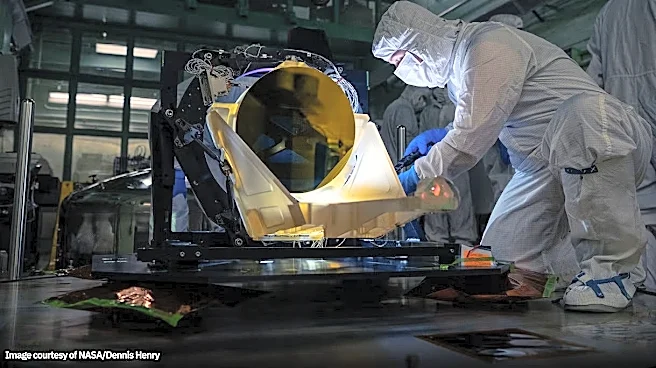
Each satellite will be equipped with a pair of L3Harris telescopes to transmit and receive laser beams with the support of ceramic glass. A full-scale prototype telescope for LISA was previously manufactured and assembled to help in the development of flight hardware at NASA’s Goddard Space Flight Center. Completion of the prototype, the Engineering Development Unit Telescope, was announced in December 2024.
This article originally appeared on Rochester Democrat and Chronicle: Rochester-made telescope to help detect gravitational waves