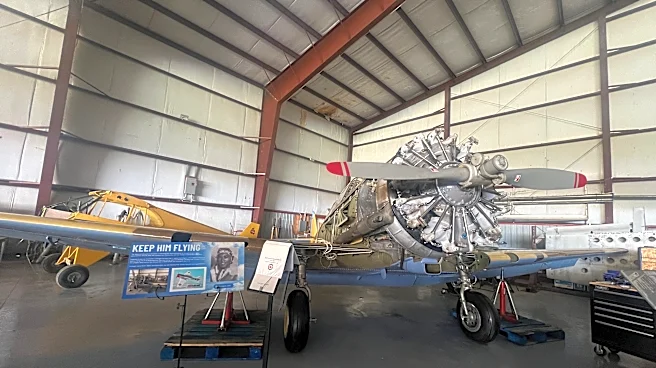









Tucked in the back corner of the National Warplane Museum, work is underway to restore a piece of local and national aviation history.
In the back of the museum’s hangar, an AT-6 Texan has most of its body panels removed. Hand tools and some wiring sit on one wing, signs of recent work on the electrical and hydraulic systems. Also known as the Harvard, the advanced training plane was used to prepare World War II fighter pilots.
One of the pilots that trained in an AT-6 was Flight Officer Leland Pennington, a Rochester native and a Tuskegee Airmen, among the first Black military pilots in United States history. Pennington was flying a P-51 Mustang, nicknamed Lucy Gal, while escorting B-24 Liberator bombers on April 21, 1945 when he reported feeling
unwell and returned solo to a base in Croatia.
He was never seen again, reported missing in action.

While the museum has been in possession of the training plane for decades, it only recently became the focus of a project to make it flightworthy again. A $20,000 grant from the Rochester Area Community Foundation is helping to push that work ahead, led by local pilot and first-time restoration mechanic Austin Hancock.
“We decided to really make that a focus to try and get this flying because not only does it represent all of the people that trained in these planes during the Second World War and went on to be fighter pilots, it also represents the Tuskegee Airmen and the local connections with Pennington,” Hancock said.
The recent work on the aircraft includes replacing spark plugs and restoration of the starter and ignition to get the engine running. The plane is expected to be ready to fly in the next couple of years.
“This airplane, it’s about 80% complete but the last 20% takes 80% of the time,” Hancock said.
The National Warplane Museum doesn’t just leave its planes on display, with many able to fly and do — taking part in aircraft rides and the annual Geneseo Airshow on the historic grass airfield. Keeping the history of the aircraft alive through those flights make it a lot more relatable to people than just seeing them in a museum or reading about it in a book, Hancock said.
“You can talk about these aircraft all day. You can read textbooks, you can see them in movies, you can watch PowerPoints. But until you actually get up and not only see one sitting here, but you see it running, you hear it, you see it fly — it really activates all of the senses,” he said.
Fully restored, the AT-6 Texan will serve as a living piece of aviation history in honor of Pennington and all World War II fighter pilots.
“Once we get flying, it will tell the story of Leland Pennington, the Tuskegee Airmen, and keep his story alive,” Hancock said.
This article originally appeared on Rochester Democrat and Chronicle: How a Rochester Tuskegee Airman is now being remembered | Exclusive