







First, Brighton native David Kwong found a way to fuse his love for magic with his love for puzzles, an equation that led to the creation of his popular stage show, “The Enigmatist.”
Now, Kwong has harnessed the popularity of two trends – the growing field of video podcasts and the public’s thirst for puzzling – into his weekly Netflix game show, “The Puzzle Room with David Kwong.”
The show has fared so well, inviting celebrities and the viewing public to participate, that Netflix recently announced its renewal for 26 more episodes.
“This is a cliché that holds very true,” Kwong said in a recent telephone interview. “It happened overnight after about 20 years of work.”
A graduate of Brighton High School and Harvard University, Kwong had been playing
with the idea of a podcast that merged puzzles and his mentalist and magic performances. The timing was perfect: Brandon Riegg, the head of Netflix’s “unscripted” shows, knew Kwong. The two had attempted a show for NBC 15 years prior that did not get off the ground.
Kwong pitched him “The Puzzle Room” concept; Riegg and Netflix bit; and now the show is moving into another 26-episode stretch with a new episode each week.
“My hybrid of magic and puzzles, which I’ve done successfully with ‘The Enigmatist’ in theatre, hadn’t really found its footing in traditional media yet,” Kwong said. “The video podcast just gives me this canvas where I get to be myself and do my thing.”

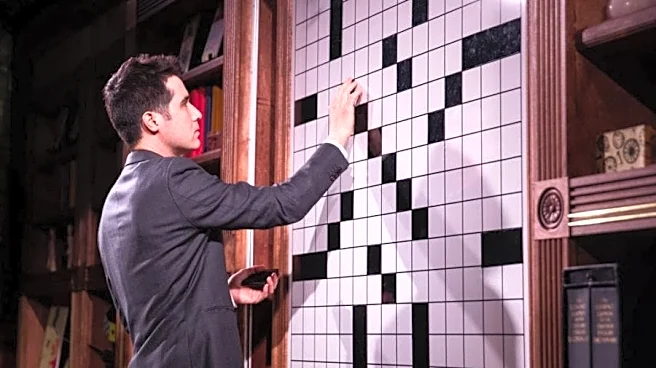
With “The Enigmatist,” Kwong allowed the audience to solve puzzles that delved into cryptography and code-breaking. (Kwong also creates crosswords for The New York Times.) Kwong also utilized his magician tricks with the one-man show.
The show was a hit across the country and beyond, with performances that included London, the Kennedy Center, Toronto, and the ESL Rochester Fringe Festival.

The Toronto Star wrote of the show: “With the ubiquity of CGI and AI, the world has lost some of its magic, its capacity to wow.
“Prepare to have that sense of wonder restored by taking in ‘The Enigmatist,’ a mesmerizing solo show by New York Times crossword constructor, magician, and all-round genial nerd David Kwong.”
'The Enigmatist' blends puzzles and television

“The Enigmatist” was crafted for the stage, and was not a show that could easily make a leap to the small screen. But, during its run, which began in 2019, there were noticeable changes in public appetites.
“Password” is back on television. So is “Hollywood Squares,” along with a host of newly minted game shows.
Meanwhile, the puzzle field has exploded, whether word or math or puzzles of other stripes. Kwong sees this as a new “Golden Age” of puzzling. Wordle, Strands, Connections, Spelling Bee, and many more have joined with the long-running popular fare of crosswords and games such as Sudoku.
The “Puzzle Room” concoction timing was perfect: Game shows and puzzling, combined with a touch of mentalist tricks.
Toss in some celebrities and humor, and the resulting brew can be inebriating.
“Kids are watching with their parents and yelling out the answers at the TV,” Kwong said. “People are trying to get the answers before the celebrities.”
The puzzles are more Monday New York Times crossword toughness than Saturday’s. This is part of the attraction, the ability to reach across generations.
“I don’t think puzzles have to be scary for everyone,” Kwong said. “There’s something for everyone.”
The very first episode laid the groundwork, with the witty spark and natural charm of actors Elizabeth Banks and John Michael Higgins, the team of a capella judges from the film “Pitch Perfect.”
The actors confront word puzzles with personalized themes. In one, they must come up with answers that begin with the letters E.B., the same initials as Banks. (Some are simple, such as the creature that hops about and carries eggs. Others are mildly tougher.)
After working their way through a series of puzzles and answers, Banks and Higgins were stunned by an act of mentalism from Kwong. It involves coloring by crayon, a miniature letter, and a tiny wife, which, again with personalization, is a nod to Banks’ role in the 2026 Peacock series, “The Miniature Wife.”
How David Kwong grew up with magic and words
Kwong has been performing magic since he was young; he often used his Brighton High School classmates as an audience. “I have a harebrained scheme of wanting to perform in my high school auditorium,” he said.
Kwong's father, Tai Kwong, is a retired professor of pathology and laboratory medicine at the University of Rochester Medical Center.
His mother, Joan Shelley Rubin, is a history professor emeritus at the University of Rochester and instilled in her son the love of puzzling. Each day, in phone calls, they work their way through The New York Times “Spelling Bee” together, Kwong said.
Kwong also travels the U.S. and internationally for private and corporate engagements. He has been a magic consultant on popular Hollywood films, including “Now You See Me," with Jesse Eisenberg and Woody Harrelson as bank-robbing magicians.
Kwong has authored one children’s book of magic tricks entitled “How to Fool Your Parents.” A new book of tricks, “How to Fool Your School” is scheduled for an April Fool’s Day release and can be pre-ordered now.
The books, he said, showcase his “desire to share what I do with a broader family audience.”
Puzzling, he said, can be a family affair, just as is the daily phone call with his mother as they tackle “Spelling Bee.” They have done so for five years, Kwong said.
“I think that puzzles and games are bringing people together,” he said. “It’s a way to show they’re smart and share in the experience.”
Gary Craig retired from the Democrat and Chronicle in 2025. Primarily a courts reporter, he has always found time to write about the arts in Rochester.
This article originally appeared on Rochester Democrat and Chronicle: Brighton native turned puzzles into a Netflix hit and 26 more episodes