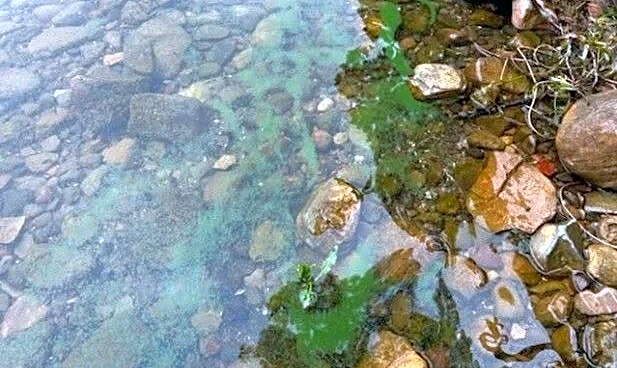




The Livingston County Department of Health on Tuesday issued a harmful algal bloom advisory for Conesus Lake.
Why was the advisory issued?
Health officials observed widespread blooms in multiple locations along the eastern shoreline of Conesus Lake, which they described as a "lakewide bloom." Slicks also were observed in open water.
People and animals should stay out of the water where blooms are present and avoid areas where blooms have been observed, health officials said.
Is the public water supply safe?
Yes. Livingston County health officials said the "public water supply is safe for drinking."
What are harmful algal blooms?
Harmful algal blooms, or HABs, can cause water to turn green and form thick scum on the surface, according to Livingston County health officials.
HABs can develop and disappear quickly, according to the New York
State Department of Environmental Conservation. They can be triggered by a combination of environmental and water conditions, including:
- Excess nutrients such as phosphorus and nitrogen
- Plenty of sunlight
- Low water or low-flow conditions
- Calm water
- Warm temperatures
Some algal blooms can produce toxins that are harmful to people and animals. Exposure can cause diarrhea, nausea or vomiting, skin, eye or throat irritation, allergic reactions and breathing difficulties.
What precautions should you take?
The DEC recommends that people, pets and livestock avoid contact with floating mats, scums or discolored water. Colors can include shades of green, blue-green, yellow, brown or red.
Other precautions include:
- Never drink, prepare food, cook or make ice with untreated surface water, whether or not an algal bloom is present.
- People who do not use a public water supply should not drink surface water during an algal bloom, even if it has been treated. In-home treatments such as boiling, chlorination, ultraviolet treatment and water filtration may not remove HAB toxins.
- Don't swim, wade, boat or fish near suspected harmful algal blooms.
- Don't eat fish caught in waters with suspected harmful algal blooms.
- Don't drink or cook with untreated lake water.
- Rinse with clean water if you come into contact with water affected by a harmful algal bloom.
Children and pets are more susceptible to the effects of HABs, county health officials said. They should be kept out of water where suspected blooms are present.
How to report a harmful algal bloom
In Livingston County, contact the Department of Health at (585) 243-7280 or email the Watershed Inspector at donmaryanski@livingstoncountyny.gov.
Statewide, harmful algal blooms can be reported to the DEC using its Suspicious Algal Bloom Report Form. Residents are encouraged to include photos when possible.
For more information, contact HABsInfo@dec.ny.gov.
This article originally appeared on Rochester Democrat and Chronicle: Conesus Lake under harmful algal bloom advisory