




Nearly 80 years ago, the Edinburgh Festival Fringe began quietly, drawing minimal attention and minimal media.
A far larger international arts festival in the Scotland city, a fete to celebrate the end of World War II, received much more notice. But there were eight artistic troupes that could not find a place within that festival, so they set up shop in church basements and barrooms – on the fringe of the bigger celebration – and performed dramas, puppet shows and music for those who ventured in.
Now that smaller festival is the Edinburgh Festival Fringe, held for three weeks each August. It has ballooned into one of the world’s most popular events.
In fact, the Edinburgh Festival Fringe as it is known (most others flip the “festival” and “fringe”
words) is third to the Olympics and the World Cup for largest-ticketed attendance numbers. Hosting 4,200-plus shows throughout Scotland’s cobblestone-streeted capital city, Fringe this year had nearly three million tickets sold for shows.
Fringe in Edinburgh can seem like controlled chaos, a mass of people hustling to their next venue or halting in the streets for the bevy of free performances – more than 300 of them - from magicians to fire-eaters to buskers. Take any festival you can imagine and add a diet of steroids and Red Bull to that image. Then multiply that image by 10, at least.
Still, amid the human hurly-burly, the bonding tissue with the original Fringe and its worldwide offspring is apparent, in the freeness of opinion and presentation, in the creativity that challenges boundaries and tastes and in the artistry that seems fitting for this festival but might be less welcome elsewhere.
How ESL Rochester Fringe Festival has roots in Edinburgh Fringe
The ESL Rochester Fringe Festival, now in its 15th year, displays the genetic lineage from the Edinburgh Festival Fringe. While Rochester’s festival, like others, is a reflection of its community, it also features much of the same intriguingly eclectic art and performance that is the foundation of Edinburgh.
Erica Fee, the chief executive officer of the Rochester Fringe Festival, returns each year to Edinburgh, where she previously performed in and produced shows. There, each year, she scouts performances that could be fitting for Rochester.
With the Edinburgh Festival Fringe, she said, there is “an energy that cannot be easily described - boundless, enthusiastic, exuberant, hopeful, yet sure. With over 4,200 productions putting their best foot forward, Edinburgh has a buzz that is more roar than hum.”
On-the-scene interlude #1: 'The King of All Birds'

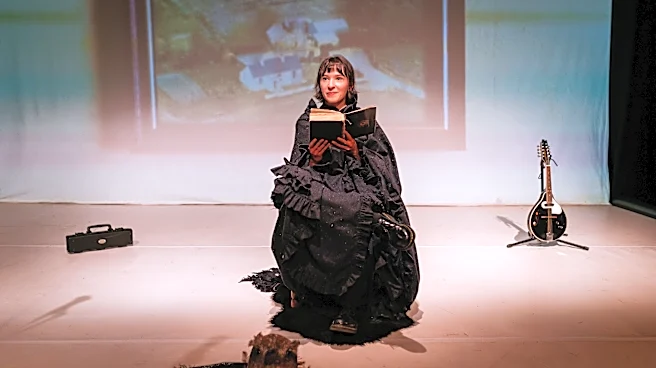
This one-woman show is not what I expected, and I am all the better for it. I was expecting something more traditional from “The King of All Birds,” a look at the aviation history of Ireland, from wildlife to manned flight.
Welcome to the Edinburgh Festival Fringe, where quirky and peculiar can be more norm than, well, fringe. My wife, Charlotte, and I have joined our friend Erica Fee to experience a few days of the festival.
Charlotte and I are among a crowd of several dozen squeezed into the black-box performance room – a former locker room - to witness Martha Knight’s show.
“The King of All Birds” opens with Knight, perched, cloaked, and donning a long-beaked birdlike mask. She eventually scraps the mask as she tells of how the king of all birds is chosen, and her subsequent whimsical tale of fantasy intersects throughout with Ireland’s history of flight.
Along the way, she enchants us with occasional performances, using various musical instruments, of the traditional folk song, “Wild Mountain Thyme.” Some versions of her song are liltingly quiet and melodic, while others are up-tempo and vocally scratchy, bordering on amateur one-person heavy metal. The music, like the show, can shift moods quickly, without losing its thematic core nor its audience.

By the show’s end, the story has become far more personal for Knight, as it has for us. It reminds us that art can be – and often should be – boundless and borderless, and, like flight, not always grounded.
(What others said: “Joy Nesbitt directs Knight’s quixotic creativity in such a way as to turn childish fantasy into quasi-mythological reality, or is it rather the other way around? There is much to reflect on after experiencing this small but mighty song in the sky that flies in the face of a buried golden age of Irish aerialism.” From “Musical Theatre Review”)
From 'entertaining sideshows' to a worldwide artistic force
For much of its first decade, the Edinburgh festival received scant media mention, but enough, when coupled with lesser-known artists hunting for performance locations, to keep its lifeblood flowing.
In 1954, the Belfast Telegraph wrote of the festival that there are “entertaining sideshows” and “hardly an interest or hobby (that) is not catered for by some exhibition or demonstration of skill.”
The following year a Glasgow, Scotland publication complained that the festival was growing too quickly, saying that too many acts were unprofessional and “third-rate.”
“This long-haired Fringe badly needs a trim,” the publication, the Daily Record, proclaimed.
Audiences felt otherwise, and the festival thrived. In 1959, the Edinburgh Fringe Society was created as a coordination mechanism, while the original format – with venues choosing their performances – continued in place.
Fifteen years later, in 1974, the Edinburgh Festival Fringe for the first time sold more tickets than the continuing Edinburgh International Festival.
Then, as now, performers were welcome, as long as they could find a venue. Throughout the city, new venues arose, eager to host Fringe acts.
Now there are more than 250 performance sites across Edinburgh. The decentralized approach is what helps lend the festival its funky appeal.
In both Rochester and Edinburgh, Fringe venues multiply
The Rochester Fringe Festival, following in some of Edinburgh’s footsteps, operates in a bifurcated fashion with its 45 venues determining their own programs. As with Edinburgh, the number of Rochester venues continues to increase.
But Rochester has its own personality, one that has become so recognized in the Fringe world that it is called the “Rochester model.” Unlike other Fringes, Rochester’s 12-day festival in September always includes an outdoor spectacle event, typically at Parcel 5 and often aerial in nature. This year, the show will bring five circus troupes to town for outdoor shows on Sept. 18 and Sept. 19.
Once one partakes of Edinburgh’s Fringe, it is easy to see how its offbeat undergirding is a thread throughout its brethren festivals, including Rochester. (There are more than 300 worldwide.)
“I think the spirit of Fringe is a real phenomenon,” Fee said.
On-the-scene interlude #2: 'Coma'

I am on my back, on a military-style cot, with two bunks and two people above me. There are others on cots throughout this tightly confined shipping container and we have been assured – accurately I hope – that the plastic sheets are regularly sanitized.
A disturbingly soothing male voice is repetitively directing us what to do – to lie down, to remove our shoes if we so choose, to settle in, to place the nearby headphones on. And then the shipping container goes dark, deep black and ominously dark.
This is “Coma,” an Edinburgh Fringe show that many find disturbing. While the narrative that seeps through the headphones during the 25-minute immersive experience can be confusing, it is meant to be, as those who have braved the show become, according to the plot, medical guinea pigs trapped in what is at first portrayed as a harmless undertaking.
The lulling voice grows closer, seemingly over your shoulder as he encourages you to take your medication. You smell his aftershave; it is of a cheap quality. Other voices roll through the headphones, others who are talking to your fellow travelers in stillness and darkness.
Erica has convinced me to join her in “Coma.” Charlotte is not interested.
Inside the shipping container, “Coma” grows into a crescendo-moment for those of us who are cot-bound. As reviews show, many learned they are claustrophobic inside the container, yet gave themselves fully to the creepy narrative.
I admit, I did not feel psychologically threatened or physically constricted by “Coma.” Perhaps I am simply weird with what bothers me and what does not. I know, based on Fringe reviews and conversations with others, that many were unnerved by “Coma.”
The highlight: Charlotte was prepared for us and how we reacted to the immersion. She had cold beers awaiting us as we exited the container.
(What others said: “The experience leaves space for contemplation, though very restricted space as you lie cramped in a metal bunkbed. There are moments of repetition within the narrative, loud buzzing sound effects, and breathing exercises all while we try to figure out our part in the story. It is slightly mystifying in the end, and you leave trembling, overly aware of yourself as you stumble out into the bright Edinburgh sunshine.” From BingeFringe reviews.)
SUNY Brockport graduate an Edinburgh Fringe performer

Amid the mass of people at Edinburgh Fringe is the constant presence of leafletters, handing out descriptive flyers telling of their shows, hoping to entice or cajole you to visit their performance. Some leafletters are costumed and animated; others, perhaps exhausted, go about the task with the energy of a drunken slug.
Marisa f. Ballaro, a 2007 graduate of SUNY Brockport and the founding artistic director of New York City-based Ballaro Dance, was among the throngs with leaflets, encouraging visits to the show “Twelve” from her dance troupe, a performance that is an amalgam of boxing and dance.
This was Ballaro’s first visit to the Edinburgh festival, and she and the five dancers who traveled with her found the artistic atmosphere energizing and invigorating.
Art “is typically segmented, even in a place like New York, which is obviously artistically dense,” said Ballaro, who lives in Brooklyn.
But, at the Edinburgh festival, those walls disappear and one art form seems to drift into another.
“I learned so much being in union with so many different art forms,” she said. “I wouldn’t typically go see a one-man show about a cross-country runner or a banjo performer.
“… There is no polite entry into Fringe art. You feel like you’ve been dropped into the middle of the ocean with it. It was like an all-you-can eat buffet.”
On-the-scene interlude #3: 'Twelve: Going the Distance'

This spacious performance room has a somewhat ominous name: “The Dissection Room.” The history explains why: This room was part of a veterinary college which 15 years ago was bought and transformed into a multi-disciplinary arts space now called Summerhall.
Ballaro and her dance troupe are here for their performances of “Twelve: Going the Distance,” a mix of dance and boxing.
Though the Dissection Room can feel cavernous, the seating can be arranged to transform performances into a more intimate sensation, as has been done with “Twelve.” It’s as if we have ringside seats.
It would be a lie to say I’m a connoisseur of dance, but I did grow up witnessing one of the golden eras of boxing: Ali, Frazier, Leonard, Duran, Foreman, etc. I am curious how what can be a delicate art will mix and morph with a sport that is typically brutal.
And it works. The dancers, with fluid and physically poetic jab connections, uppercuts and roundhouse hooks, seamlessly transform a 12-round boxing match into a gracefully captivating blend of dance forms – or vice versa, with the dance transformed into boxing.

My one concern early in the show was whether it might grow repetitive, with “Twelve” divided into 12 separate rounds, broken by the ring of the boxing bell. But Ballaro and her dancers have escaped this trap with a narrative woven into the performance, with each round standing alone as an individual chapter, including one that centerpieces a dancer as referee.
One more note: Rochester native Hannah Dillenbeck, a 2016 graduate of Aquinas Institute of Rochester, is one of the Ballaro dancers.
(What others said: “ ‘Twelve: Going the Distance’ brings together the beauty of dance and the savagery of boxing in a way where they don't clash but provide a beautiful merger of style and substance, of technique and beauty. It enhances your appreciation of anybody who takes up either form.” From the British Theatre Guide.)
Final thoughts on the eccentricity of Edinburgh Fringe

Once one has experienced the Edinburgh Fringe, it is easy to see how its eccentricity is the vein that runs throughout its brethren festivals.
While the performances may sometimes be zany or sorrowful, magical or mournful, there is a gentle warmth that – despite the millions of visitors to the city – permeates the festival.
There is ample politeness, not hurried jostling, and a surprising air of sobriety as the crowds are there for art and not simply seeking an outlet for drunkenness.
It was among those crowds where Marisa f. Ballaro and I met, as she spotted my Buffalo Bills cap amid the masses.
She had decided that not only would she and her dancers perform but she would also ingest the Edinburgh Fringe in all its glory.
“I wasn’t going to Scotland quietly,” she said. “I wasn’t sure if I could sustain my energy and do all the things I wanted to do but I did.”

Ballaro said she found herself overwhelmed by the vulnerability within many of the acts she saw and the performers she met. Even with shows that some might find objectionable – some have nudity, profanity, and carnal topics – the performers stripped away their emotional shields and bared themselves psychologically.
“There is a lot of really risky and risqué boundary pushing,” Ballaro said.
And there are acts for all ages, for all tastes, for all personalities. This is why Fringe festivals – whether Edinburgh or Rochester or Ithaca or Prague – continue to grow and to attract. They remind us that art can be connective, especially at a time when personal connectivity – the heart of live theatre – is on the wane.
In a world of AI and social media, Fringe is, thankfully and blessedly, neither robotic nor algorithm-driven.
Charlotte and I had a quick visit to the Edinburgh Festival Fringe, squeezing in nine shows over four days. They ranged from the aforementioned shows to a performance of Greek mythology merged with professional wrestling to improv comedy based on the hit show “Miami Vice.” (That show featured comedy partners Tito Perez and Jacob Liss, the latter who is the son of Julie Libera Liss and Clifton Springs native Joe Liss, himself an improv comic and Second City alum who will be at Rochester’s Fringe this year.)
Next year is the 80th anniversary of Edinburgh Fringe and I already feel the itch. The spirit of Fringe is contagious, in all the best ways.
Gary Craig retired from the Democrat and Chronicle in 2025. Primarily a courts reporter, he has always found time to write about the arts in Rochester.
This article originally appeared on Rochester Democrat and Chronicle: How Edinburgh Fringe inspired Rochester's biggest arts festival | Exclusive