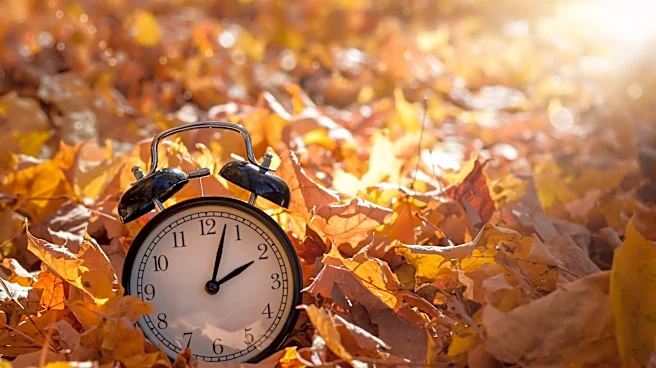








The end of daylight saving time, when clocks are set back by one hour, is set for Sunday, Nov. 1.
While Congress is considering permanently ending the twice-yearly time change and making daylight saving time permanent in the United States, nothing has been decided yet. The House of Representatives approved legislation in July that would make daylight saving time permanent and sent it to the Senate, where it was referred to a committee.
The Senate could consider establishing permanent daylight saving time, but no vote is currently scheduled, according to USA TODAY.
The time change affects the daily lives of hundreds of millions of Americans, requiring clock changes twice a year and potentially disrupting schedules for children, adults and pets.
When does daylight saving time end in 2026?
Daylight saving time ends on the first Sunday in November — this year, on Nov. 1, the earliest possible date.
The change officially occurs at 2 a.m., when clocks are set back to 1 a.m. and the country returns to standard time.
Since 2007, daylight saving time has begun on the second Sunday in March and ended on the first Sunday in November. Before that, it began on the first Sunday in April and ended on the last Sunday in October.
It's not plural
It's "daylight saving time," not "daylight savings time."
The official name refers to saving daylight, so "saving" is singular.
Daylight saving time was not created for farmers
Daylight saving time was not created to benefit American farmers, despite a common misconception.
According to timeanddate.com, daylight saving time was first used in 1908 in Port Arthur, Ontario, now part of Thunder Bay. Germany helped popularize the practice when it moved clocks forward on April 30, 1916, during World War I as a way to conserve fuel.
The United States adopted daylight saving time nationally during World War I, although the policy has changed several times since then.
Congress established the current framework for U.S. daylight saving time with the Uniform Time Act of 1966, which standardized the country's time zones and set rules for the seasonal time change.
Do all states observe daylight saving time?
No.
Hawaii and most of Arizona do not observe daylight saving time. The Navajo Nation in Arizona does observe it.
U.S. territories including Puerto Rico, the U.S. Virgin Islands, Guam, American Samoa and the Northern Mariana Islands also do not observe daylight saving time.
Who sets the rules?
The U.S. Department of Transportation oversees the nation's time zones and administers the federal rules governing daylight saving time.
When did daylight saving time start in 2026?
Daylight saving time began this year at 2 a.m. Sunday, March 8, when clocks moved forward one hour.
The change marked the beginning of the period when most Americans observe daylight saving time.
When is the shortest day of the year in 2026?
The shortest day of the year is the winter solstice, which falls on Monday, Dec. 21, in 2026.
The winter solstice marks the shortest period of daylight and longest night of the year in the Northern Hemisphere.
Is daylight saving time ending permanently?
Not yet.
The effort to eliminate the twice-yearly clock change has been debated in Congress for years. The Senate unanimously passed the Sunshine Protection Act in 2022, which would have made daylight saving time permanent, but the legislation did not become law.
More recently, the House approved legislation in July to make daylight saving time permanent and sent it to the Senate, where it was referred to the Commerce, Science and Transportation Committee.
The Senate is scheduled to resume regular business Sept. 14. No Senate vote on the legislation is currently scheduled.
How late would New York sunrises get under permanent daylight saving time?
Permanent daylight saving time would have little effect during the summer because New York already observes daylight saving time from March through early November.
The biggest change would come during the winter, when both sunrise and sunset would occur one hour later.
For example, on the 2026 winter solstice, sunrise would shift to about 8:17 a.m. in New York City, 8:21 a.m. in Albany, 8:29 a.m. in Binghamton, 8:33 a.m. in Syracuse, 8:39 a.m. in Rochester and 8:41 a.m. in Buffalo.
Sunset would also shift one hour later, ranging from about 4:40 to 5:45 p.m. in those cities.
New York — like every other state — would not gain additional daylight. The change would simply shift an hour of daylight from the morning to the evening.
What about the rest of the world?
Daylight saving time is used in dozens of countries around the world, although the practice varies widely by region and country. According to timeanddate.com, about 70 countries observe daylight saving time.
The start and end dates differ among countries, and many countries near the equator do not use daylight saving time because seasonal changes in daylight are relatively small.
As winter approaches in the Northern Hemisphere, days become shorter because of Earth's tilt, which causes the Northern Hemisphere to point farther away from the sun.
How about next year?
Unless the law changes, daylight saving time will begin again Sunday, March 14, 2027, when clocks move forward one hour.
It is scheduled to end Sunday, Nov. 7, 2027.
This article originally appeared on Rochester Democrat and Chronicle: Daylight saving time 2026: When do clocks fall back?