
The rise of artificial intelligence is creating exciting economic opportunities in America, but the most successful users also should be the most responsible.
That's a bipartisan thread of agreement that
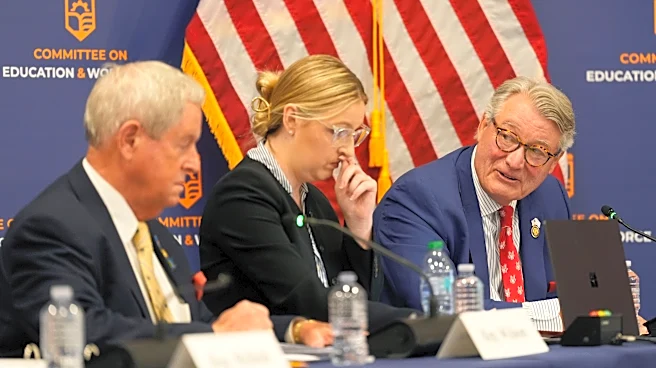
ran through comments and testimony Friday at a field hearing conducted by Georgia and South Carolina members of Congress who sit on the House Committee on Education and Workforce.
U.S. Rep. Rick Allen (R), chairman of one of the group's subcommittees, joined U.S. Reps. Lucy McBath (D) of Georgia and Joe Wilson (R) of South Carolina to pose questions to local witnesses about the innovations and potential pitfalls that accompany their work sectors' use of AI.
"As we see this technology introduced into more workplaces, our job as policymakers is to foster an environment that delivers new and greater opportunities for American workers," Allen said to open the hearing at Augusta University's Georgia Cyber Innovation and Training Center. "The potential for AI to create jobs, strengthen existing industries and empower job creators is immense, but we must ensure that our policies encourage its responsible adoption so that every worker can benefit from these advancements."
Ajikumar Parayil is the founder and CEO of Manus, which operates a biotech facility in Augusta that engineers microorganisms to help produce medicines and food additives at a level that until recently had been cost-prohibitive. AI technology helps Manus rapidly produce tiny cell factories on a commercial scale.
"AI is giving manufacturers like Manus new tools to optimize production, improve quality, reduce space, bringing new products to market faster," he said.
Row-crop farmer Brad Edenfield has been director of the Burke County Farm Bureau for more than 20 years. He said he sees AI as an opportunity to infuse needed youth into agribusiness. AI can help farmers evaluate data to improve crop yields and better allocate resources through precision agriculture.
Farmers in the 21st century will have to be "looking for a new type of employee, one that can bridge that gap between the historical type of work we've always done and this intangible element that we may not have considered in the past," he said.

Dr. Jeffery Talbert is the inaugural chairman of Augusta University's Department of Artificial Intelligence and Health. In medical fields demanding high-functioning precision, AI helps doctors draft clinical notes and analyze data for quicker, more accurate diagnoses.
"The strongest evidence suggests that AI delivers the greatest value when it amplifies human expertise rather than replaces it," he said. "This allows health care professionals to spend their time caring for patients, detecting, diagnosing and treating disease earlier, and celebrating scientific discovery."
AI can't always make tasks easier. Tony Barlow is vice-president of the Communication Workers of America's Local 3204 in Atlanta. He represents union members who complain that their bosses use AI to speed workflow and cut human positions but end up sabotaging productivity instead.
"Workers across the country have seen employers racing to adopt new artificial intelligence tools. Without proper guardrails, AI has the potential to displace workers, degrade job quality and undermine service quality," he said. "It is crucial that workers have a voice in this technology that's used in the workplace."
McBath, whose District 6 in Congress covers north and west Atlanta, cautioned that AI progress mustn't harm the humans it's designed to help. One of her constituents, she said, is losing her home because a high-voltage power line is being strung across her property to help power a data center facilitating AI.
"Yes, we need the innovation, but we have a responsibility to make sure that it does not come at the expense of the people it is meant to serve," McBath said. "The future of AI is definitely promising, but it must also be guided by fairness, respect for people's homes, and a commitment to protecting families in Georgia and the communities they have built and lived in for generations."
This article originally appeared on Augusta Chronicle: Augusta AI hearing weighs economic gains against worker risks