


After a weekend of unacceptable heat indexes, many Georgians are anxious for a cool, brisk winter. But will that be the case this year? Here're the forecasts:
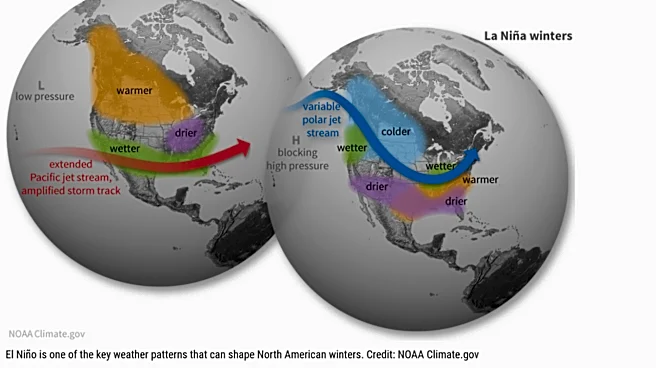
What does the Old Farmer's Almanac say about Georgia's winter? El Niño has returned
The Old Farmer's Almanac suggests Georgia may have a wetter-than-usual winter because North America will see El Niño in action during the winter months.
"Think of the Pacific Ocean as one of Earth’s most powerful weather engines. When its waters warm in just the right places, the jet stream — the fast-moving river of air that steers storms — often shifts its path. That change can influence where rain, snow, and colder air are most likely to travel across North America," the Almanac said.

What does the Farmers' Almanac predict for winter in Georgia?
The Farmers' Almanac is forecasting a "cool, wet, and stormy" winter for the southeast. It's also concerned
about El Niño, saying residents should watch for frequent storm systems, muddy fields, and occasional surges of cold air.
There's also expected to be heavier-than-normal precipitation. When the colder air meets abundant moisture, some storms could produce sleet, freezing rain, or heavy, wet snow.

How accurate are farmers almanacs?
There are a variety of reports on how accurate the almanac's forecasts are, generally ranging from 50 to 80% depending on the source.
Basically, the further out you're looking, the less accurate the forecast is. NESDIS, a division of NOAA, says five-day forecasts are reliable about 90% of the time, seven-day forecasts are about 80% accurate, and and 10-day forecasts are about 50% accurate.
Georgia live weather radar
For now, here's a radar powered by the National Weather Service so you can keep an eye on Georgia's current conditions:
What does the National Weather Service predict for winter in Georgia?
The NWS long-range outlook seems to confirm the almanacs' forecast with at least 33% chance of above-normal precipitation throughout Georgia, and those chances increase as you travel farther south, reaching up to 70%.
As for temperatures, NWS predicts what's average for December through February.
When is the first day of winter 2026?
Winter officially begins in December, though the exact date varies. Meteorological seasons are divided into four three-month groupings, with Dec. 1 marking the start of winter every single year. But, astronomically speaking, the first day of winter begins on the winter solstice — the day when the sun is at its lowest point in the sky. This year's winter solstice will be on Monday, Dec. 21, which also marks the shortest day and longest night of the calendar year for the Northern Hemisphere.
Find your next winter coat at Belk
How does the sun's solar cycle impact winter?
High levels of solar activity have been associated with warmer temperatures, which could contribute to a warmer winter. The sun is in its solar cycle 25 which passed its peak activity in 2024, but sunspot activity remains relatively elevated, according to the Old Farmer's Almanac.
"Although the sun may look like a constant ball of light every day, its activity rises and falls in a repeating cycle of about 11 years. A period of low activity, or solar minimum, in 2019 marked the beginning of solar cycle 25. In 2024, it entered into solar maximum, which is the peak of activity in the cycle. It will end when the next solar minimum is declared, completing the (about) 11-year wave," NOAA said.
Solar Cycle 26 is expected to begin some time between January 2029 and December 2032, said the NASA Space Weather Prediction Center.
@weatherchannel Heavy hail buries Englewood, Colorado, forcing plows to clear roads after a severe Saturday thunderstorm on August 15.
♬ original sound - The Weather Channel
What does The Old Farmer's Almanac say about ocean patterns to forecast winter?
To predict how active winter storms will be, forecasters monitor ocean patterns: the Atlantic Multidecadal Oscillation, the Pacific Decadal Oscillation and Indian Ocean Dipole, according to the Old Farmer's Almanac.
"Together, these ocean patterns can influence how much moisture reaches winter storms and where those storms are most likely to develop. Sometimes they help fuel coastal systems. Other times they influence how active — or how quiet — a season becomes," the Almanac said.
The ocean patterns also help forecast temperatures and how moisture is distributed across North America.
How does the polar vortex help forecast winter conditions?
The large mass of frigid Arctic air trapped around the north pole known as the polar vortex is another weather phenomenon used to predict winter in North America.
"One clue forecasters watch is a band of high-altitude winds that circles the equator. Scientists call this pattern the Quasi-Biennial Oscillation (QBO). Changes in these winds can sometimes influence the behavior of the polar vortex later in the season," the Old Farmer's Almanac said.
Monitoring the polar vortex helps determine when Georgia will have extreme low temperatures during winter.
"Every so often, that circulation weakens or shifts. When it does, colder Arctic air can spill farther south, bringing outbreaks of wintry weather to parts of the United States," the Almanac added.
Miguel Legoas is a Deep South Connect Team Reporter for USA Today. Find him on Instagram @miguelegoas and email at mlegoas@gannett.com.
This article originally appeared on Augusta Chronicle: Old Farmer's Almanac winter forecast: What's in store for Georgia