






Georgia’s General Election will test whether the state’s recent competitiveness becomes a more durable Democratic coalition or remains a narrow, candidate-specific opening.
Races to watch include a U.S. Senate race pitting a Democratic incumbent against a former U.S. House Republican, and a governor's race between a popular Democratic former mayor of Atlanta and a self-made healthcare billionaire who embraces President Donald Trump.
Since the 1994 Republican Revolution in Congress, Georgia has been a solid red state. But streaks of blue have peeked through; Joe Biden scraped by to win Georgia in the 2020 presidential election, and Kamala Harris lost in 2024 by just 2%. Also, for the first time since 2003, both of Georgia's U.S. Senate seats are
held by Democrats.
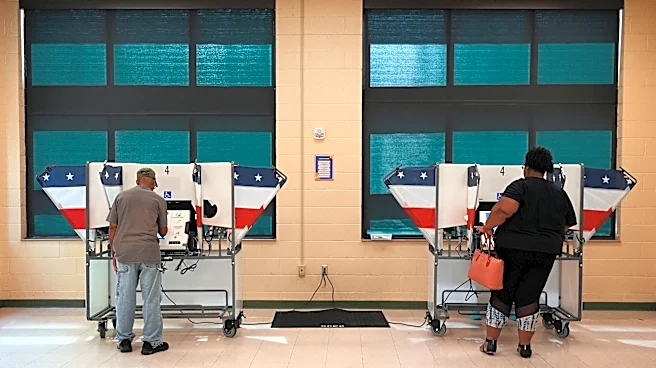
While what was once red might now be a slight shade of purple, voters in November could decide how much more blue gets thrown into the mix. Here are five things to know ahead of Georgia's General Election on Nov. 3, with early voting getting underway on Oct. 13.
The blue factor
Georgia is no longer safely predictable statewide, even though Republicans retain deep institutional strength in much of the state.
Democrats’ modern path has depended on high turnout among Black voters, continued strength in metro Atlanta, and improvement among suburban, younger and college-educated voters.
Statewide, the Democratic argument is likely to center on the economy and affordability. They'll hope to harness frustration over prices and potential energy consumption and environmental concerns tied to data centers. With the exit of a popular GOP governor, Republicans likely will ask voters to trust them to manage Georgia’s economy, infrastructure and services.
Republicans continue to dominate many rural counties and remain highly competitive in outer suburbs, though that will be tested at the local level as Democrats are making their presence known. In deeply conservative Columbia County, for example, Democrats are seeking three seats on the county commission for the first time in years.

Governor's race pits Dem stalwart against GOP newcomer
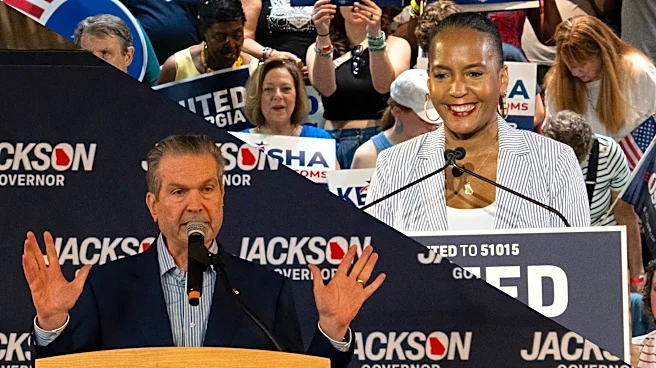
Keisha Lance Bottoms and Rick Jackson are competing to succeed popular Gov. Brian Kemp, who is term-limited.
Bottoms served as Atlanta’s mayor from 2018 through 2022 and secured the Democratic nomination in the May primary. Jackson, a wealthy healthcare executive with no prior elected-office experience, won the Republican runoff over Lt. Gov. Burt Jones despite Jones’s endorsement from President Donald Trump.
An August Quantus Insights poll commissioned by the Natural Gas Association of Georgia and reported on by WJCL showed Bottoms at 46.4% and Jackson at 44.9%, with a 3.6-point margin of error; effectively a statistical tie with a substantial undecided bloc among independents.
Jackson’s primary win is notable because it showed that money, message and voter preferences can diverge from a presidential endorsement in Georgia’s GOP. But the general election will be a different contest.
Bottoms has had more time to consolidate Democratic support, while Jackson has both the resources and a potentially favorable national environment among Republican voters.

U.S. Senate race pits progressive against MAGA
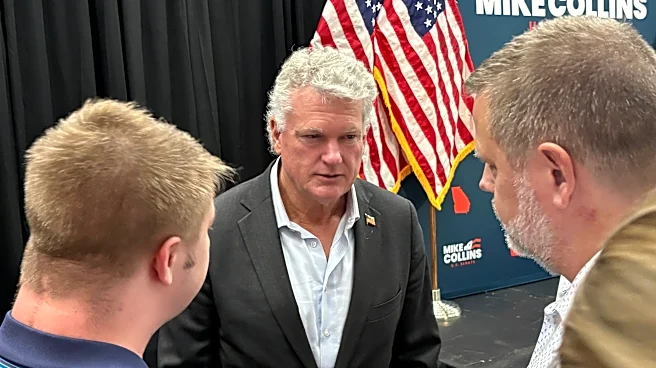
Ossoff is seeking a second term in the Senate seat he has held since 2021. Collins, a second-term congressman known as an immigration hardliner and Trump ally, won the Republican runoff over former football coach Derek Dooley and advances to what national observers told The New York Times is expected to be an expensive, high-intensity race.
The race is likely to become one of the country’s most important Senate contests because control of the chamber, or the size of either party’s majority, could hinge on seats such as Georgia’s.
Ossoff enters as an incumbent with national Democratic support and a record he will portray as delivering for Georgia while providing a check on the Trump administration.
Collins is likely to run a MAGA-aligned campaign, using immigration, cultural issues and criticism of Democratic economic stewardship to consolidate Republican voters.
Congressional races to watch
U.S. House races in much of the state pit GOP lawmaker veterans against Democratic political newcomers.
While the Senate and governor's races might be tight, many Democrats running for congressional seats likely face uphill battles.
In Augusta, District 12 five-term GOP incumbent Rick Allen faces Democratic Army veteran Ceretta Smith. The District 10 race in Athens will see former and popular state representative Houston Gaines (R) face Pamela Delancy (D). In Savannah's District 1, Jim Kingston (R), whose father, Jack, represented the same district for 22 years, faces Amanda Hollowell (D).
GA-10 and GA-1 are especially worth watching because open seats can produce more uncertainty than incumbent-held districts, even where the electorate still favors Republicans.

Constitutional amendments will appear on the ballot
Georgia voters will also decide three legislatively referred amendments. Each is a statewide yes-or-no choice so that they can draw support or opposition across party lines depending on concerns about public safety, tax policy, and judicial elections, noted Ballotpedia.
Here is a breakdown:
The Next Generation 9-1-1 Fund would allow the state Legislature to dedicate revenue to a specialized emergency communications fund. It is primarily about allowing dedicated funding for communications upgrades.
The Conservation Use Property Tax Amendment would raise the acreage limit for agricultural and timber land eligible for Georgia's conservation-use tax assessment program from 2,000 to 4,000 acres. It asks voters whether larger landowners should be eligible to enroll more acreage under a favorable tax-assessment program for the purposes of conservation. Voter approval is required for legislation concerning property tax exemptions.
The Nonpartisan Probate Judge Elections would require probate judges to be elected in nonpartisan elections rather than by party affiliation. The probate-judge proposal would align probate elections with the nonpartisan structure already used for other Georgia judicial offices, according to The Atlanta Journal-Constitution.
This article originally appeared on Augusta Chronicle: Georgia's purple-state test puts Senate, governor's office in play