






The evenings have been so nice lately that I’ve spent a lot of time tinkering about in the yard, as I'm reluctant to go inside when it gets dark.
On some recent nights, I set out a couple of folding chairs in the driveway to watch neighbors walk by and enjoy the fresh air. Where I set my chairs up in my driveway is next to a large iron gate that separates the front and back yards and is flanked by two gigantic ‘Evita Rose’ lantana that have several lavender-and-pink flower clusters with yellow centers.
Bees, butterflies and hummingbirds are constantly feeding on this perennial spectacle. The past few evenings, I have been buzzed by an interesting flyer that, if you
didn’t know any better, you would bet it was a hummingbird.
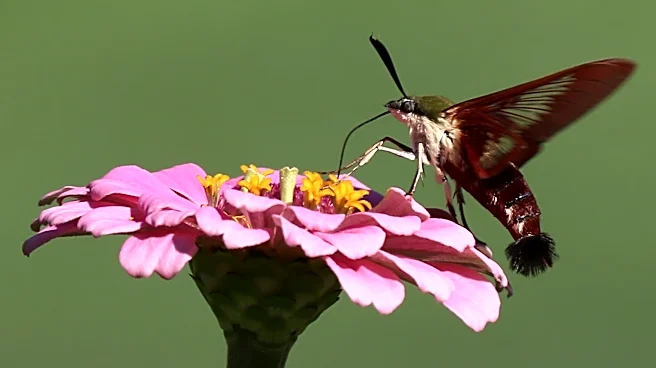
But it isn’t. It is a large insect that is called the hummingbird moth, and it moves quickly from bloom to bloom, hovers almost motionless while feeding and even produces a faint humming sound. At first glance, you would swear you were watching a very small hummingbird.
Hummingbird moth is a common name given to several members of the sphinx moth family. In Georgia, two particularly interesting species are the hummingbird clearwing and the snowberry clearwing. Both belong to the genus Hemaris.

Unlike many moths we see fluttering around porch lights at night, hummingbird clearwings are active during the day. They are strong, fast fliers capable of hovering in front of a flower while feeding. Their wings beat so rapidly that they can be difficult to see clearly while they are in flight.
The hummingbird clearwing is a fairly large moth, with a wingspan approaching 2 inches. Its body is thick and somewhat furry-looking, which adds to its resemblance to a tiny bird. The wings have large transparent areas surrounded by darker reddish-brown borders.
Interestingly, newly emerged adults don't start with completely clear wings. Much of the wing is initially covered with scales. Many of these scales are lost during the moth's first flights, exposing the transparent portions that give clearwing moths their name.
Their feeding behavior completes the hummingbird illusion.
The moth approaches a flower and hovers in front of it rather than landing. It then uncoils a long, straw-like mouthpart called a proboscis and inserts it into the flower to reach the nectar. When feeding is finished, the proboscis coils back up.
Because they move between flowers collecting nectar, hummingbird moths also serve as pollinators.
Gardeners who want to see them should provide plenty of nectar-producing flowers. Lantana, bee balm, phlox, verbena, butterfly bush, honeysuckle, coneflower and salvia are among the types of flowering plants that can attract sphinx moths and other pollinators. A landscape containing flowers throughout spring, summer and fall provides a more consistent food supply.
The other half of the hummingbird moth's life cycle doesn't look anything like a hummingbird.
The larvae are caterpillars, and because hummingbird moths belong to the sphinx moth family, the caterpillars have the familiar appearance of hornworms. They are often green and possess a noticeable horn-like projection near the rear of the body.
Depending upon the species, the caterpillars may feed on plants such as viburnum, honeysuckle and several other shrubs and vines. Finding one doesn't necessarily mean you have a pest problem. A small amount of caterpillar feeding on an established landscape plant is generally something I would tolerate. Learning to tolerate a little feeding damage helps ensure we don't eliminate the butterflies and moths those caterpillars eventually become.
Hummingbird moths are a good reminder that a healthy landscape is about more than having perfect plants. Gardens also provide habitat for an incredible assortment of insects, birds and other wildlife.
So, the next time you see what appears to be an unusually small hummingbird hovering over your flowers, watch it for a moment. You may discover that your hummingbird has six legs and antennae.
This article originally appeared on Augusta Chronicle: Hummingbird look-alike helps pollinate flowers in Georgia | Exclusive