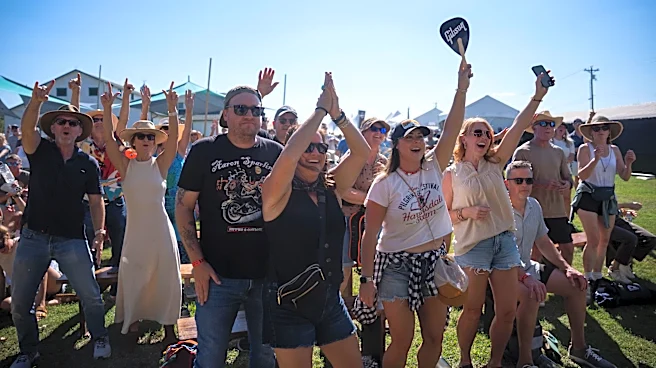






Pilgrimage Music & Cultural Festival has become one of Franklin's premier annual events, drawing sold-out crowds to a historic horse farm in late September to listen to a blend of country, rock and Americana artists.
So, why did Pilgrimage take a year off?
Organizers recently offered new insight into the challenges facing Pilgrimage, which is resuming in April 2027, at a moment when festival economics are under intense scrutiny because of cancellations elsewhere.
Festival co-founder Kevin Griffin said, on the Playlisted Podcast, that organizers believe an April event will face less competition from football season and arrive before audiences experience what he called festival fatigue.
"We'll be at the beginning of festival season as opposed to having
festival fatigue, and we won't be competing with high school, college and professional football," said Griffin.
He also previously noted the cooler April temperatures could improve the experience.
Over the past several months, festivals across the country have either abruptly canceled or announced indefinite hiatuses, including Bonnaroo's 2027 cancelation.
Soaring costs, particularly for talent, have become one of the biggest pressures facing festivals.
"What happened was the agents have pumped up the prices of bands for festivals to an astronomical height that has no connection to reality," Griffin said. "We were lucky with John Mayer because he was opening for Zach Bryan last year and suddenly John had an open Sunday night. He had his band and didn't want to deadhead it back to Los Angeles without a gig, and we got him at a high price, but a reasonable price."
According to Tiffany Naiman, director of the Berry Gordy Music Industry Center and Undergraduate Music Industry Programs at UCLA, both cost and timing are major factors affecting festivals — especially independent events.
"A festival can look enormously successful from the outside and still be financially precarious behind the scenes," Naiman said. "Simultaneously, audiences are facing higher prices everywhere due to the economy and are becoming more selective about where they spend their money, including entertainment."
In 2025, Pilgrimage celebrated its 11th consecutive sellout.
Still, Naiman said festivals often assume significant financial risk long before attendees arrive.
"Festivals incur enormous expenses months before the audience arrives. If advance ticket sales aren't where they need to be, organizers may decide that canceling is financially safer than proceeding and potentially taking a much larger loss," she said. "When a festival cancels, the immediate explanation might be ticket sales, weather, a permit problem, the loss of a site, or a combination of factors, but underneath that is often a much larger question of financial risk."
One of the major concerns surrounding Pilgrimage's hiatus was the potential loss of revenue for the local economy. In 2019, Visit Franklin found the festival generated more than $3 million in economic impact for the area. Hotels, restaurants and other local businesses all stood to feel the effects of the festival's absence.
"You lose much more than a concert," Naiman said. "Hotels, restaurants, bars, vendors, transportation companies and local workers lose business, and artists and music industry workers lose opportunities. But there's also a cultural loss that's harder to measure. Festivals become rituals, part of how communities gather, how artists find audiences and sometimes how a city understands itself. When one disappears, even temporarily, you're removing a vital part of a much larger cultural and economic ecosystem."
On Sept. 14, Pilgrimage Festival announced its return, though with a significant change. Instead of its traditional late-September dates, the festival will move to April beginning in 2027.
The reasoning behind the change was also influenced by the heat in September, organizers said during the Sept. 23 Franklin Board of Mayor and Aldermen meeting.
"We think it's a much better time. I'd rather be a little chilly at night in April than hot. We're excited about the move and glad to be back," Griffin said.
Presale ticket information has not yet been announced.
"People clearly still want live music. The more important question is what kind of festival ecosystem can survive," Naiman said. "If only the biggest operators can absorb this level of risk, we could end up with a live music business that looks incredibly successful on paper while becoming less diverse, less independent and less locally rooted."
This article originally appeared on Nashville Tennessean: Rising costs, festival fatigue, heat factored into Pilgrimage's April move