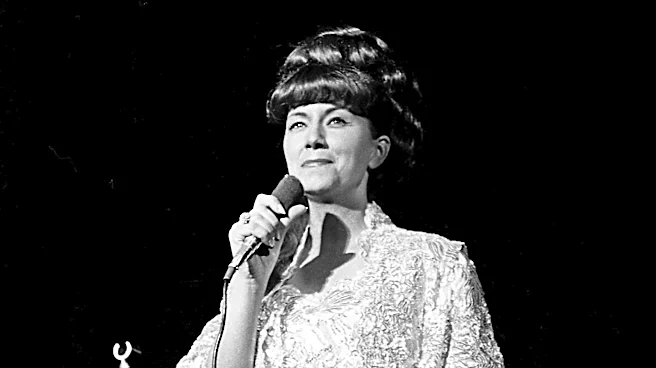





One of the biggest stars in country music history, Dottie West had arguably the worst beginning and worst ending of any celebrity icon.
In between, West had five No. 1 country hits, was a member of the Grand Ole Opry and was the first-ever female country artist to win a Grammy Award. Beginning in the 1970s, she became a television star, appearing as a co-host with Kenny Rogers on "The World's Largest Indoor Country Music Show" and then on "The Love Boat," "The Dukes of Hazzard" and "The Fall Guy."
Almost three decades after her death, she was posthumously inducted into the Country Music Hall of Fame in 2018.

Oct. 11 would have been her 94th birthday. She died in 1991. On Oct. 10, She will be remembered in a birthday celebration at The Park Theater,
115 West Main Street in McMinnville. Linda Davis, Tess Frizzell (Dottie West's granddaughter), Larry Gatlin, Bobby Tomberlin and Lang Scott are scheduled to attend.
"You can knock me down, but you better have a big rock to put me there," West said to The Nashville Network just months before she died. "It's been tough, but that's alright. I am the oldest of ten kids and I am a survivor. I love this business so much, that there's no way I could think of retiring."
The road to fame for West went through a courtroom, and she survived a horrific case of child abuse that scarred her forever.
Born Dorothy Marsh in Frog Pond, about 45 minutes west of Nashville, she was the oldest of 10 children. Beginning at age 11, she was repeatedly abused by her father, Hollis Marsh, who often held her at gunpoint. At age 15, she had a miscarriage.
After Hollis Marsh burned down the family house in Frog Pond, the Marshes moved to McMinnville, where West attended high school. She played guitar in a McMinnville High School band called the Coonskins.
She also told her teachers about the abuse, triggering the arrest of her father.
With his daughter testifying against him, Hollis Marsh was convicted and sentenced to 40 years in prison. He died in 1967 when West was one of the most famous country singers in America.
West attended Tennessee Technical College in Cookeville on a music scholarship. That's where she met her future husband Bill West, who was a steel guitar player.
After they married, the Wests moved to Cleveland, where Dottie landed a job as a singer on a regional country music television show called "The Landmark Jamboree."
In 1963, West wrote "Is This Me?" which Jim Reeves recorded, and got her noticed in Nashville. In 1964, she wrote a Top 10 hit, "Here Comes My Baby," that made her a star and won her the Best Female Country Performance Grammy.
In the mid-1960s, she was a regular performer in Nashville's Printers Alley. She had massive hits with Kenny Rogers ("What Are We Doin' in Love" and "Every Time Two Fools Collide").

Her success, however, didn't last. She had trouble with money and declared bankruptcy in 1990.
On Aug. 30, 1991, West was scheduled to appear at the Grand Ole Opry, and she was running late.
Her car stalled on the way to the venue, and as she stood outside the car wondering how she was going to get to the Opry, her neighbor, George Thackston, pulled up and offered to take her.
She hopped in his car.
At the Opry exit, Thackston lost control of his car going 55 miles per hour. He and West were rushed to the hospital.
Thackston survived his injuries and was charged with reckless endangerment. He had to complete an alcohol-recovery program assigned by the court.
West died on the operating table on Sept. 4, 1991. She was 58.
Kenny Rogers said it was the emotion in her songs that connected with audiences.
"When she sang about pain, she felt pain," Rogers said. "When she sang about love, she felt love. When she sang about beauty, she felt that beauty. While some performers sang words, she sang emotions."
This article originally appeared on Nashville Tennessean: Remembering Dottie West, who turned pain into stardom