






It was a day like any other day.
Dickson County General Sessions Court Judge Craig Monsue wasn’t scheduled to appear in court, so he drove to work a little later in the morning.
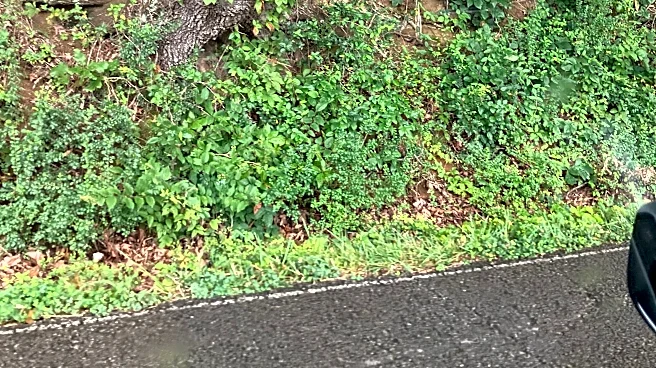
He made his way down winding roads until reaching about a half mile from the city of Charlotte when a large furry black animal suddenly appeared as he came around a curve on Town Branch Road.
“And I’m like, ‘what am I looking at?’ because it wasn’t making sense,” Monsue said. “It’s not a dog. It would have to be a huge dog, right? I’ve seen cows in the road before (but) it’s not a calf, it doesn’t have a long tail and it’s too furry.”
Monsue realized he was nearly face-to-face with a black bear as the animal turned, revealing the distinctive side profile.
“I knew they had
been spotted in the area, but this was kind of unusual for me (in) broad daylight, and it’s just standing in the middle of a county road,” he said.
The Tennessee Wildlife Resources Agency has received an average of 1,215 calls about black bear sightings each year over the past five years. The agency's highest call volume was in 2024 with 1,770 calls.
Several Middle Tennessee counties have reported sightings in recent weeks.
"We believe there have been four to five different bears in Middle Tennessee this year," TWRA Public Information Officer Barry Cross told The Tennessean.

Bears have been spotted in Cheatham, Dickson, Hickman, Robertson, Smith, Sumner and Wilson counties, according to a July 9 news release from TWRA. They've also been known to show up in Nashville on occasion.
"Each spring, yearling bears disperse from their mothers in search of their new home range," a June 5 TWRA statement read. "During these travels, bears may appear in areas of Middle Tennessee where bear sightings are less common, but always possible."
Bear activity is especially high from May to August, according to the Great Smoky Mountains National Park, though sightings can happen any time of the year.
Monsue's brief and puzzling encounter ended as the bear climbed up an embankment. He frantically searched for his phone to capture the moment, as he thought “nobody’s going to believe this.”
The lifelong hunter and Middle Tennessee resident said this was his first time crossing paths with a bear.
Monsue grew up in Dickson County before spending several years southeast of Nashville in Antioch and Murfreesboro and later moved back to his hometown in 2005.
“I’ve heard people talk about seeing bears, but not with the frequency that this year (has) been where it seems like everybody is seeing bears now.”
Are black bears dangerous?
While spotting a black bear may be startling, the agency said they do not view humans as prey but rather associate them with an easy meal if they continuously find food from garbage cans, pet food, bird feeders and other human sources, The Tennessean previously reported in June.
"A bear passing through a neighborhood is not cause for alarm," the agency previously said. "If it is lingering, it likely has found easily accessible food, called attractants, like unsecured garbage, pet food, or bird seed and will keep coming back as long as attractants remain available."
In the morning before Monsue's sighting, another bear encounter captivated residents.
A bear was seen crossing Dickson County Sheriff’s Office Detective Steven Rychlik’s yard — possibly the same bear Monsue encountered in the road an hour or two later.
“(It was) right on the Charlotte Square … it was a half mile away and it was earlier that day, so I’d say chances are it probably was the same bear,” Monsue said.
Dickson County Sheriff’s Office Detective Jim Gardner filmed the bear crossing Rychlik’s yard.
“It was the first time we’d seen a bear out here,” Rychlik said.

Rychlik was in the northern part of the county at the time when he heard the call over the radio.
“People were calling it in nonstop,” he said, noting at least a dozen phone calls were made about the bear roaming around downtown Charlotte that morning.
The bear was seen hanging around the backside of the square, crossing major city roads including highways 48 and 49, and entering nearby neighborhoods.
Monsue and Gardner have had some of the closest encounters to black bears in recent weeks.
Where do Tennessee black bears live?
According to TWRA, there are two main black bear populations in Tennessee: The Appalachian population along the Tennessee and North Carolina border and the Cumberland population along the Tennessee and Kentucky state line.
Bears were nearly eradicated from Tennessee altogether due to loss of habitat and overexploitation in 1949, when the agency was founded. The population has since recovered to an estimated 6,000 bears today.
As their numbers continue to grow, black bears will continue to expand into more areas of Tennessee, eventually reaching all areas of the state, biologists have said.
More: Black bears are coming to Middle Tennessee. 'You have to do things different,' TWRA warns
More: Bears in Middle Tennessee: How to avoid a trash buffet as population rebounds
Most bear sightings occur from spring into late summer, Cross told The Tennessean.
Black bears hibernate during the winter and typically emerge from their dens in late March or early April when natural foods are scarce. They’re then lured by the smell of food to denser, human-populated areas.
Bear sightings peak in June and July as yearling bears are cast out on their own and work to establish a home range. Breeding males will also travel substantial distances in search of females.
"Since we have seen some adult-size bears, as well as young males, the adult males could be seen into late fall as long as food sources are available," he said.
Cross added that while the number of bears the agency is aware of may have risen slightly by a couple, the "sightings" increase due to the abundance of cameras on the landscape.
"Phones, trail cameras, door cameras, security cameras, etc. Where bears may have traveled through unnoticed before, they are now more readily documented," he said. "Bear movements are affected by food availability. Young males being pushed out or adults taking up new territory that is closer to the Middle Tennessee area. Bear populations in general have increased over time which will lead to natural expansion."
In January 2024, TWRA warned Middle Tennessee residents that "the long-term trend will be increased sightings".
Black bear safety tips
Tennesseans can help ensure everyone remains safe as black bears continue seasonal movements across the state with these tips, TWRA officials said.
- Secure trash and other potential food sources.
- Bring pet food indoors when not in use.
- Remove bird feeders if bears are active in your area.
- Keep a safe distance from any bear you encounter.
- Never feed or approach a bear.
- Report bear sightings through TWRA's "I Saw A Bear" program.
How to report a bear sighting
TWRA officials are asking for the public's help as they track the recolonization of the black bear in Tennessee.
Tennesseans are encouraged to report bear sightings through the agency’s "I Saw A Bear" reporting system. Reports of black bear sightings help wildlife biologists monitor their movements and better understand their distribution across the state.
Report a bear sighting online at https://shorturl.at/zaN7d.
Officials warn the form is for reporting a sighting only and should not be used to report a sick or injured bear. Visit https://www.tn.gov/twra/contact-us.html to contact a regional office for help with a sick or injured bear.
To report bear conflicts, call 800-831-1174.
Katie Nixon can be reached at knixon@gannett.com.
This article originally appeared on Nashville Tennessean: Black bears are showing up across Middle Tennessee. One surprised a judge.