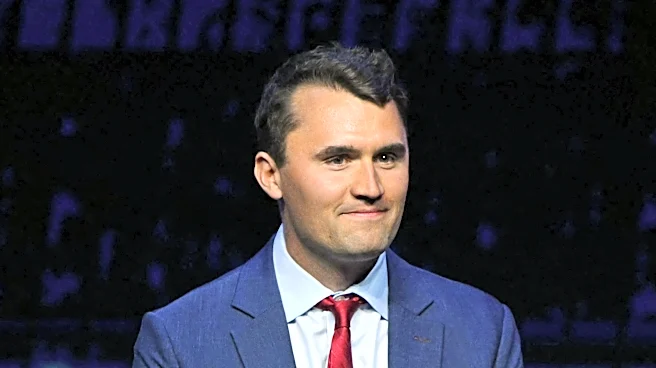




He made his name confronting ideological opponents. A conservative political prodigy, he founded Turning Point USA to recruit young conservatives and counter what he saw as the liberal ethos on college campuses.
He was brash, aggressive and, in this columnist's view, abhorrent because of comments he made about the Civil Rights Movement, systemic racism, Black women and affirmative action.
On the Civil Rights Movement, Kirk said: “I have a very, very radical view on this, but I can defend it, and I’ve thought about it,” as documented by FactCheck.org. “We made a huge mistake when we passed the Civil Rights Act in the 1960s.”
On systemic racism, Kirk said: “We decided to all of a sudden embrace this idea that we’re systemically racist. We’re a white
supremacist country, and if you dare disagree with us, we will character assassinate you, mock you and ridicule you because you’re a racist; sit down and shut up.”
On Black women and affirmative action, Kirk said: “If I’m dealing with somebody in customer service who’s a moronic Black woman, I wonder is she there because of her excellence, or is she there because of affirmative action?”
He also said: “If we would have said that Joy Reid and Michelle Obama and Sheila Jackson Lee and Ketanji Brown Jackson were affirmative action picks, we would have been called racists. Now they’re coming out and they’re saying it for us … You do not have the brain processing power to otherwise be taken really seriously. You had to go steal a white person’s slot to go be taken somewhat seriously.”
And in the aftermath of the Covenant School shooting in Nashville, Kirk famously said: “I think it's worth having the cost of, unfortunately, some gun deaths every single year so that we can have the Second Amendment to protect our other God-given rights. That is a prudent deal. It is rational ...”
Whether you supported or despised Charlie Kirk, no person, no matter how offensive their views, should be assassinated for espousing their beliefs.
After all, it was Kirk who posted on X: “Hate speech does not exist legally in America.
“There's ugly speech. There's gross speech. There's evil speech. And all of it is protected by the First Amendment.”
If you're truly committed to free speech, it means confronting repulsive views that make you uncomfortable, not controlling how and where speech is practiced.

More speech, not less
As this nation reflects on the first anniversary of his assassination, one irony remains inescapable, especially here in Tennessee. Republican lawmakers have passed legislation he'd probably object to: statutes that could be used to snuff out dissent rather than confront it.
Of the two Tennessee laws passed in his name, one seemingly runs counter to the spirit of the departed provocateur.
Earlier this year, Tennessee Gov. Bill Lee signed the Charlie Kirk Act into law.
On its face, the heavily amended bill is intended to protect free speech, religious and ideological viewpoints on public college campuses and make it harder to disinvite guest speakers with controversial views. It also requires adopting principles stating that civility cannot be used to shut down ideas that are offensive and disagreeable, according to the nonprofit Foundation for Individual Rights and Expression that supports the amended law.
Kirk would probably agree that civility shouldn’t have the final say, and that anything ugly and disagreeable should have its say.
But what if that same legislation could be interpreted to neuter dissent?
A free speech paradox
The broadly written act could allow ideologically dominant groups to wield the Charlie Kirk Act like a cudgel under the guise of protecting free speech. It places limits on campus protest.
Actions that disrupt a speaker could subject students to scrutiny under state law.
The act prohibits yelling to drown out the speaker and using protest signs to obstruct views.
“It’s possible that this law could be abused to punish any protester with a sign who for a brief moment slightly impedes someone’s view of a speaker,” an Inside Higher Ed analysis states. “This would be an unconstitutional misuse of the law, but the poor wording of the legislation creates that possibility.”
It comes down to how it is enforced and by whom. In the hands of a dominant political group, the act could be used to neutralize dissent in the very environments where divergent ideas are supposedly encouraged, even when they collide, to further discourse, enlightenment or, at the very least, vigorous debate.

Legacies repurposed
The Charlie Kirk American Heritage Act, Tennessee's other namesake bill, allows state public school and college educators to teach about Christianity's influence on American history and the nation's founding, especially its positive aspects. The elephant in the room is the history of how religion has been manipulated to justify atrocities like slavery. But that’s for another column.
And speaking of weaponizing legacies to suit political motives, there are those who misuse Rev. Martin Luther King Jr.'s famous “I Have a Dream” speech to push for laws that the civil rights leader would categorically oppose.
"He said he didn't want people judged on the color of their skin, but on the content of their character,” Florida Gov. Ron DeSantis once said in 2022 before signing the "Stop Woke Act" to limit discussions around slavery and racism in public schools.
I am in no way comparing Kirk to King. The two men don’t occupy the same stratosphere. Yet, a year after his death, I wonder if he’d be warm to the idea of the government playing a role in limiting free speech. Would he favor government protection of conservative ideas?
Or would he prefer an arena where conservatives, progressives, socialists, Christian nationalists, outlaw Christians, atheists, agnostics, students, professors, provocateurs and intellectuals can tussle without the government poking its nose in it?
I could not verify the author of this quote, but what it says about this moment is too on the nose: "The living owe it to the dead to tell their stories truthfully, not to twist their memories into mirrors for our own modern vanities."

Tacuma R. Roeback is The Tennessean’s community engagement and opinion editor. Reach him at troeback@gannett.com or follow him onX,Bluesky orLinkedIn.
This article originally appeared on Nashville Tennessean: One year after Charlie Kirk's death, a free speech irony | Opinion