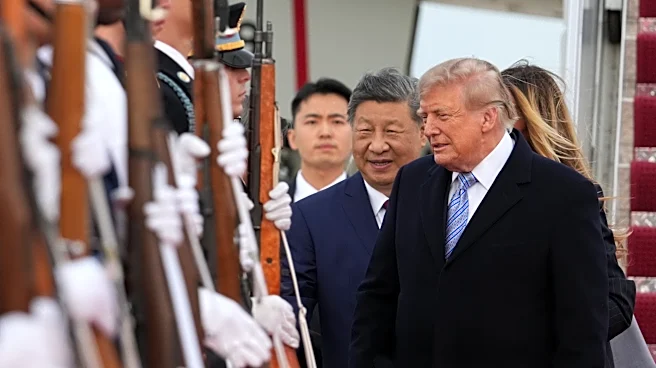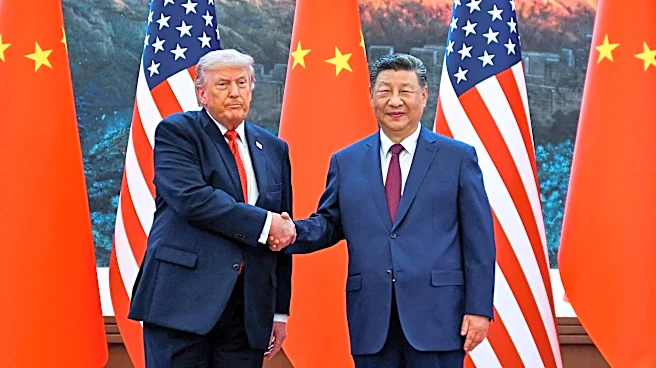







This week, Chinese President Xi Jinping is in Washington for a state visit with President Donald Trump. How could their discussions impact Tennessee's economy?
Taiwan — a growing trade partner for Tennessee — will be a key topic in their discussion.
Tennessee’s economic ties with Taiwan have exploded in the last five years. Exports of Tennessee goods to Taiwan have doubled, from $255 million five years ago to $514 million in 2025. Meanwhile, imports from Taiwan have tripled in the state, hitting $10.6 billion in 2025. Computer equipment and semiconductors are the largest category of both imports and exports.
China is the United States' biggest trade partner after Mexico and Canada. Taiwan ranks No. 4.
Xi has intensified threats against Taiwan this
year, framing the United States' formal recognition of Taiwan as a red line that would likely trigger a major military conflict. Beijing is pressing Trump to freeze a proposed $14 billion arms sale to Taiwan — which Taiwan officials see as crucial to survival.
Ahead of the United Nations General Assembly meeting this week, from which Taiwan is banned, officials invited media from around the globe, including The Tennessean, to Taipei to deepen understanding of the island's democracy and economy.
Here's what Tennesseans should know as Xi visits.

One China
The United States does not have formal diplomatic relations with Taiwan. Under the One China Policy, effective since the '70s, the federal government recognizes Beijing as the sole legal government of China and does not see Taiwan as an independent, sovereign nation.
"Over the last decade, China has adopted various laws to make sure that it has tighter control over not just citizens of Taiwan, but also on foreigners and its own Chinese citizens — whether in the area of cybersecurity, religious freedom, or entry and exit of its borders, we have seen China tighten its grip," said Lou Wen-Jia, secretary general of the Straits Exchange Foundation, a quasi-governmental group that handles civil business matters between mainland China and Taiwan.
While China asserts control over Taiwan, the situation hasn't become a hot war. But Chinese grey zone tactics like maritime provocations and economic coercion are escalating.

Earlier this month, the Taiwanese Coast Guard said it intercepted and expelled Chinese vessels out of Taiwan waters — a violation of the status quo by China.
"Anytime we have the capacity to counter their unlawful actions, we do so," Taiwan Coast Guard Administration Deputy Director-General Hsieh Ching-chin told reporters through an interpreter. "The hyper-threat toward Taiwan is aggravating. [China is] trying to create a narrative that they have jurisdiction over Taiwan."
As a result, Taiwan is looking to deepen political and economic ties with like-minded democracies. So while formal ties with the U.S. federal government aren't legally possible, agreements with individual states are.

Why Taiwan is focused on individual states
Because formal diplomatic relations with the U.S. as a whole are not possible, Taiwan officials have leaned into strategic economic outreach to individual states, including Tennessee.
Taiwan has 14 unofficial diplomatic missions in the U.S., and about half of U.S. states have official representative offices in Taiwan. Tennessee could soon be among them.
“We are working very hard to build common interest in the USA,” Taiwan Deputy Foreign Minister François Wu told The Tennessean, pointing out that it's not common for so many individual states to staff offices — similar to embassies — in foreign capitals.

“I think Taiwan is one of the countries that you have the most dense state representation in the world," Wu said. "And we hope that you can be even more present here in Taiwan."
Earlier this year, the U.S. Department of Commerce announced that Taiwan Semiconductor Manufacturing Company would expand operations in Arizona as part of a pledgeto invest a total of $265 billion in the U.S. and create a dozen cutting-edge semiconductor manufacturing plants.
Beyond semiconductors and computers, Taiwan is supporting development of renewable energy on the state level.
"At the federal level, the Trump administration does not trust green energy," said Da-Nien Liu, senior deputy executive director of the Chung-Hua Institution for Economic Research.

"[Economic relations with individual states are] very important," Liu said. "For the current U.S. government, the Trump government does not make clean energy a priority for the U.S federal government. For the state level governments, we do have some kind of clean energy cooperation. I think that is very significant to international trade investment relations."
During his Asia tour last year, Tennessee Gov. Bill Lee signed a bilateral trade agreement with Taiwan’s President Lai Ching-te, making the Volunteer State the 25th to formalize an economic relationship with the island nation.
Tennessee’s goal is economic growth.
For Taiwan, it’s strategic diplomacy.
“We really try to maintain and improve our general relationship with the whole United States. ... We are now your fourth trade partner; we are doing more business with you than the British,” Wu said. “It began at the state level.”

Taiwan and Tennessee
Taiwan-owned companies, most of which are located in Middle Tennessee, contribute $158 million to the state’s economy and employ about 1,175 Tennesseans, according to the state's Department of Economic and Community Development.
Computer terminal producer Quanta Manufacturing in Nashville’s La Vergne suburb has grown to employ more than 1,000 people, bolstered in recent years by state FastTrak incentives. Altogether, the state has offered Taiwan-owned companies $7 million in financial incentives since 2019, with much of that going to Quanta.
Eight other Taiwanese-based companies operate in Tennessee, in industries ranging from machinery wholesale to plastic packaging and electronic connector manufacturing.
During his meeting with the governor last year, President Lai praised Tennessee as a “key industrial hub” within the U.S.
“As a longstanding and trustworthy trading partner of the U.S., Taiwan sees Tennessee as an important site for its global deployment,” Lai said.
There's also growing political support on the state level. Tennessee lawmakers formed a Taiwan Legislative Caucus, which backs resolutions each year in support of Taiwanese democracy and economic ties to Tennessee.
A Tennessee trade branch in Taipei?
As part of Tennessee’s agreement with Taiwan, the ECD pledged to open a satellite office in Taipei. It would mirror similar existing branches in Japan, South Korea, Italy, Germany and the United Kingdom. Lai said the forthcoming office would “open a new chapter of bilateral cooperation.”
But one year later, the office has not yet opened.

ECD spokesperson Chris O’Brien told The Tennessean that Taiwan "represents a particularly compelling market for Tennessee," but the agency is working through the required negotiations and state contracting process.
“Taiwanese companies are global leaders in several industries that closely align with Tennessee’s economic strengths and strategic priorities, including advanced manufacturing, semiconductors and electronics, automotive and electric vehicle supply chains, energy technology and related research and development," O'Brien said.
“We are still in the evaluation phase of opening an FDI office in Taiwan to better strengthen the state’s partnership with countries like Taiwan that are driving innovation, but nothing concrete has been solidified,” he said. “If things do progress, we may have more to share in the coming months.”
Vivian Jones covers state government and politics for The Tennessean. Reach her at vjones@tennessean.com.
This article originally appeared on Nashville Tennessean: As Chinese President Xi visits, why has Taiwan deepened ties with TN?