
We're still a couple years away from logging the final tally on the 2022 NFL Draft trade that upended the Tennessee Titans and set the Philadelphia Eagles on course toward some of the highest highs in franchise history.
The Titans (0-1) host the Eagles (1-0) at Nissan Stadium on Sept. 20 (noon CT, FOX) in a matchup that's a reminder of the teams' shared history. During the first round of the 2022 draft, the Titans shipped star receiver A.J. Brown off to Philadelphia in exchange for a pair of draft picks which, through a few additional trades, ended up becoming five players.
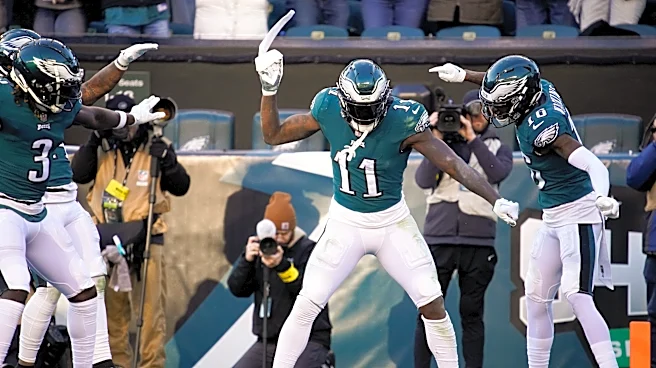
The Eagles went to two Super Bowls in four years after the trade with Brown leading the way in the receiving room before his relationship with Philadelphia soured similarly
to how it had in Tennessee. Back in June, the Eagles got two draft picks back for Brown in a trade with the New England Patriots, reuniting Brown with former Titans coach Mike Vrabel.
Before this weekend's matchup, let's take a look back at the tentacles of the initial Brown trade, how the trade changed the course of how the Titans have built their roster and if there are any lessons to be learned from the opposite directions these two teams went in the last four years.
What Titans got from A.J. Brown trade
The Titans traded Brown in exchange for the No. 18 pick and the No. 101 pick in the 2022 draft. With the No. 18 pick, they attempted to replace Brown with WR Treylon Burks. Less than an hour later, the Titans packaged that No. 101 pick along with their own first-round pick, No. 26, to receive picks Nos. 35, 69 and 163 from the New York Jets. With those picks, the Titans selected CB Roger McCreary, OT Nicholas Petit-Frere and WR Kyle Philips.
Four years later, the Titans traded McCreary for a fifth-round pick. That pick was later swapped in a trade package that the Titans used to acquire rookie LB Anthony Hill Jr.
Burks only played 27 games in a three injury-addled seasons in Nashville, catching 53 passes for 699 yards and one touchdown. Philips caught 23 passes in 13 games and returned nine punts. Petit-Frere grew to be a liability across 34 appearances (28 starts) with the Titans, allowing 18 sacks and 87 total pressures. McCreary was the most reliable player in the bunch, logging 17 PBUs and three interceptions across 55 appearances. Hill led the Titans with 16 tackles in his rookie debut.
How A.J. Brown trade changed Titans future
Short version: The Titans spent a lot of money and draft capital trying to replace Brown, and that money and draft capital ended up not being used on other weaknesses.
Burks didn't work out. That led to the Titans trying their luck with veterans DeAndre Hopkins, Calvin Ridley, Tyler Boyd and Tyler Lockett. That worked out to roughly $118 million in free agent spending, on top of the $14 million in Burks' rookie deal. Brown's initial contract with Philadelphia, for what it's worth, was valued at $100 million.
The constant resource churn at receiver hamstrung the Titans with their other needs. This was exacerbated by the failures of players like Petit-Frere and CB Caleb Farley to fill needs they were expected to, and the snowball effect that came from missing on their potential replacements Andre Dillard and L'Jarius Sneed, among others. But the fact remains that if the Titans paid Brown, they would've been able to devote resources elsewhere and fill out depth more effectively rather than swinging over and over for fixes at the same position.
Did the Titans fall apart because of A.J. Brown?
In part, maybe. The downfall is far more complicated than that. The core roster Brown grew up on got old, and the Titans might've held on a little too long in some spots. Draft misses on Farley and OT Isaiah Wilson predated the Brown trade. Internal friction led to questionable front office and coaching staff hirings and firings. Short-sighted fixes led to whiffs on win-now veterans rather than long-term investments in youth and depth. And bad quarterback play hung like a storm cloud over all this.
Is A.J. Brown trade still to blame for Titans' standing?
Probably not. The Titans' collapse in 2022 and continued descent through the end of Vrabel's tenure had a lot to do with Brown's absence. But the Titans' misfires in hiring GM Ran Carthon and coach Brian Callahan ― and the ensuing misfires on hiring inexperienced coordinators, putting their eggs in QB Will Levis' basket, overspending on Ridley and Sneed, betting on JC Latham's ability to play left tackle and failing to get much out of QB Cam Ward early in his career ― have more to do with the Titans' present-day predicament.
Nick Suss is the Titans beat writer for The Tennessean. Contact Nick at nsuss@gannett.com. Follow Nick on X @nicksuss. Subscribe to the Talkin’ Titans newsletter for updates sent directly to your inbox.
This article originally appeared on Nashville Tennessean: How much A.J. Brown trade is still causing Tennessee Titans struggles