






The Boring Company's plans to tunnel beneath Nashville could trigger sinkholes and spread toxic contamination through the city's groundwater, a new report warns.
The report, released Oct. 21 by the Southern Environmental Law Center, raises concerns about the risks of digging throughNashville's porous limestone bedrock
, where water has dissolved underground caves and voids known as karst formations.Chris Groves, a hydrogeologist at Western Kentucky University who authored the report, found that the company's planned Music City Loop tunnels would encounter karst-prone rock beneath the Cumberland River, Mill Creek and other waterways, despite the company's stated intention to avoid such formations.
The report also raises concerns about tunneling
near the former Aladdin Industries site on Murfreesboro Pike, where soil and groundwater have been contaminated with industrial chemicals, including the carcinogen trichloroethylene.
Trey Bussey, an attorney with SELC, said the company's lack of transparency has left unanswered questions about how it plans to manage those risks and who would be responsible if something goes wrong.
"We don't know what happens if a tunneling machine gets stuck under Mill Creek, what happens if there's a sinkhole in a downtown street that interferes with traffic and undermines the structural integrity of buildings along the route," Bussey said. "Who pays to fix that?"
The Boring Co. did not respond to a request for comment. The company publicly acknowledged Nashville's geological challenges in 2025 and developed a karst mitigation plan, according to documents obtained through a records request. CEO Steve Davis described the city's geology as "an engineering problem that's fairly easy and straightforward to solve."
In a 2025 environmental impact assessment, the company concluded that tunneling would not significantly affect Nashville's geology, endangered species, air quality or other key resources. The assessment states that the company will "attempt to avoid tunnel boring in areas where karst development is identified."
But the SELC report challenges those assurances, finding that portions of the planned route cannot avoid karst-prone rock.

Geologist warns of worst case scenario
Geologists have likened the karst layers of rock under Nashville to Swiss cheese, with underground caves and voids that can pose significant challenges for tunneling projects.
"There is extensive literature that describes sometimes severe karst-related problems that in other tunneling projects have included massive water or mud inflow and flooding, sinkholes and ground subsidence above the tunneling, and machine entrapment with 'stuck' (boring machines)," Groves said in the SELC report.
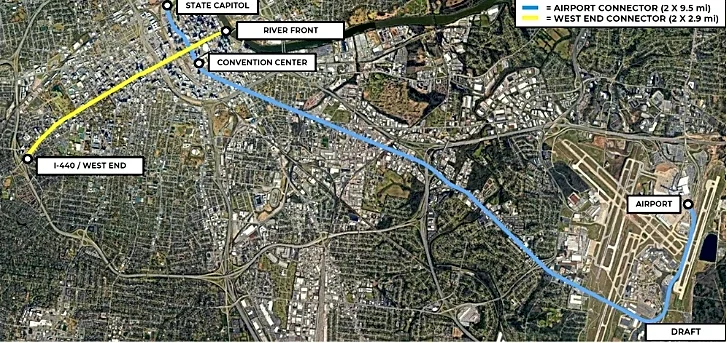
Currently, The Boring Co. has two sets of tunnels planned, and once they are completed, drivers will transport passengers through them in a setup similar to rideshare. The first set of tunnels will run 9.5 miles from downtown Nashville to Nashville International Airport under 8th Avenue South and Murfreesboro Pike, and the second will run 2.9 miles from West End down Broadway and under the river to Nissan Stadium.
While The Boring Co. intends to avoid known karst formations, Groves warned that underground cavities can be difficult to detect before excavation, particularly when exploratory boreholes are spaced roughly 500 feet apart.
The company's mitigation plan outlines how it would identify and respond to underground hazards through drilling, geophysical testing and probing ahead of its tunneling machines. But Groves found that the plan provides little explanation for its methods or how they draw on lessons from previous tunneling projects in similar geological conditions.
A separate report by a company contractor assessed the risk of encountering karst formations as "low to moderate." But Groves identified several large underground cavities near the planned airport route, including one measuring 13.5 feet — roughly the diameter of the proposed tunnels — and a cave with passages measuring up to 30 by 40 feet.
Encountering underground cavities filled with water or mud can flood tunnels, damage boring machines and bring construction to a halt, according to a 2017 study cited by Groves.
Geological researcher Bin Liu warned that failing to identify karst formations before excavation can lead to severe consequences, including collapsing rock and sudden water inflows.
"In the worst case, it will end up with heavy casualties and serious economic losses, or, even worse, with construction cessation or rerouting of the current underground construction," Liu wrote in the study published in the Journal of Applied Geophysics.

Music City loop runs near contaminated sites, report finds
In addition to the structural unpredictability, the SELC report found that planned path for Music City Loop will tunnel in proximity to nine contaminated sites, according to information from the Tennessee Department of Environment and Conservation's remediation branch.
"A big question to me is what happens if the tunnel runs into highly contaminated soil or groundwater, and that groundwater starts rushing in all new directions," Bussey said.
Of the nine contaminated areas, SELC is most concerned with the former Aladdin Industries site on Murfreesboro, which was a production plant for kerosene and electric lamps, vacuum parts, radios and televisions. The location has a history of soil, groundwater, ground air and soil gas contamination by the carcinogen trichloroethylene, other hazardous solvents, and metals, according to SELC.
SELC officials fear that The Boring Company doesn't have an adequate plan should it encounter these contaminants. The Boring Co. does not mention how any impacted groundwater encountered would be treated prior to disposal if necessary in its environmental report.
Hadley Hitson covers business news for The Tennessean. She can be reached at hhitson@gannett.com. To support her work,subscribe to The Tennessean. Kelly Puente is an investigative reporter for The Tennessean. Read more of her work here.
This article originally appeared on Nashville Tennessean: Report warns Boring Co. tunnels could cause Nashville sinkholes