






A coalition of national civil liberties groups is seeking records from five Tennessee school districts after they announced plans to display the Ten Commandments inside schools, following a recent state law that allows schools to do so.
The groups, including the Americans United for Separation of Church and State, the American Civil Liberties Union of Tennessee, the national ACLU, and Freedom From Religion Foundation sent letters with records requests to five Tennessee school districts on Aug. 20.
The requests went to Blount County, Rutherford County, Washington County, White County, and Wilson County school districts, in an effort to get further information regarding the districts’ recently announced plans to install Ten Commandments displays
inside the schools.

The group’s letters come one day after Rutherford County Board of Education approved a design for the school system’s Ten Commandments plaque.
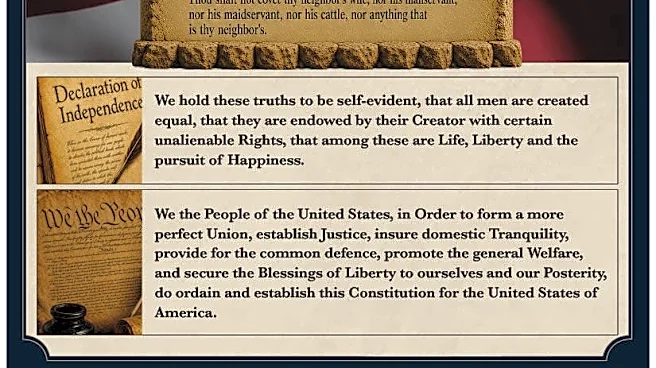
The installations follow a recent state law that allows Tennessee school districts to display the Ten Commandments,alongside key founding documents such as the Bill of Rights, Declaration of Independence, the Tennessee Constitution or the U.S. Constitution — all of which are already allowed to be displayed in schools — in a “prominent location” inside schools.
The law defines “prominent location” as a “school entryway, cafeteria, or common area where students are likely to see the display.”
The law passed in May after years of similar attempts to pass such bills.
In a joint statement, the coalition called the move a violation of families’ religious freedom.
“Families and faith communities, not the government, get to decide what role religious doctrine and belief play in their lives,” the statement read. “We are committed to protecting students’ and parents’ constitutional rights and are launching an investigation of every school district that foolishly accepts the state’s invitation to trample those rights. We urge families who will be affected by these religious displays to contact our organizations.”
Nancy Noet, a litigation attorney with the Freedom From Religion Foundation, told The Tennessean that the inquiry into the Volunteer State’s efforts came after families contacted the coalition about the districts’ decisions.
“We're keeping our fingers on the proverbial pulse of these bills as they are passing in other states, and Tennessee was one of a couple others that came up more recently,” Noet said. “So we're just trying to do our homework here, and we're gathering as much information as we can.”
Due to the recent state law, the creation and display of these plaques are technically legal — but Noet says the group is checking into them as part of their nationwide effort to scrutinize violations of the First Amendment in public schools.
She added that displaying text from one religious group in a taxpayer-funded establishment violates parents’ rights to practice their own religious preferences.
“We're challenging similar, but not identical, laws in other states, and at the end of the day, we're challenging them as unconstitutional,” she said. “We've not brought that challenge in Tennessee, because we don't know what they're going to do, and the law is different. But in general, it's our position that forcing biblical scripture on public school, impressionable children violates the family's religious freedoms.”
Rutherford County signs will cost over $12,000
The Tennessean has reached out to all the school systems named in the group’s letters.
In response to a comment request from The Tennessean, a spokesperson from Rutherford County Schools confirmed the receipt of the records request and said the specific location of the plaques have not yet been decided.
At the Aug. 20 board of education meeting, board members approved the design for the sign, stating that the total cost for all 53 schools' 24-by-36 inch metal signs will be over $215 each — totaling around $12,400.
According to board members, $7,000 has already been raised privately to cover the cost, though the law does not require the costs be covered by outside donations.
The board intends to return in September with another design tailored specifically for elementary school children to make “something more appealing for the younger kids,” a request made by board member Butch Vaughn.
Ten Commandments one of many recent efforts to fold religion into public schools
The move to display the Ten Commandments inside schools is not limited to Tennessee.
Multiple lawsuits across the country against similar laws, including in Arkansas, Texas and Louisiana, are being helmed by the same coalition.
A federal judge ruled favorably for the group in Arkansas last August, barring several Arkansas school districts from implementing what the judge described as a “plainly unconstitutional” state law requiring public schools to display the Ten Commandments in their classrooms and libraries.
The judge noted that the U.S. Supreme Court struck down a “nearly identical” law in Kentucky in 1980, and called the effort a likely “coordinated strategy among several states to inject Christian religious doctrine into public-school classrooms.”
The state was permanently enjoined from displaying the Ten Commandments in March, marking a major victory for the coalition.
On Aug. 17, the group filed a joint petition to the U.S. Supreme Court after a federal appeals court upheld the Texas Ten Commandments law.
Noet said the requests for information from Tennessee are not an explicit indication that they plan to go to court, but that they are simply “information gathering” as more states test the boundaries of the separation of church and state.
Tennessee’s bill drew heavy constitutional criticism from Democratic lawmakers, including a pastor, during the 2026 legislative session.
Despite the pushback, the bill passed in May almost entirely on party lines.
Although the sponsor of the bill framed the Ten Commandments as a document of significant cultural heritage offered in the context of history, civilization, ethics or other secular subjects, the law states that the point of the effort is to help bring back “the traditional recognitions of our religious heritage.”
The law was far from the only bill seeking to pull state public education onto a more religious path in the 2026 session.
One bill proposed by Rep. Gino Bulso, R-Brentwood, sought to require Bible education for K-12 students at public schools, overturn historical constitutional standards regarding the separation of church and state, create time in public schools for “voluntary vocal prayer” and require curriculum about Israeli history, the Bible and its influence on western civilization — all to the tune of up to $37 million.
The bill was sent to summer study in April, effectively killing it.
Another bill, titled the Charlie Kirk Heritage Act, emphasizes the teaching of the “historical, positive impact of religion on American history,” and the “influence of Judeo-Christian values on the freedom and liberties ingrained in our culture” as a way to reduce "ignorance of American history, hate, and violence in our society.”
The bill passed in March.

This follows the 2024 decision to mark a Revolutionary War bible, known as the Aitken Bible, as a state book.
An exclusive Tennessean investigation found the lobbying group pushing the Aitken Bible within state governments across the country has ties to larger Christian groups seeking to erode the separation of church and state.
Each of these bills uses a similar justification in an attempt to bypass First Amendment scrutiny: labelling explicitly Christian texts as items of historical significance to Tennessee and American culture, emphasizing their need to be taught in secular situations.
The USA TODAY Network - The South region's coverage of First Amendment issues is funded through a collaboration between the Freedom Forum and Journalism Funding Partners.
Have a story to tell? Reach Angele Latham by email at alatham@gannett.com, or follow her on X at @angele_latham
This article originally appeared on Nashville Tennessean: Coalition seeks records as TN schools plan display of Ten Commandments