



The lawsuit by families of victims of the 2021 Waverly flood against railroad company CSX finally reached trial on Aug. 4, nearly five years since the historic flooding destroyed parts of the small town and claimed 19 lives.
The trial is being held in the Fred D. Thompson U.S. Courthouse in Nashville.
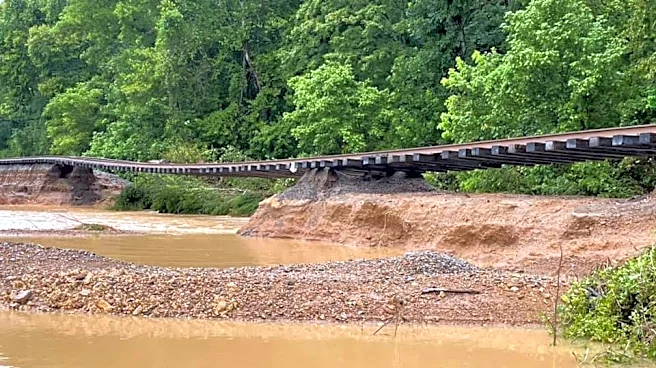
The families suing say CSX contributed to the disaster. They say that on Aug. 21, 2021, the company’s raised railroad embankments near Trace Creek acted like an artificial dam, pooling water until the flow eventually topped the tracks and eroded the earth and gravel below it. The embankment supporting 300 feet of track near the Trace Creek bridge washed out that day and, according to the plaintiffs, unleashed a surge of 229 million gallons of water on the town.
The families argue CSX had a duty to notify Waverly authorities or the local community of the risk of a washout.
“(CSX) had the information, and they never made the call,” Peter Flowers, an attorney for the plaintiffs, said during opening statements the morning of Aug. 4.
The biggest obstacle for the plaintiffs’ attorneys may be convincing the jury that the washout, not the sheer scale of the flooding, is the cause of the deaths.
The flood marked the highest 24-hour rainfall total in Tennessee’s recorded history at 20.73 inches. Not a single weather model predicted the amount of rain that fell. It was a “1,000 year storm,” Camille Reifers, lead attorney representing CSX, told the jury during opening statements. Even once it began, railroaders did not know how catastrophic it would be, Reifers indicated.
Reifers asked track supervisor Corey Oakley, the first witness to testify, if he would have warned people if he had known what was coming.
Oakley, a lifelong Waverly resident, responded in an instant, “I’d have let everybody know.”
But nobody has a crystal ball, Reifers asked him. Oakley just held his head down and shook it for three seconds: “No ma’am.” As she asked her next question, Oakley wiped his eye.
Oakley testified that other washouts had happened in the area before, but nothing of this magnitude. While inspecting the tracks the morning of Aug. 21, 2021, he did not think a possible washout would have the potential to harm people or their homes.
“I just thought … eventually the water would be going down and it wouldn’t be a big deal,” Oakley testified. “That’s all my past experience taught me. I never thought it would have turned out the way it did.”

Reifers during her opening statement asked jurors to “think of the perspective of every railroader and what they knew at the time.”
Plaintiffs’ attorneys questioned Oakley and the second witness, Ed Sparks, the head of bridges, design and construction at CSX, about whether employees should be trained to “understand that a washout could affect the safety of the people that live near the tracks.”
Sparks answered, “At a high level, I suppose.”
Flowers told the jury the plaintiffs have two claims. One is for failure to warn, arguing that CSX had a duty to alert authorities or the community of dangerous conditions near its railroads around Trace Creek, and the other is a legal nuisance claim, arguing that CSX had a duty not to interfere with the natural drainage of surface water in a way that exposed others to an unreasonable risk of harm.
The trial is split into three phases. In the first phase, which just began, the jury will determine if CSX should be held liable for those claims. It is expected to last two weeks, according to a pretrial order from U.S. District Judge Waverly Crenshaw, who is overseeing the case. The second two phases, if needed, will determine penalties against CSX.
Only nine jurors were hearing the case Aug. 4 after three were excused that morning because of emergencies.
Shifting theories
The case has shifted over time. As recently as mid-May, when The Tennessean interviewed Flowers, the plaintiffs’ main theory was that CSX had allowed debris to collect under its 150-foot railroad bridge at Trace Creek. The clogged culvert, the theory went, was what caused water to pool and eventually wash out the railroad embankments just north of the creek.
A picture Oakley took of the bridge, however, showed water at the same height on both sides of the Trace Creek bridge at 7:40 a.m., when nearly a foot of water had already fallen.
On Aug. 4, the focus was on CSX’s actions after water had pooled up behind the embankments surrounding the Trace Creek bridge and the risk of a washout was imminent.
Oakley, the track supervisor, canceled rail service in Waverly at 7:50 a.m. after seeing water top the tracks 0.7 miles from the Trace Creek bridge.
Flowers argued that is when Oakley, the track inspector working, or another employee should have contacted authorities. Attorneys for plaintiffs also noted that Oakley received emailed weather warnings the morning of Aug. 21. One alerted him that 8-12 inches had fallen and that rain would continue falling at a rate of 2.5 inches per hour. Another, sent at 6:17 a.m., said to "watch out for washouts along the track."
“They decided to protect their tracks and their trains … but they also decided not to warn anybody,” Flowers said during his opening statement.
Oakley, the first witness called by the plaintiffs, was a sympathetic figure. Before and after his testimony, he sat at the defense table next to CSX’s attorneys.
Oakley told jurors that after he canceled railroad service the morning of the flood, he drove people along the railroad tracks to higher ground in his truck outfitted to ride the rails. He was later commended by the Federal Railroad Administration. Reifers read the commendation, which said he saved multiple people’s lives.
Have questions about the justice system? Evan Mealins is the justice reporter for The Tennessean. Contact him with questions, tips or story ideas at emealins@tennessean.com.
This article originally appeared on Nashville Tennessean: Waverly flood trial begins as families seek answers from railroad