




The 38th Southern Festival of Books kicked off its “biggest year yet” on Oct. 17, welcoming hundreds of attendees, authors, artists and vendors to celebrate the written word.
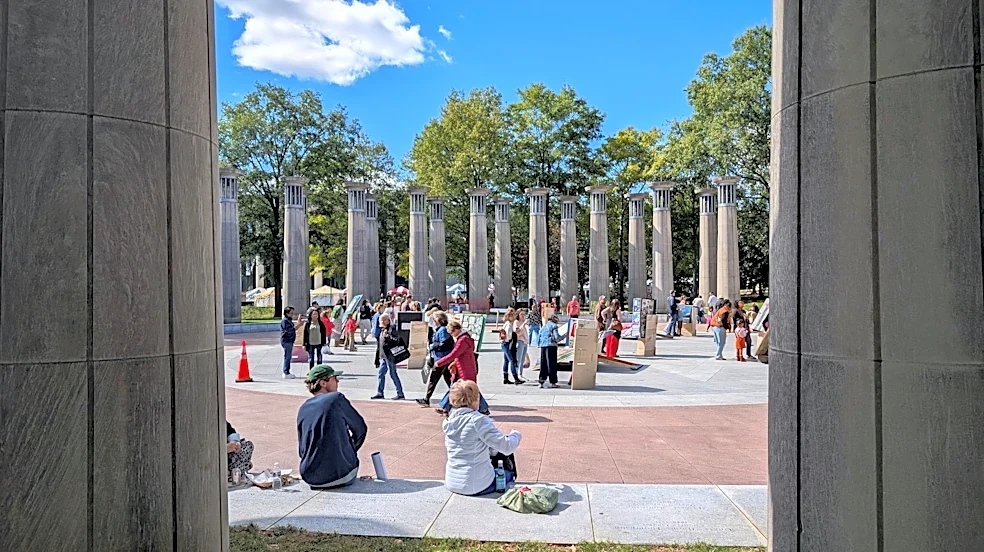
The event, held at Bicentennial Mall, the Tennessee State Museum, and the Tennessee State Library and Archives marked a triumphant second yearafter the hugely popular festival faced potential closure in 2025 due to federal funding cuts.
“The big idea is: let’s just gather people to tell stories and narratives and share the love of the written word,” said Tim Henderson, executive director of Humanities Tennessee, the nonprofit body that manages the festival. “There’s a great literary life in Nashville, and in this part of the state and the South. Nashville is something really
special.”
Under the sparkling autumn sun — and perfect crisp temperatures for the region’s coziest book-lovers — crowds swirled through the festival’s rows of vendor tents, games, artisans, book stacks and author panels.

Among the major names at the festival were local author and national bestseller Anne Patchett, bestseller Kathryn Stockett, recently out with "Calamity Club" nearly 17 years after her smash debut “The Help,” and former Tennessee Gov. and U.S. Sen. Lamar Alexander, whose 10th title is the newly published memoir "The Education of a Senator: From JFK to Trump.”
The timing of the event rounds out weeks of literary appreciation in the Athens of the South, following National Literary Month, nationally recognized in September, and Banned Books Week, nationally recognized Oct. 4-10.
“Everyone feels represented here, but also challenged. It’s a great place to come together and share some humanity,” said Henderson. “I think there’s a connecting principle to that. I think when people try to ban or shut down certain narratives, it’s framed as protecting certain populations. There may be a good intent there, but what I think this serves to remind us is that challenging ourselves is not a negative thing.
“We grow stronger when we’re challenged,” he added. “When we read narratives that might not coincide with our own … that makes us deeper as human beings. It’s important to protect those stories and challenge ourselves. We cannot allow ourselves to be frightened by other people’s stories.”
Festival pays tribute to Dolly Parton's lasting impact on literacy
Inside the lobby of the Tennessee State Museum, a new display greeted festival attendees: three wooden butterflies, around 5 feet tall, framing lengths of rope upon which perched dozens of smaller paper butterflies.

The butterflies themselves were beautiful — in the quiet of the marble halls, you could almost imagine hearing them fluttering — but closer inspection revealed rows of messages for the late Dolly Parton, Tennessee icon, singer songwriter and humanitarian.
Parton passed away on Aug. 25, after a life characterized by her charitable endeavors and gifts, most notably her Imagination Library, which gave participating children younger than 5 years a free book in the mail each month with no strings attached.
The display invited attendees to write notes in honor of Parton on the wings of the creature she was so often depicted with.
“She was a big supporter of literacy and a storyteller herself,” Henderson said, while promising “not to tear up.”
Messages stretched the lobby. Some written in the handwriting of an adult, with thanks to Parton for her impact on their childhood, others written in the handwriting of children thanking Parton for the books they continue to receive.

“We’ll tie these letters together after the festival and string them across the lobby,” he said. “That is really just a small memorial and acknowledgment of the value Parton brought to storytelling.”
The Unbannable Library returns bigger than ever
In the center of the belled courtyard at the park, acting as a focal point of the entire festival sprawl, were 20 massive books. Each ranging from around 3 to 8 feet tall and crafted with firm spines and real, movable pages, the intricately painted books towered over festival attendees.
The books were part of Austin Peay State University Professor Paul Collins’ Unbannable Library, an art project in which artists around the world, from adults to high schoolers, create massive books with different passages or themes from commonly banned or restricted books, or books that speak to the importance of literary access and social issues.

“The books work because they show direct, lived experiences,” said Collins. “They’re real, true and diverse. And their scale makes them undeniable in a way. I think anybody who sees these knows that they stand for a defense of books.”
Collins said the giant artworks serve to make the idea of banning books tangible.
“They’re absurd! Their softness, their vibrancy, their colors are disarming. People laugh when they see these, knowing they can touch them and they’re real. … But I think when they’re in libraries they’re (easier to dismiss).”
Collins’ displays come just one week after National Banned Books Week, in which literary advocates across the nation vouch for accessibility to literature amid a rising trend of book bans and removals.
In 2025, Tennessee ranked as the third highest state in the nationfor the number of banned books in public school libraries. This ranking followed years of increasing legislative restrictions regarding book content in public school libraries.
In a newly released study, PEN America, a leading literary advocacy group, found nearly 12,000 books were banned in public schools across the nation during the 2025-2026 school year — the highest number ever recorded by the group.
The group sponsored a book in Collins’ library, with one page asking attendees to answer what “freedom of expression" meant to them.

“Banned Books Week is a nod to a really serious, persistent condition of intimidation,” Collins said. “So I think that these books are disarming and joyful. It’s not fixing the problem, but it’s a contributing factor of support for books in libraries.”
He turned and smiled toward the formation of giant books as their pages rustled in the wind, some taking on a life of their own as they flipped in front of delighted viewers.
“Someone once called this project a love letter to libraries, and I thought that was so beautiful, because its true,” he said.
Angele Latham’s role covering First Amendment issues at The Tennessean is made possible by a collaboration among Freedom Forum, Journalism Funding Partners and the USA TODAY Network. Freedom Forum does not provide editorial input. Reach Angele Latham at alatham@gannett.com, on X at @angele_latham and on TikTok at @angelelatham.
This article originally appeared on Nashville Tennessean: Southern Festival of Books returns, honors Parton