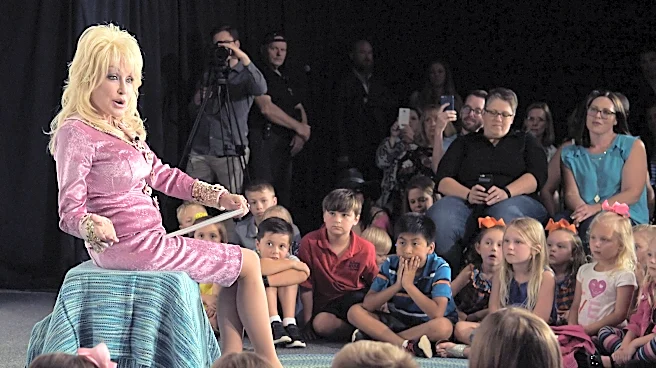





Sept. 25 was Dolly Day, a day to celebrate the life and legacy of a Tennessee icon whose impact reached far beyond music. But if we truly want to honor Dolly Parton, every day should be Dolly Day in every classroom.
Not with rhinestones, songs playing over the intercom or another proclamation or celebration. But with children reading.
With teachers having the support and resources they need to teach their students. With parents knowing the truth about whether their children are reading on grade level. And with schools refusing to allow children to move through the education system year after year without receiving the help they need.
For decades, Dolly put books directly into the hands of children through her Imagination Library. She understood
something simple and profound: Literacy can change the trajectory of a child’s life.
Dolly did her part. She made sure millions of children had books in their homes. Now those of us responsible for public education have to confront a harder question:
Can our children read them?

When progress isn't enough
That question is particularly urgent in Nashville. Despite small academic gains, roughly two-thirds of Nashville public-school students are still not proficient in English Language Arts. At the same time, MNPS is graduating more students than ever.
Sit with that for a moment. Nearly 7 in 10 students are not meeting the state’s proficiency standard in English Language Arts, while Nashville celebrates historic graduation rates.
Both things can be true. Our schools can make progress... and far too many children can still be struggling.
We can acknowledge improvement without pretending that improvement is enough. And we can celebrate students earning diplomas while still asking whether those diplomas represent the level of academic preparation families believe they represent.
Growth cannot become the finish line when roughly two-thirds of our children still have not reached proficiency.

The crisis Nashville PROPEL saw coming
At Nashville PROPEL, we have been sounding this alarm for years.
In 2024, we launched a data-transparency campaign with a deliberately provocative message: Report Cards Lie.
Some people did not like it, but we were not calling teachers liars. We were pointing to something parents across Nashville were experiencing. A child could bring home A's, B's and passing grades while other academic data told a very different story about that child’s performance.
A parent sees a B and reasonably believes, “My child is doing fine.” But what happens when that same child is not proficient in reading? What happens when families do not learn how far behind their child is until another assessment arrives – or until years have passed and catching up becomes even harder?
We told you grades and proficiency were not always telling parents the same story. We told you parents cannot intervene in a literacy crisis they do not know exists. We told you transparency matters. And most important: We told you this because parents were telling us.

The fight for transparency
Parents were sitting at kitchen tables looking at report cards that said one thing while watching their children struggle with the work sitting right in front of them. Some asked questions. Some pushed harder. Some were dismissed, blamed or labeled difficult. Some were even called “crazy.”
But they weren’t crazy. They were paying attention.
So we organized. We collected parent stories. We demanded greater transparency about children’s actual reading performance. That parent-led movement helped build momentum for Tennessee’s 2025 report-card redesign law, requiring additional reading information to be provided to families in grades K–8.
We did not fight for that law because we wanted another number printed on a piece of paper. We fought for it because parents deserve the truth. That is the heart of the hidden literacy crisis campaign: making visible what families were already seeing but official grades often failed to show.
The crisis was hidden not because children’s struggles were invisible, but because the information families received did not always make those struggles clear. A child could be promoted, pass classes and eventually graduate while still lacking the reading skills necessary for college, career or full participation in civic life.
The report-card redesign was a necessary response to that failure of transparency. But a redesigned report card matters only if it gives families information they can understand and use – and only if schools respond when that information shows a child is behind.
Today, that fight feels even more urgent.

Can parents trust report cards?
Nashville is confronting serious allegations involving grade changesand credit recovery within MNPS. Those allegations deserve a fair investigation, and the facts should determine what happens next. But the larger issue did not begin with today’s controversy. We were asking the question before the headlines. And now we have to ask it again:
Can parents trust report cards?
That question is at the heart of our Report Cards Lie campaign and the demand for a report-card redesign. Not because every report card is false, and not because teachers are lying. But because a report card can tell a parent a child is passing without clearly telling that parent whether the child is proficient.
And when roughly two-thirds of our students are still not proficient in English Language Arts, that distinction is too important to ignore.
A grade should mean something. A report card should mean something. A diploma should mean something.
We can change a grade. We can promote a student. We can increase a graduation rate. But we cannot change what a child actually knows by changing the number on a piece of paper.
And we certainly cannot grade-change our way out of a literacy crisis.

'It's time to listen'
A report-card redesign must do more than add data. It must restore trust by connecting classroom grades to clear information about reading performance, grade-level expectations and the support a child needs next.
Parents should not have to decode multiple systems to understand whether their child can read. They should not have to wait for a state test, a middle school transition or a high school failure to discover that a problem has existed for years. They should not have to choose between believing the report card and believing their own eyes.
This is why “We told you,” cannot simply mean, “We were right.”
It has to mean: "It's time to listen."
Listen to parents before another child loses another year. Listen when a family says the grades do not match what they are seeing at home. Listen when literacy data tell us that roughly two-thirds of our students still have not reached proficiency. Listen when parents demand a report card that tells the truth clearly, consistently and early enough to make a difference.
MNPS has said it wants "every student known." I believe in that vision, but every student cannot be known if every parent is not heard.
Parents are not the enemy. They are not problems to be managed when they ask uncomfortable questions. They are partners, and if we are serious about literacy, we need them.
Every day should be Dolly Day
Dolly Parton showed us what urgency around literacy looks like. She did not wait for children to fail before deciding they deserved access to books. She put books into their homes before many of them could even read their own names.
Imagine if we brought that same urgency into every classroom.
For Nashville PROPEL, our commitment is clear. We will keep demanding literacy transparency. We will keep helping families understand what academic data actually mean. We will keep pressing for report cards that give parents a complete and accurate picture of their children’s reading performance. We will keep asking uncomfortable questions when grades, proficiency and graduation rates do not seem to tell the same story.
And we will keep organizing parents until every family has the information, choices and access necessary to help their children succeed.
Sept. 25 may be called Dolly Day, but Dolly’s commitment to literacy was never limited to one day. Ours cannot be either. The greatest tribute Tennessee can give Dolly Parton is not simply remembering what she did. It is continuing what she started.
Dolly gave our children the books. Now let’s make every day Dolly Day by making sure they can read them.
Sonya Thomas is Executive Director, Nashville PROPEL.
This article originally appeared on Nashville Tennessean: How we can make every day Dolly Parton Day for MNPS kids | Opinion