



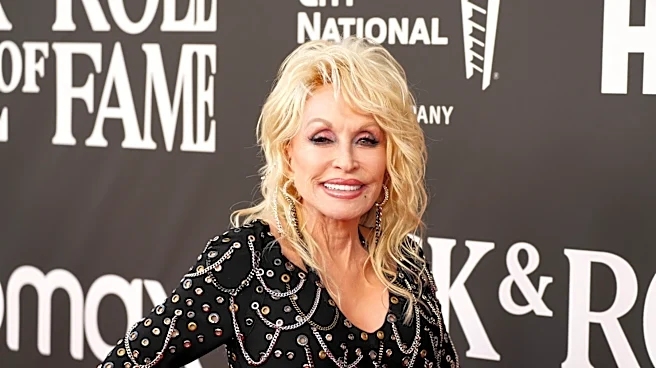
Nearly 60 years before Dolly Parton was laid to rest beside her husband in a Nashville mausoleum, she wrote a song about a little girl who begged her parents never to bury her underground.
The song was “Jeannie’s Afraid of the Dark,” recorded with Porter Wagoner in 1968. Jeannie fears darkness so deeply that even a family visit to a cemetery becomes terrifying. She asks her parents not to bury her when she dies. In the song’s final image, after the child’s death, they place an eternal flame at her grave so that darkness will never completely surround her.
The song feels different now.

The fear behind the song
Dolly herself spoke openly about a profound fear of the dark. She recalled frightening childhood experiences, including being shut inside a dark coat closet by other
children. That incident is associated with the bullying she later wrote about in “Coat of Many Colors,” not necessarily with “Jeannie’s Afraid of the Dark.”
What matters here is simpler: Dolly personally understood the fear of darkness that gives “Jeannie” its emotional force.
Now, after her death, Dolly will rest above ground in a mausoleum at Woodlawn Memorial Park in Nashville, beside Carl Dean.
A life sometimes creates its own poetry.
My connection to Dolly's world
That idea resonates with me partly because my own connection to Dolly reaches back into the same southern Appalachian world that shaped so much of her imagination. Dolly and I were fifth cousins. My great-grandfather, Benjamin Hyde, was born in Cherokee, North Carolina, in the mountains just across the state line from East Tennessee. Years later, I met and interviewed Dolly at Dollywood. When I founded a nonprofit organization serving travelers with disabilities, Dolly made its first donation.
Those experiences made it difficult for me to think of Dolly simply as a celebrity. She seemed to belong to an older Appalachian tradition in which storytelling could be sentimental without embarrassment, humorous without cruelty, and deeply serious without becoming solemn.

Dolly, death and memory in Appalachian music
Death has always lived close to the surface in Appalachian music. Graves, heaven, mothers, children, separation and reunion appear alongside kitchens, porches, mountains and homecomings. Mortality is not treated as an abstraction. It is part of family life.
Dolly inherited that tradition, but she had an extraordinary gift for personalizing it. She could take something as intimate as a frightened child’s fear of darkness and turn it into a story understood far beyond the mountains where she grew up.
That is why “Jeannie’s Afraid of the Dark” carries a different weight today.
Answering darkness with light
The parents in the song cannot reason their daughter out of being afraid. They cannot promise that death will never come. Instead, they answer darkness with light. They leave a flame burning.
There is something fitting in that image now.
Dolly spent a lifetime making brightness out of things that might otherwise have remained dark: poverty, loneliness, ridicule, grief and fear. She transformed them into songs, stories, laughter and acts of generosity that millions of people could carry with them.
No, an old song did not determine Dolly Parton’s final resting place, and we should not pretend that it did.
But we can recognize the symmetry.
A woman who once wrote so tenderly about the fear of being left underground in darkness will not be left beneath it.
For Dolly Parton, somehow, that feels right.

Anton Anderssen is a journalist, anthropologist and former concert pianist whose work has appeared in CBS Detroit and other publications. He is a fifth cousin of Dolly Parton and interviewed her at Dollywood.
This article originally appeared on Nashville Tennessean: Dolly's 'Jeannie's Afraid of the Dark' feels different now | Opinion