







Cell phone jail is a real thing now for Tennessee schools.
But the second year of implementing a state law that prohibits students from using wireless communication during instructional time hasn't been so bad. At least some say.
Some schools, including Mt. Juliet High School, have found creative ways to meet the law requiring students to put away cell phones and other wireless communication devices during class time.
However, the legislation that went into effect before the 2025-26 academic year does afford individual school districts enforcement flexibility, which can vary significantly.

Mt. Juliet High follows Wilson County Schools district policy that does let students bring cell phones and wireless devices to school with the requirement that they
must be stored or out of direct possession during instructional time.
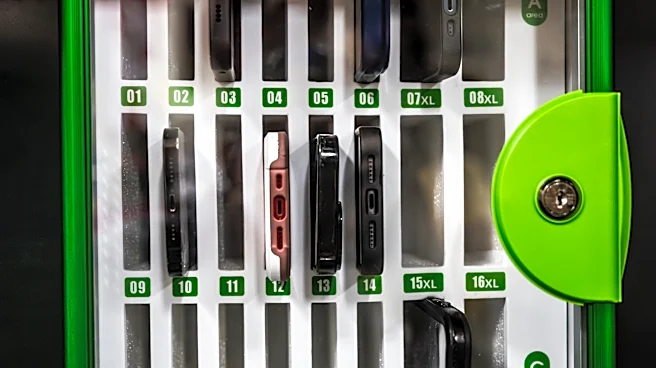
The school has storage pouches or other containers set up in classrooms for students to drop off their phones before class and pick them up afterward.
Like the box in teacher Dominique Crawford's criminal justice class that is named Cell Phone Jail, a moniker given by students mostly because it is divided into sections that make it look like a mini jail.
“I honestly think it’s good because I feel like phones are very distracting and if I have my phone, I’m more likely to pick that up than … do my work,” Mt. Juliet High senior Kara Hall said of the law.
Maybe somewhat surprisingly, many students at Mt. Juliet High don't seem to have a real issue with a cell phone-less pocket and hand.
Mt. Juliet senior Casey Sherman believes her grades have improved because phones have been removed as a distraction during class.
“I asked (students) last year a lot, ‘what do you all think?’” Mt. Juliet Principal Ryan Hill said. “And the biggest response was ‘I don’t feel distracted, I’m not checking my pocket or worried about what’s going on in another class because my friends don’t have their phones on either'."

The Putnam County School System has seen a reduction in bullying incidents that Communications and Marketing Supervisor Buddy Pearson credits to the cell phone prohibition.
And Hill believes the classroom cell phone ban is having a positive effect on a lost art among many teens — face-to-face communication.
It isn't perfect.
Some students work to sneak in phones or burners. But Executive Director of Professional Educators of Tennessee JC Bowman said teacher feedback on the law has been positive overall.
"Most teachers largely back the new cell phone policies, seeing them as helpful for instruction and noting a significant drop in discipline issues," Bowman said "However, some advocate for a complete ban, citing bullying concerns."
Many districts have adopted certain exceptions to the classroom cell phone ban that include emergencies, teacher authorization related to classroom education and health management reasons.
Here is a look at the different ways Nashville and surrounding suburban districts apply the cell phone law in classrooms.
Metro Nashville Public Schools
Grades 6-12: Students may possess a cellular telephone or other personal technology on school property and may use such devices during lunch and transition times. Teachers are encouraged to integrate technology into instruction when appropriate, according to district policy.
Grades K-5: Students can possess a cell phone and other personal technology on school grounds. Use is permitted only at the discretion of the building administrator in accordance with district policy.
Wilson County Schools
Wilson County students can bring cell phones and wireless devices to school buildings, but they must be stored or out of direct possession during instructional time.
Students can use their phones during non-instructional times such as lunch or class changes.
A backpack, purse or locker are acceptable ways to store a phone or device.
Mt. Juliet High School has students store wireless communication devices in a designated area such as a phone pouch on a classroom wall or another area.
Sumner County Schools
Students may possess personal communication and electronic devices on school property, but they must be powered off and kept in a backpack, purse or similar personal carry-all and may not be used during school hours.
The teacher or administrator may grant a student permission to use a personal communication for educational purposes within a classroom setting under teacher supervision and incorporated into a lesson plan with principal approval.
Rutherford County Schools
Students can possess wireless communication devices, but they must be stored, put away and not in use for the entirety of the school day.
Cheatham County Schools
Grades K-8: Students may possess wireless communication devices as long as they are turned off and stored all school day.
Grades 9-12: Students may possess wireless communication devices so long as such devices are turned off and stored during instructional time. During breaks throughout the school day, students may use wireless communication devices.
Robertson County Schools
Students in grades 3-12 can bring wireless communication devices to school, but they must be turned off and stored during instructional time.
Williamson County Schools
Students in grades K-12 are allowed to have cell phones and wireless communication devices, but they must be securely stored away during the school day.
Any visible device during school hours may be confiscated.
High school students may access their devices during their assigned lunch period. They are not to access their devices during class changes.

Putnam County Schools
Students are banned from possessing any type of phone or personal communication device at any time during the regular school day unless stored in a school-approved plastic case in their backpack or locker.
Students who wish to carry a cell phone with them to and from school can keep the device in the student’s vehicle or another school-approved location.
“The students are much more engaged and (we’ve) had fewer bullying incidents,” district Communications and Marketing Supervisor Buddy Pearson said.
Clarksville-Montgomery County School System
Students are expected to turn phones and electronic devices off or put them on silent mode and be out of sight during the entire instructional day.
This article originally appeared on Nashville Tennessean: Better not hear me now. How Tennessee schools enforce cell phone bans