








While navigating an account of a distressing period of Mark Twain’s life, page 606 of the universally acclaimed author Ron Chernow’s 2025 biography “Mark Twain,” I finally felt my reader’s depression vanish. The next few pages related an experience Twain and his family had with Fisk University’s Jubilee Singers.
Samuel Clemens, Twain's real name, and his family were in Europe recovering from the embarrassment of bankruptcy while coping with the famous humorist's illnesses and even more serious health challenges within his family. In 1897, they chose to spend the summer in Weggis, a small town on Switzerland's Lake Lucerne, when the Nashville-based choristers provided a welcome diversion.

When six Fisk Jubilee Singers silenced a Swiss beer hall
Reading about that moment led to an unexpected series of
events that deeply impacted my life. But first, here’s how the captivating Chernow told Twain’s story:
“Amid these gloomy reflections there came a happy reminder of Black life in America when the Fisk Jubilee Singers performed in Weggis. The a cappella group was touring to raise money for Fisk University in Nashville, and Twain again responded to their songs of joy and lamentation, which had sometimes contained coded messages for the enslaved. As early as 1873, Twain had written a publicity blurb honoring the Jubilee Singers as authentic voices of the Black experience and scoffed at comparisons with fake minstrel shows: “I think these gentlemen & ladies make eloquent music . . . they reproduce the true melody of the plantations, and are the only persons I ever heard accomplish this on the public platform. The so-called ‘negro minstrels’ simply mis-represent the thing; I do not think they ever saw a plantation or ever heard a slave sing.
When the Jubilee Singers performed in Weggis at a local beer hall that August, Twain’s love for the group and its music flamed anew. At first, he observed, The German and Swiss patrons chattered over their beer mugs and seemed indifferent to the sextet preparing at the far end of the room. “The Singers got up and stood—the talking & glass-jingling went on. Then rose & swelled out of above those common earthly sounds, one of those rich chords the secret of whose make only the Jubilees possess, & a spell fell upon that house. It was fine to see the faces light up with the pleased wonder & surprise of it.” For Twain, “their music made all other vocal music cheap.” In the end, he bestowed on this music his highest encomium as “the perfectist flower of the ages.” Stirred to his core, Twain said that the singing was “utterly beautiful . . . and it moves me infinitely more than any other music can.”
The next day in his notebook he wrote that the six singers were, quote, ”diviner even, than in the early days, 26 years ago. They came up to the house this morning and sang to us. They are as fine people as I am acquainted with in any country.” Their private performance for Twain expressed the depth of their affection for him. He had a chance to get acquainted with the six singers – three born into slavery, the other three children of the enslaved – and them as endearing as their music. “How charming they were – in spirit, manner, language, pronunciation, enunciation, grammar, phrasing, matter, carriage, clothes – in every detail that goes to make the real lady and gentlemen, and welcome guests.”
The journey that saved a university and earned Nashville its nickname
Filled with awe after reading Chernow’s exhaustive 1200-page Twain tome, I visited Fisk’s website. Much to my surprise, I learned that the Jubilee Day Convocation was set for five days later, on Monday, Oct. 6, 2025.
Fisk’s annual celebration of that date marks the day in 1871 when the original Jubilee Singers began their uncharted journey to raise money to keep the five-year-old institution alive. The students’ tour featuring a cappella renditions of songs of slavery and hope began slowly, but as their story and beautiful sounds began to resonate, and, in today’s language, go viral, they traveled to perform in England and Europe.
One of the most important performances was at a royal palace in London for Queen Victoria.
Following that performance, tears in her eyes, the matriarch was quoted as saying that the singers “must be from a music city.”
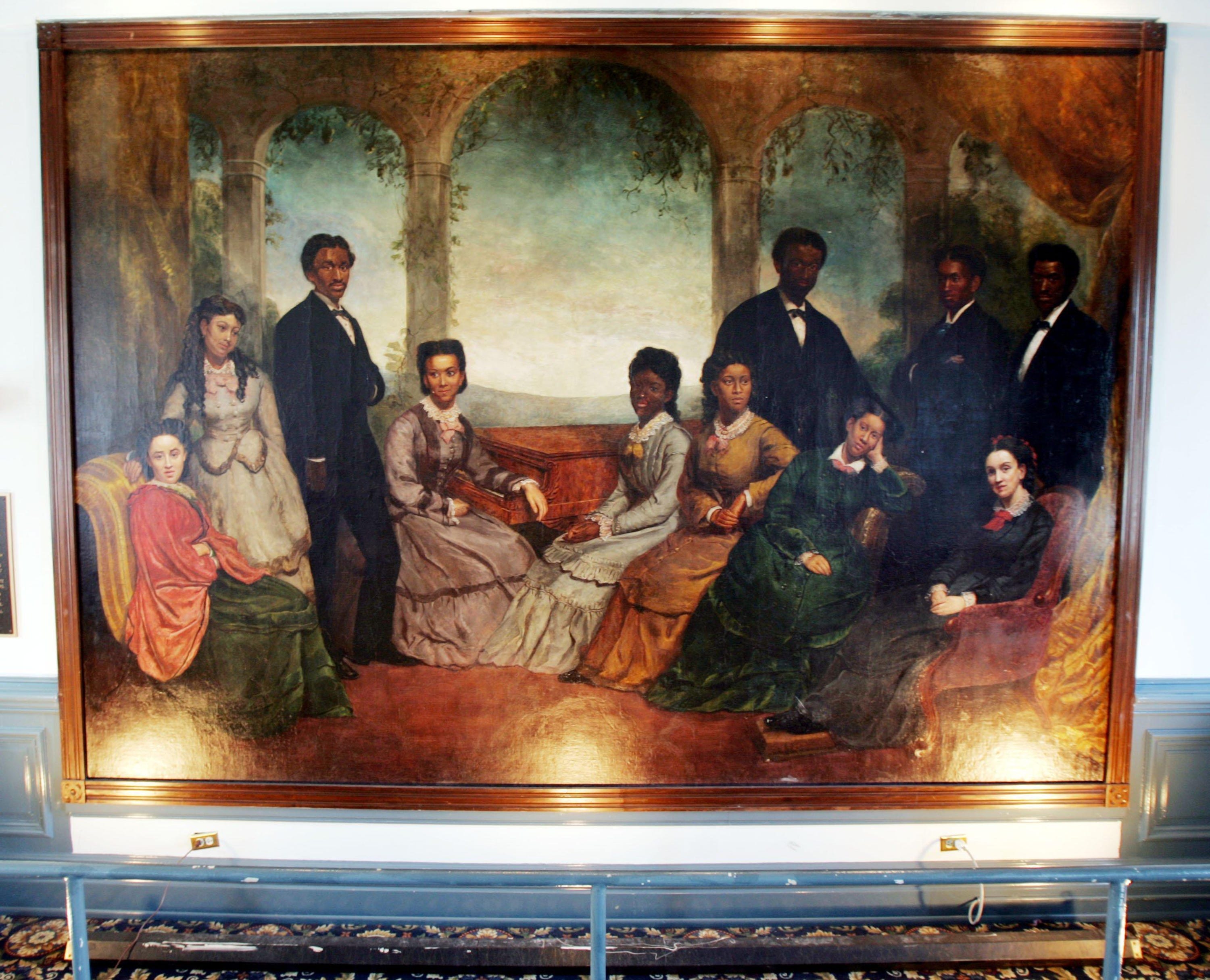
The Queen then commissioned Royal Court artist Edmund Havel to capture the talented group on canvas.
Havel’s massive, life-sized portrait was presented to Fisk, and is prominently displayed in the historic Jubilee Hall, which was the first new building on the campus. Constructed in 1896 with funds raised by the traveling vocalists, Jubilee Hall was designated a National Historic Landmark in 1974.

At Fisk, a neutral observer gets swept away
I knew the story, I thought, and was in touch with Adrian Taylor Latham, executive director of Fisk’s General Alumni Association, who also presided over the convocation’s program. I wanted to attend in 2025, and with her help, I would also hitch a ride in the cavalcade to the Pilgrimage ceremonies. There were two Nashville cemeteries to visit where four of the original singers are buried.
Let me summarize my experience by saying I was attending as a neutral observer. But following the services in the Fisk Memorial Chapel, and the joyous, heartfelt services at the cemeteries, I felt I had been swept up in an ocean swell of competing, yet confluent, emotions generated by that small, private HBCU in North Nashville.
As I cautiously approached the chapel entrance, I was greeted with a friendly smile from the effervescent Fisk President, Agenia Walker Clark, whom I knew.
After securing a seat in the standing-room-only chapel, I glanced at the lengthy program, and thought, “Oh Lord, how long is this going to take?”
Ninety minutes later, I wished we’d had more time!
Among the experiences was the Jubilee Day speaker, Dr. Shirley Jordan Bailey, Class of 1958, who had a remarkable career with national impact through her dentistry and as a renowned author and public speaker. She was the first in her California-based family to attend Fisk. She had been introduced by her younger sister, Carolyn Jordan Booker, ‘61, a retired IBM executive, past chair of the Fisk General Alumni Association, and mother of the formidable U.S. Sen. Cory Booker of New Jersey.
The stories the sisters shared about each other and their sincere appreciation of beginning their adulthood at Fisk were incredibly moving.
And, moving would be the word I would use to describe the entire program, which concluded with the current Jubilee Singers, directed by G. Preston Wilson, Jr., singing two moving (that word again) spirituals. During their performance, the silence engulfing the audience brought to mind Twain’s descriptions of those attention-demanding renditions.
Why Fisk remains a lifelong calling
Following the chapel ceremonies, I was assigned to my cemetery cavalcade "chauffeur" Willie Moody, Class of 1984. The CEO of a major New Jersey counseling center, Moody is the chairman-elect of the Fisk General Alumni Association.
He also spoke at one of the four brief (and moving) ceremonies, called “The Pilgrimage,” held in the Nashville City Cemetery and Greenwood Cemetery.
As we were returning to the Fisk campus, I discussed with Moody his journey to Fisk from New Jersey. One of his high school teachers was a Fisk alumnus, and he and his family decided, sight unseen and unable to afford an advance visit, that Moody would head to Nashville.
I asked if, after arriving for his first look and experience at Fisk, had he ever had that “Oh no, what have I done?” moment.
Without hesitation, he replied: “Never. I fell in love with Fisk that first day, and I still love it 45 years later.”
Willie, even Mark Twain couldn’t have expressed it more eloquently.
Fisk University will celebrate Jubilee Day at 10 a.m. Tuesday, Oct. 6, in Fisk Memorial Chapel. Alumnus and scholar Dr. Ernest Gibson III, Class of 2005, will deliver the keynote address honoring the legacy of the Fisk Jubilee Singers.

Bo Roberts is a Nashville-based marketing consultant, frequent op-ed columnist, and author of two books, “Forever Young” and “Flaming Moderate,” and finishing up three additional books.
This article originally appeared on Nashville Tennessean: Mark Twain was right about the Fisk Jubilee Singers | Opinion