






She had an elevator in her house.
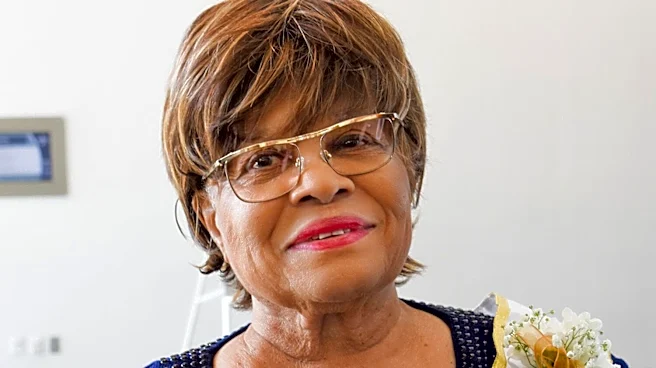
The white brick ranch that belonged to Rosetta Miller-Perry, tucked away on a quiet Haynes Area street in northwest Nashville, is typically charming, but extraordinary if you knew that particular detail. When you enter through those thick brown doors a clearer picture of the late Tennessee Tribune publisher emerges.
Most of the world knew Miller-Perry as a businesswoman, civic leader and pillar of Black Nashville. If you were fortunate enough to attend one of her soirees, then you’d understand who she truly was. Like that house, her life possessed a grandeur not so easily observable from a distance.
The estate sale at her home on a recent September weekend gave you a glimpse into that life. And what you would’ve
immediately learned was this: She loved to throw parties.
“She did a lot of entertaining,” said her daughter Wanda Miller-Benson, who sat in a chair as visitors milled about picking through her mother’s things. “If it was Green Day,” Wanda said, “She'd have a party. It didn't matter.”
As light poured in from the large picture window, Wanda told stories about her mother, who died last June. They added context to the items displayed on tables, walls and in crates in the living room, dining room and in the home’s six bedrooms and furnished basement. The fine china, silverware, bar furniture, wine fridges and record collection speak of Miller-Perry the entertainer; the art, stuffed animals, jewelry, handbags and books, of the traveler and scholar.
They’re keepsakes of an influential figure who held court with the city’s biggest power brokers, and they went out of their way to curry her favor.

More than the publisher Nashville knew
On the weekend of Sept. 11 through 13, anyone who showed up to her home had a chance to leave with a piece of her.
“I've been explaining to people as they enter the home to know whose estate they're in and what they're departing with,” Miller-Perry’s longtime friend Carmelitar Parham said.
Adjoined to that living room was the dining room, where Parham was stationed. As visitors entered, she told the history of her friend and the significance of the rows of china, flatware and drinkware that filled every table in that room. For those who purchased items, Parham reminded them that they were leaving with a treasured item.
“You can actually say you're drinking out of a cup, or you're using a fork that Rosetta Miller-Perry used every day, and nobody can say that about all items,” she said, with shards of anguish caught in her throat.

Miller-Perry was her standing 6 a.m. Saturday hair appointment. Parham said. She measured the years of knowing her by how long she had been married. For the record, she met Miller-Perry before her husband over 40 years ago.
And in that house, the memories that come to the fore for Parham are the meetings and dinners she had with Miller-Perry as members of the service organization Top Ladies of Distinction and of Les Gemmes Inc., the women’s civic organization.
“Lady Rosetta had such a heart that she can go to the mountaintop with individuals,” said Parham, “and then she can walk down Jefferson Street, just with the common everyday people,” Parham added, “Even though she's no longer here with us physically, we still hold her deep in our hearts, and she quietly speaks.”

A tour through her world
I never had the pleasure of meeting or even hearing Miller-Perry speak, but I was fortunate to learn of the things that mattered to her, thanks to Wanda, Parham and another beloved friend, Karen Johnson, the register of deeds for Nashville–Davidson County. Johnson stopped by the estate sale that same afternoon and gave me a tour of the furnished basement of Miller-Perry’s home.
A large wooden bar greets you after going down a spiral staircase. A ceramic decorative cat is perched above the bar, which is filled with more items for sale like wine glasses, vases and pink crystals. A figurine of a mustachioed man with a string instrument shares space atop the bar. To the right is a towering library filled with medical textbooks, historical fiction and crime thrillers. There’s even a piano tucked against the wall near the bookcase.
But Johnson pointed at the lamps hovering above the bar.
“Did you see the music notes on the top?” Music notes and an instrument were emblazoned on the inside of each lampshade.
Speaking of music, Johnny Mathis and Lou Rawls were Miller-Perry’s favorite singers. Yet her collection told of someone with an eclectic palette, who also favored the jazz-funk and soul of Herbie Hancock, Donald Byrd, Roy Ayers and The 5th Dimension. I even spotted a New Riders of the Purple Sage, country rock album among the collection.

Then there was the elevator
Johnson and I passed a guest bedroom with two life-sized Raggedy Ann-style dolls laid out on a made-up bed. Yet, as we wound our way through that basement I landed at the one thing I didn’t expect inside of a traditional ranch-style home: that elevator. On this day, it functioned as a closet, holding photos, art, a cardboard box, among other things. It has a button, and a standard door conceals it. There were photo displays of folks Miller-Perry knew affixed to walls of the elevator hallway, especially those invited to her home. And there were apparently many.
One time, an influential invitee heard that a political official had visited Miller-Perry and bent the knee. That person decided to do one better.
“He got on two knees to wish her a happy birthday,” Wanda said, pointing to an area on the floor toward the entrance of the house. “It was funny.”
Johnson added this about Miller-Perry's events: “It was a society deal, and anybody in leadership in the city wanted to be in her presence.”

The invitation everyone wanted
Miller-Perry was especially known for her New Year’s Eve and Super Bowl shindigs, which were catered. There were chefs and servers in their whites slicing meats at carving stations.
There were TVs all over the house for those Super Bowl parties, not because she liked football. But because she liked having folks over. “So you could go anywhere but the bathroom and look at the game,” Wanda remembered. “You didn't have to miss anything.”
And if you’ve never been to a Rosetta Miller-Perry party at her 4,681-square-foot palace, there’s more that you missed.
“The food, the dishes, the fine china, the ambiance, the environment, the laughter, the love, the joy,” said Johnson, who had known Miller-Perry since 1988.
“She stood in place of my late mother at my wedding.”

What remains after the party

Indeed. The estate sale was a hive of activity with friends, neighbors and strangers coming in and purchasing pieces of Miller-Perry’s legacy. Amid the jubilance over memories of Miller-Perry hung a cloud of melancholy of her loss, in that house and across Nashville. Everyone there, from family members and longtime friends, vowed to keep her legacy alive.
There appeared to be solace among the folks who knew her, who were fortunate enough to leave with a piece of Miller-Perry that weekend. My wife is included in that group. She purchased a pair of moissanite earrings.
"It's like having a small part of her legacy with me," she said.
But of all the items for sale, one stood out: a quote printed on a plaque that could easily apply to its former owner.
“There is only one success – to be able to spend your life in your own way.”

Tacuma R. Roeback is The Tennessean’s community engagement and opinion editor. Reach him at troeback@gannett.com or follow him onX,Bluesky orLinkedIn.
This article originally appeared on Nashville Tennessean: What Rosetta Miller-Perry's estate sale revealed about her life