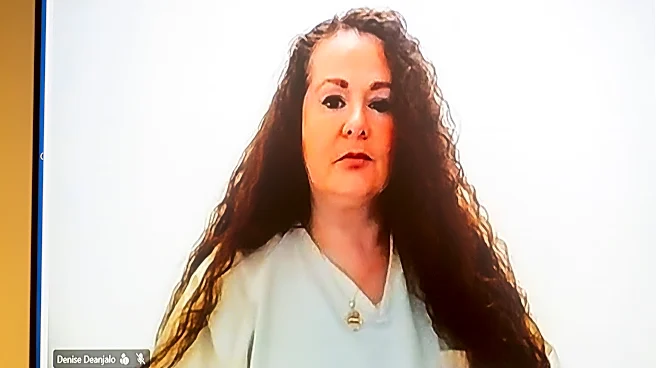







In recent days I have been corresponding with Christa Pike, who is scheduled to be killed by lethal injection on Sept. 30. To my knowledge, she will be the first woman executed in the state of Tennessee since 1848.
As I try to make sense of all I am learning, I find myself returning to Zora Neale Hurston’s Their Eyes Were Watching God. Coming to know Christa has brought me back to it, not because I see Christa in Janie, its protagonist, but because Hurston understood what happens when a woman’s life is narrated by everyone except the woman herself.

When others become the author of your story
The novel begins with Janie returning home after a long absence. Before she has spoken a word, the women on the porch are already constructing her story. Hurston writes simply: “They sat in judgment
…They made burning statements with questions and killing tools out of laughs … it was mass cruelty.”
Hurston doesn’t spend the rest of the novel proving Janie innocent of every judgment. Instead, she allows her life to unfold without making it tidy for the reader. The story remains Janie’s to tell. Hers is the voice we hear, and she gets to speak for herself.
A life is larger than its worst moment
Most of us think we know Christa Pike’s story. On Jan. 12, 1995, 18-year-old Christa participated in the brutal murder of 19-year-old Colleen Slemmer. That truth cannot be written out. But neither can Christa’s life be reduced to the worst thing she did.
Before the crime that would define her, Christa was a child living with abuse, trauma, neglect and instability. There are accounts of severe sexual abuse and rape. By adolescence, she had attempted to take her own life and run away from home. Social services encountered her. Public schools encountered her. The signs of deep distress were there. So were the adults.
Then she turned 18, and we became very interested in accountability. Why does our moral accounting of Christa’s life begin there? Childhood trauma does not erase adult responsibility. But accountability that travels in only one direction is not accountability at all. What responsibility belongs to the adults and institutions that encountered an endangered child but failed to protect her?
Christa was grievously harmed and grievously harmed another person. She was a child who needed protection and became a woman someone else needed protection from. Both are true. Once we know what she did, however, we are tempted to let the crime become our narrator.

Accountability travels in more than one direction
Christa’s story has been told for 30 years – by prosecutors, courts, journalists, advocates, opponents and now, admittedly, by me. Beneath those competing narratives is a woman I am only beginning to know. I am grateful she is allowing me to listen.
Near the end of the novel, Hurston offers a simple truth about the limits of knowing another person’s life. Janie says to her friend Pheoby, “you got tuh go there tuh know there.” Pheoby had done something the other women on the porch were unwilling to do: she listened. And listening changed her. Hurston does not erase the violence or grief Janie has experienced. She allows Janie to hold the whole of it. No part of her life must disappear for another part to remain true.
Before the final sentence
Before Tennessee writes the final sentence of Christa’s life, we ought to have the courage to read the pages that came before the most familiar one. The little girl. The teenager who needed help. What Christa did to Colleen. The woman who has spent three decades in prison.
None erases another. Justice should be strong enough to hold all of them at once.
Hurston leaves us with this: “She pulled in her horizon like a great fish-net. Pulled it from around the waist of the world and draped it over her shoulder. So much of life in its meshes! She called in her soul to come and see.”
That is what I am asking of us. Not to look away from what Christa did. To look longer. And before we decide to call Christa’s killing “justice,” let’s call in our own souls – and ask them to come and see.

Bethany Mann is the founder and CEO of Child Arise Tennessee, a nonprofit supporting children and families impacted by parental incarceration. Her work centers on the human consequences of incarceration and the relationships that endure around it. She has been visiting men on Tennessee’s death row for more than 15 years.
This article originally appeared on Nashville Tennessean: Before Tennessee executes Christa Pike, read the whole story | Opinion