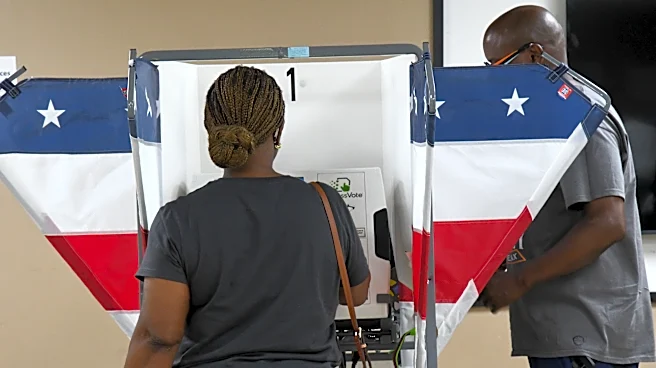




During this year's primary election cycle, Tennesseans will vote under a new congressional map after lawmakers approved and Gov. Bill Lee enacted the revised map into law on May 7 following a special legislative session.
Approved by Republican lawmakers in a 25 to 5 vote, the new congressional map extensively edited Tennessee's former map, splitting Memphis into three districts and the Nashville area into five. East Tennessee did experience revisions, but not to the same degree as Middle and West Tennessee.
The main flashpoint of the redistricting effort was the overhaul of Tennessee’s 9th Congressional District, which dissolved the state's only majority-Black congressional district and divided it into three.
The process of approving and ratifying
the map transpired quickly so that it could be used in this year's primary and midterm elections. Following the approval, the NAACP, ACLUand other groups filed lawsuits against the state over concerns of gerrymandering and the dilution of black voting power in Tennessee.
Here is how to find your district and voter precinct for the 2026 primary elections in Tennessee.
How to find your district in Tennessee?
After the passing of the new congressional map, Tennessee's Secretary of State Office updated its website with information on how to find and locate one's district. Beyond being able to access detailed maps, voters can go to the Secretary of State's website and look up their new district by putting in their address.
Tennessee residents can also visit house.gov and find their representative and district by searching for their zip code.
How to find your voter precinct?
The easiest way to find your voting precinct in Tennessee is through the Tennessee Secretary of State's voter information portal.
When you visit the portal, you must enter your first and last name, date of birth and then the system will show your voter registration status, your county, your election day polling location, your congressional district and most importantly, your precinct.
How do congressional maps work?
Congressional maps divide each state into districts, and the residents of those districts then elect members to the U.S. House. In Tennessee, there are nine districts. How many districts a state has is based on population counts from the U.S. Census.
According to GovFacts, redistricting usually happens every 10 years. Prior to the redrawing in May, the last time Tennessee redrew its congressional map was in January 2022.
The redrawing of a congressional maps can become controversial when officials revise maps to favor parties and incumbents, this is known as gerrymandering
Why did Tennessee redraw its map?
In May, Tennessee was not the only state to revise its congressional map and engage in a contentious "redistricting arms race," fueled by President Donald Trump and a Supreme Court ruling inLouisiana v. Callais that softened key provisions of the historic Voting Rights Act. Louisiana, Alabama, Florida, Missouri and Texas all enacted or pursued new maps.
Republican lawmakers in Tennessee rushed into the redrawing process in hopes of eliminating Tennessee's singular blue seat, which is currently held by U.S. Rep. Steve Cohen of District 9.
During the redrawing, Republicans cited various reasons for wanting to revise the map, but the ultimate motivation was to make Tennessee a totally red state.
"I urge our state legislature to reconvene to redistrict another Republican seat in Memphis. It's essential to cement @realDonaldTrump’s agenda and the Golden Age of America," wrote U.S. Sen. Marsha Blackburn in an X post following the SCOTUS ruling. "I've vowed to keep Tennessee a red state, and as Governor, I'll do everything I can to make this map a reality."
"Tennessee is a conservative state, and our congressional delegation should reflect that," Sen. John Stevens, R-Huntingdon told the Tennessean. "This bill ensures it does."
Peter Burditt covers trending news and service journalism for The Tennessean. Contact him at PBurditt@nashvill.gannett.com
This article originally appeared on Nashville Tennessean: Redistricting changed Tennessee voting maps. Here's where to vote