




As details of the Tennessee Department of Transportation’s multibillion-dollar choice lanes project crystallize, reality is starting to set in for some Nashvillians who own homes and businesses near Interstate 24: soon, they’ll likely be displaced.
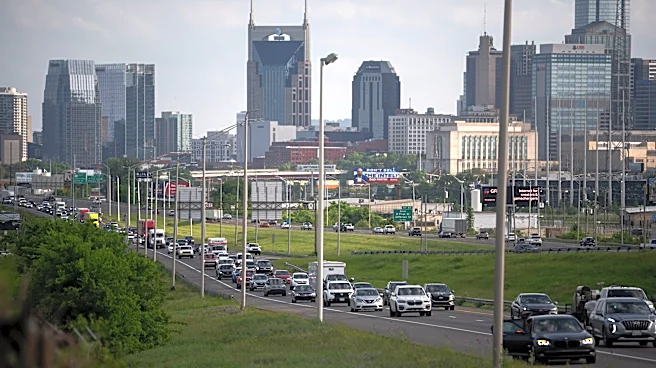
That’s at least what some South Nashville neighbors have learned over the past month or so. Letters from the state started hitting mailboxes in July, outlining that those property owners should expect to be affected by the project adding optional toll lanes along a 26-mile stretch of I-24 between Nashville and Murfreesboro.
TDOT hasn’t shared the full contents of those letters publicly or detailed exactly how many of them have been mailed, citing a desire to protect property owners’ privacy. Instead,
the agency says letters were sent to a “limited number of properties that are known to be impacted.”

District 16 Metro Nashville Council member Ginny Welsch, whose district includes the Glencliff and Woodbine neighborhoods located right off the interstate, said she has seen a copy of the letter mailed to one of her constituents, after she asked the state to share one with her directly but was turned down. But the crux of what she read was this: Regardless of what the plan ends up being, your house is in the path of this project, no matter what.
"We’ve been talking about these lanes, the state’s been talking about them, for several years,” Welsch said. “And it’s all theoretical. You see these designs and it’s all whatever. But then the day you actually get a letter that says, ‘Your home is going away,’ that is, no matter how much information you have earlier, that’s a gut punch.”
Where the choice lanes project stands today
Most recently, state officials made their pick for the private vendor who’ll build, operate and maintain the toll lanes for the next 50 years: DriveTN.
The vendor is actually a consortium of six companies including toll road operator Transurban, which operates I-495 Express Lanes on the Capitol Beltway around Washington, D.C., and Madrid, Spain-based global transportation infrastructure construction company Ferrovial.
Without that private partner, the project wouldn’t be possible in the first place. Department officials have said a traditional interstate-widening project on the same scale would cost $4 billion, nearly four times TDOT’s $1.3 billion annual work program budget.
DriveTN, on the other hand, will not only entirely shoulder the $9.2 billion it expects construction costs to total, but will also pony up $24.8 billion in concessions to the state over the 50-year partnership.
When state officials announced the vendor selection on Aug. 19, they said a timeline for the project is still being finalized. But once TDOT closes on the project by early- to mid-2027, construction will immediately follow. Construction will likely take at least eight years.

A shifting landscape
Even with a private partner finally on board, some project elements have yet to come into view.
According to a project FAQ document updated most recently on Aug. 21, for example, any property impacts shouldn’t be considered final for now. TDOT officials say they won’t be until all the necessary design, environmental and right-of-way reviews have been completed.
“TDOT is reviewing the design details and evaluating potential impacts, property by property and community by community,” TDOT Commissioner Will Reid said in a statement. “DriveTN’s proposal reduces impacts overall, but every remaining impact matters.”
Reid said TDOT will reach out to potentially affected property owners directly as sufficiently detailed information becomes available, contacts that will continue into next year.
Reid said the affected owners and occupants will be protected by the federal Uniform Relocation Assistance and Real Property Acquisition Policies Act in places where property acquisition is required. This, in part, ensures relocation assistance is provided to lessen the emotional and financial toll of displacement. No individual or family should be displaced unless decent, safe and sanitary housing is available within their financial means.
But public details beyond that appear like they’ll remain slim for now. TDOT says any additional information will remain confidential at this time, since the department’s still in the middle of an active procurement process.
If anything does change for the property owners who now find themselves directly affected by the project, it wouldn’t be the first time. Concept maps submitted earlier this year as part of the project’s process toward federal approval raised concerns among some property owners, including the anchor tenant of Antioch’s future “Chinatown” development, Pan-Asia Market.
The market had only just opened for business in early February when it was included in a “conceptual stage relocation plan” that showed a combined 51 businesses, single-family homes and multi-family residences along the interstate could be displaced in order to clear the right of way necessary for the project.
But they’re not at risk anymore, according to TDOT projects coordinator Brian Ledford. On Aug. 19, he said TDOT recommended DriveTN to be the project’s vendor in part because the group’s proposal had the best design and avoided disturbing surrounding areas. Their plans avoid not just Pan-Asia Market and the surrounding development, but also preserve Noble Place townhomes to the north in the Glencliff neighborhood. DriveTN's plans also eliminate the need to rebuild the Hickory Hollow Parkway bridge.
‘There’s an element of grief,’ council member says
That still leaves things a bit up in the air for the everyday folks on the other side of the equation, however, with a high cost looming for some residents in Welsch’s district.
Namely, Welsch said, that cost is community. Replacing a home is one thing. But replicating the community that residents formed around themselves, once they’ve laid down their roots, is a different challenge altogether.
“And there’s an element of grief, just losing your home through no choice of your own,” Welsch said. “Those types of things, you know, those are crises. That’s a crisis for somebody.”
For her part, Welsch called it a sad situation that’s “going to have a really negative impact on thousands of people’s lives.”
She’s not convinced about how helpful the project will be, either. Welsch said she was concerned about whether adding new lanes would actually draw even more interstate traffic, rather than mitigating it.
“I don’t believe that they are aware of what that impact is going to have on them, either, the ones who are going to benefit,” Welsch said. “I mean, seven years of construction on I-24? Think about what that does. Nightmare, you know? Nobody will be untouched by that. Every other side road, every other side street, every other interstate. Every action has a reaction, and it’s going to negatively impact just so much, and for no benefit, as far as I’m concerned. Except somebody’s going to potentially get very rich.”
Austin Hornbostel is the Metro reporter for The Tennessean. Have a question about local government you want an answer to? Reach him at ahornbostel@tennessean.com.
Get Davidson County news delivered to your inbox every Wednesday.
This article originally appeared on Nashville Tennessean: TDOT informs some Nashvillians road construction will force them to move