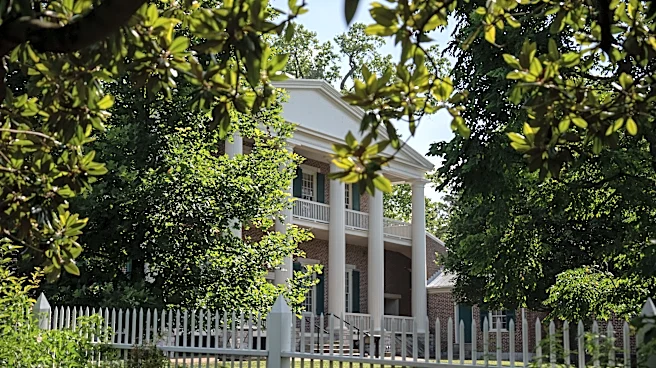


Visitors driving up to Andrew Jackson's Hermitage are greeted by a small and simple brick building, where they can buy tickets, meet their tour guide and learn a little about the life of the 7th U.S. president before seeing his home and personal belongings.
But that simple brick building, the historic site's welcome center and museum, will soon undergo a $132 million transformation.
The Andrew Jackson Foundation on Sept. 21 unveiled a transformational plan to build a new Visitor and Education Center and updated restroom facilities. The striking designs are the result of months of planning by a special committee, which included collaboration with renowned strategy and design firm Gallagher & Associates.
The plan was unanimously approved by the foundation's
board of trustees on the morning of Sept. 21.
“The new Visitor and Education Center will transport guests and raise the bar on the educational experience available at The Hermitage for generations to come,” said James Haltom, Regent of the Board of Trustees. “This vision allows us to tell a broader, fuller and more interconnected story of Jackson, the people who lived and worked at The Hermitage, and the rapidly changing nation in which they lived.”
The renovation project focuses on improving the arrival experience for visitors and creating a more relevant and comprehensive museum and education center, specifically to serve the approximately 18,000 school children who visit the site every year to learn about American history. The Hermitage's current "education center" is a tiny building that was originally used for ticket sales.
Designs for the new visitor's center show a sleek, modern building standing in striking contrast to the original mansion on the property. Architects took design inspiration from the natural landscape, aiming to create a quiet backdrop for the substance of the museum's interpretive displays.
"A central part of our mission is education," said Andrew Jackson Foundation President and CEO Jason Zajac. "We're a site of American history and Tennessee history."
While smaller in scale, another part of the renovation project involves updating a public restroom that serves visitors, burying some power lines and restoring an old barn that was built by the Works Progress Administration. The cost of that work, which is beginning immediately, will come out to about $5 million, Zajac said.
Zajac said funding for the primary $132 million project could come from a combination of private philanthropy and support from the state. Fundraising could take about two years.
Inside the plans to transform the Hermitage visitor experience
When Zajac took over as CEO of the Andrew Jackson Foundation in 2024, he started by taking inventory of the sections of the property that were not part of the historic footprint. That included the welcome center, which he said had outlived its usefulness.
He assigned a special committee to explore upgrades. That led to hiring Gallagher & Associates, a design firm that has helped with exhibits at the National Museum of African American Music, the International Spy Museum in Washington, D.C. and the National World War II Museum in New Orleans, Louisiana.
The strategy firm helped to shape the vision for what could become the interior exhibit space and educational components of the forthcoming welcome center. Next, the team solicited design pitches from multiple architecture groups through a Request for Qualifications process.
Designs submitted by North Carolina-based Perkins & Will became the clear favorite.
Zena Howard, principal at Perkins & Will, helped to guide the process. She previously served as the lead project manager on the National Museum of African American History and Culture, which was completed by the Smithsonian Institution in 2016. She is also known as an industry leader, advocating for more representation and visibility for Black female architects, who are relatively rare in the design world.
In the designs for the Hermitage, depicted in conceptual renderings, a sleek, glass-walled building is the first to greet visitors when they approach the historic property. That building would contain customer service desks and a small retail operation.
Then, visitors would move into the more educational portion of the welcome center, and begin learning about the life and legacy of Andrew Jackson in museum exhibits. The building makes the shape of a long, curved path leading visitors into the historic section of the presidential center, which will remain unchanged through construction.
Designing for Andrew Jackson, a complicated, pivotal figure in history
While designing for the future of the Hermitage, the foundation's leadership team kept some key considerations in mind.
"We believe it's appropriate that we remain centered on Andrew Jackson," Zajac said. "But what has started to really influence our thinking on the museum is, through Andrew Jackson, helping people understand that period in American history."
Included in that period, spanning Jackson's life both before, during and after his presidency, was the end of the American Revolutionary War, the War of 1812, the rise of the domestic slave trade in the U.S., Indian Removal and the major expansion of the territories of the U.S. More broadly, it represents the period of time between the revolution and the American Civil War.
"That period in between is actually incredibly formative for the America we inherit today," he said. "Not surprisingly, in that time, there was conflict. And we want to use that context of conflict in American society as part of the story we tell of that time to help people understand — some of the issues we still navigate as a country aren't entirely new. Who gets to participate? Who has he most influence? What's the role of wealth in politics?"
He said the museum will need to play a greater role in telling the stories of the people who were enslaved at the plantation, including by displaying artifacts that have been unearthed at the site. A new educational facility will provide a better environment for delicate artifacts to be preserved and displayed.
"With a site like this, we also want to make sure that we are telling the story of the people who actually lived and worked at this place," Zajac said.
Designers thought about the contradictions and complexities exhibited in Jackson's life.
Admirers of Jackson appreciate his commitment to unity for the nation, exemplified by his navigation through the Nullification Crisis, in addition to his accomplishments of paying off the national debt and expanding white male suffrage to non-elites. Historians also note his passage of the Indian Removal Act led to widespread suffering on the Trail of Tears. He owned hundreds of enslaved people and allowed for the suppression of abolitionist literature.
Confronting these contradictions, the Andrew Jackson Foundation believes, is necessary to understanding the president's complete legacy.
To that end, the design of the building that will house the new museum and visitor education center is not imposing or heroic. It's a quiet building that leans into the natural hill of the plantation. It takes full advantage of the landscape, welcoming visitors down a long corridor that leads back to the outside world, where a looping path awaits to take them to the site's historic centerpiece: Jackson's mansion.
Howard described it as a vision to move the site past being a one-liner.
"Our work is really grounded in understanding history and celebrating the nuances, the complexities of history, the contradictions, the controversies," she said. "And we can all understand how they have implications for where we are today."
She echoed the sentiments shared by Zajac, adding that she intends for the architecture to prompt people to think about our shared humanity, even in times of disagreement and polarization.
"Our democracy is still young, and it's still fragile. And we're still interrogating it, and we're still testing it," she said.

Molly Davis covers growth and development in Nashville and assists with special projects. You can email her with comments, questions and tips at mmdavis@tennessean.com.
This article originally appeared on Nashville Tennessean: Andrew Jackson's Hermitage unveils $132M push to transform visitor area