







As Tennessee enters its first full academic year after the death of conservative commentator Charlie Kirk, free speech norms for teachers and students are entering a new era — and educators are trying to find their footing.
Following Kirk’s shooting death, waves of individuals — largely professors at public universities — faced termination and other actions from employers after making negative comments about Kirk on personal social media accounts.
At least seven major lawsuits in Tennessee have resulted from such actions, forcing Tennessee to pay over $3.2 million in settlements and backpay — more than any state in the nation.
According to a recent survey by the Foundation
for Individual Rights and Expression, half of university students surveyed in the month following Kirk’s death said they were less comfortable attending or hosting controversial public events on their campus, and roughly one in five students said they are now less comfortable attending class.
But the trepidation is not limited to higher education. As Tennessee faces ongoing lawsuits stemming from these fired educators, and recently passed laws place new standards on educational speech,Tennessee grade-school educators are feeling the pressure with concerns of how to teach students civic discourse in an increasingly polarized world.
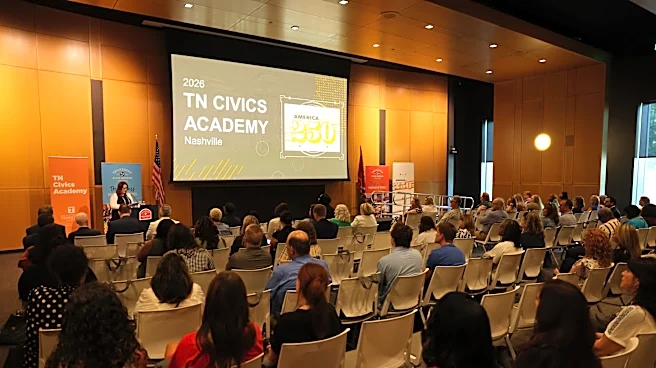
Joshua Dunn, the executive director of the University of Tennessee, Knoxville’s Institute of American Civics, is looking to provide that answer through a growing educational movement that offers civics education to K-12 teachers in Tennessee at no cost to the educator or school system.
While Tennessee children were on summer break, their teachers went back to class.

As an expert in constitutional law, Dunn said the TN Civics Academy helps teachers understand their rights as citizens and teachers. It also helps them teach these civic principles to students in an increasingly toxic political environment.
“I think one of the really healthy things about a proper understanding about rights in general, but in particular freedom of speech, is that when you do understand it, it breeds a sense of reciprocity,” Dunn said. “That your right to freedom of speech must entail the right to freedom of speech in others.”
This initiative, he said, began in 2023 and for three years was held in Knoxville. But the demand across the state kept growing.
“We had 49 participants the first year, 81 the second, and then 126 the third,” Dunn said.
The program received a federal grant in May, allowing it to expand statewide, reaching over 350 teachers so far this year in Nashville, Memphis and Knoxville.

Dunn said teachers are “hungry” for the support and community provided by the program.
“You can tell that teachers are struggling with how to address controversial issues in a way that's healthy and can model civil discourse for students,” he said. “They want to equip students so they're prepared when they go out into the broader world after high school and can engage with people in thoughtful ways.”
Logan Peterson, a teacher of 11 years, works at Bearden High School in Knoxville teaching social studies and government. He attended the first civic academy in 2023, and has been involved with the institute ever since.
He said the events always teach him something he can bring home to his students.
“In the first year, I distinctly remember Dr. Dunn's lecture on the First Amendment, and he connected it to student speech rights at school,” Peterson said. “It was so informative that we actually invited him out to give the same lecture to our AP students that year. Both times that I have gone to the institute with teachers from my own school, we would leave at least one of the lectures saying, ‘Oh my gosh, we could use this in class.’”
Dunn said his First Amendment lectures cut through the noise that often surrounds educators’ and students’ speech rights.
“It just goes a long way towards cutting through some of the misunderstandings that students can sometimes come to class with, and frankly, sometimes even teachers are subjected to,” he said.
Dunn said teachers have expressed growing concerns about addressing controversial issues in classrooms.
“(Teachers) are always worried about contemporary political issues, and the really controversial ones, taking over the classroom,” he said. ”They want to be able to use controversial contemporary issues, but they also recognize that often the emotions surrounding them are pretty heated…Teachers feel that they wouldn't be serving their students properly if they didn't use some of these things to help improve students' knowledge of how our system functions.”

Peterson said that the academy gives teacher vital space to learn about civics issues and freely discuss the growing intensity of political topics.
“I think part of our issue with civics education in the country overall is that we've forgotten how to do it,” Peterson said. “And you can't learn how to be a citizen in a democracy if somebody doesn't teach it to you…so we have to teach young people what it means to be a meaningful citizen in a democracy like ours. And I feel like this gives teachers a really good place to practice that.”
The USA TODAY Network - The South region's coverage of First Amendment issues is funded through a collaboration between the Freedom Forum and Journalism Funding Partners.
Have a story to tell? Reach Angele Latham by email at alatham@gannett.com, or follow her on X at @angele_latham
This article originally appeared on Nashville Tennessean: How fear of controversy is reshaping Nashville's classroom discussions