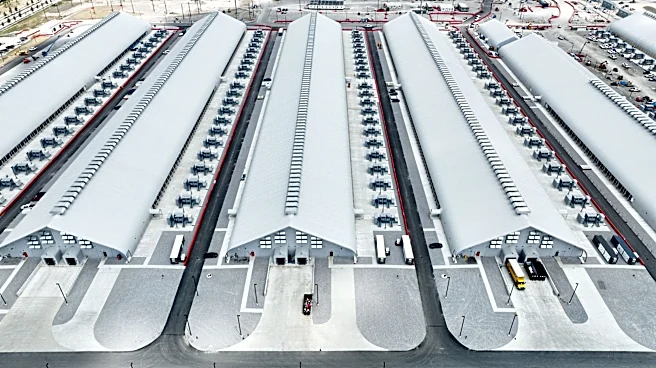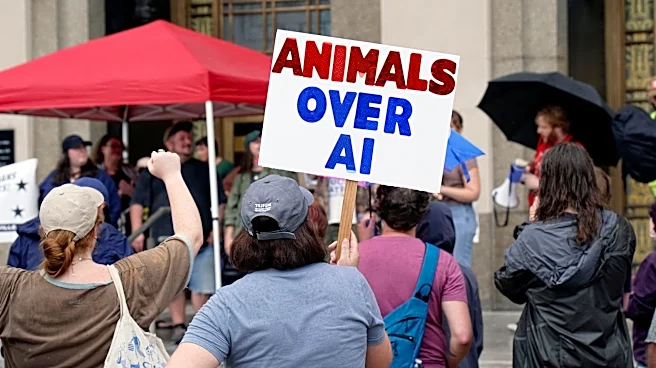

Data centers are emerging as a major political flashpoint in Tennessee, drawing bipartisan scrutiny as the artificial intelligence industry pours money and lobbyists into the state.
Kent Syler, a Middle
Tennessee State University political science professor and longtime Tennessee political strategist, said data centers have gone from a relatively obscure economic development issue to one of the country's most prominent political debates.
"The data center debate, it more or less came out of nowhere in political terms," Syler said. "It was here in an instant."
As Tennessee voters decide the governor's race and congressional contests Nov. 3, the data center debate is crossing party lines nationwide and could carry into the 2028 presidential campaign.
Unlike many political fights carefully cultivated by parties, Syler said the backlash largely began in communities grappling with proposed developments and questions about electricity and water use, and environmental impacts.
"This one was organic," Syler said. "This one came from the people."
Now candidates are being forced to take sides.
Campaign ammunition
The debate has already landed in one of Tennessee's closely watched congressional races.
Three Star PAC, a Democratic-aligned political action committee, launched an independent ad in September attacking Republican state Sen. Brent Taylor, who is running against Democratic state Rep. Justin Pearson in Tennessee's 9th Congressional District.
The ad accuses Taylor of accepting campaign contributions from artificial intelligence interests while supporting legislation affecting how utilities serve data centers.
Taylor has pushed back, saying his legislation protects utility customers from data center infrastructure costs, according to the Tennessee Lookout. The bill also allows data centers to build their own power generation, drawing criticism from environmental groups.
Pearson, meanwhile, has been an outspoken critic of data center development, particularly xAI's massive computing operations in Memphis and Mississippi and their environmental impacts on surrounding communities.
The debate has also surfaced in the governor's race.
Independent candidate David Hatley launched a statewide television ad in August attacking data centers as part of his campaign against Republican Sen. Marsha Blackburn and Democrat Jerri Green.
Blackburn has sought to balance support for artificial intelligence's economic potential with calls for greater local control.
"We must be intentional about how we regulate data center development," Blackburn said in a Sept. 30 statement to The Tennessean. "As with any emerging technology, we need to balance staying at the forefront of innovation with responsible growth, and the growth of data centers should always serve the interests of Tennesseans first and foremost."

Blackburn said local communities should determine whether and where data centers are built while arguing the U.S. must remain competitive with China in artificial intelligence.
"However, we must ensure that AI is being developed responsibly and that its costs do not fall on American families," Blackburn said.
Green in a statement said she has called for an immediate pause on new data centers to assess their impact on the environment and community.
"Tennessee’s growth should be driven by the needs of working families, not the short-term profit margins of big tech corporations and out-of-state developers," she said.

AI money flows into governor's race
As candidates debate, AI companies and their employees are pouring money into Tennessee politics.
A Tennessean review of 2026 campaign finance records found employees and executives affiliated with AI companies and organizations contributed at least $131,000 to Blackburn's gubernatorial campaign. No comparable AI-linked contributions were found in Green's campaign records.
Anthropic employees accounted for $58,300 of that total, while Oracle employees contributed nearly $42,000.
The money is not limited to individual employees. Anthropic itself contributed $250,000 in July to Tennessee Freedom Fund, a political action committee supporting Blackburn, tying for the PAC's third-largest contribution during the pre-primary reporting period.
AI industry expands lobbying presence
The industry's reach is also expanding inside the Capitol as several companies with major AI and data center interests hire Tennessee lobbyists for the first time.
Anthropic registered six lobbyists in Tennessee this year after having none in 2025, while OpenAI added three and the Data Center Coalition added one, according to a review of Tennessee Ethics Commission records.
DC BLOX, the data center company suing Nashville over its proposed facility near the Nashville Zoo, also registered three lobbyists this year after having none last year.
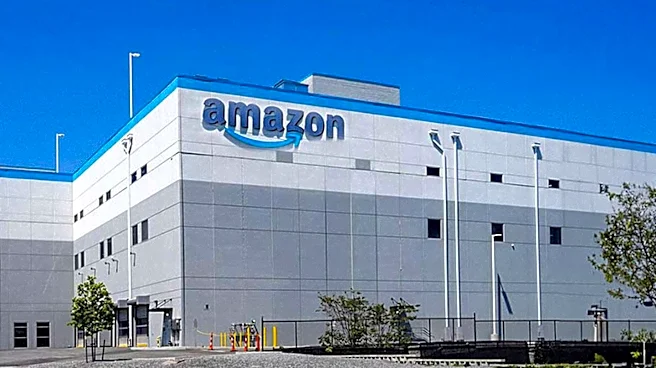
Other major technology companies already had sizable lobbying operations in Tennessee. Google has 11 registered lobbyists this year, up from 10 last year, while Amazon has six, down from seven. Oracle has nine, unchanged from 2025. Meta dropped from three to one, while Microsoft has one lobbyist, unchanged from last year.
xAI, which operates hyperscale facilities in the Memphis area, had no registered Tennessee lobbyists, according to records.
Syler said the arrival of new industry lobbyists reflects companies preparing for a political fight as lawmakers consider new restrictions.
"The AI industry sees what is happening on the ground across the country, and they know they are in for a battle," Syler said.
He expects the industry to devote more resources to influencing lawmakers as Tennessee debates how data centers should be taxed and regulated.
Lawmakers are already proposing new restrictions.
State Rep. Aftyn Behn, D-Nashville, has proposed a three-year pause on new state tax exemptions for data centers while Tennessee evaluates the costs and benefits of the incentive program.

A national, bipartisan issue
The fight is hardly unique to Tennessee.
Syler teaches a class at MTSU tracking about 50 competitive congressional races nationwide. When he asked how many students were seeing data centers emerge as an issue, every hand went up.
"This is a national political story," he said.
More unusual, he said, is that the opposition crosses party lines. Syler said data centers have become a tangible symbol of broader anxiety about AI and its impact on jobs, communities and daily life.
He does not expect the politics to fade after November.
"This is just beginning," he said. "This is a lot more than just humming buildings. I guess you could say it's a whole societal change."
This article originally appeared on Nashville Tennessean: Data centers become a new political battleground in Tennessee