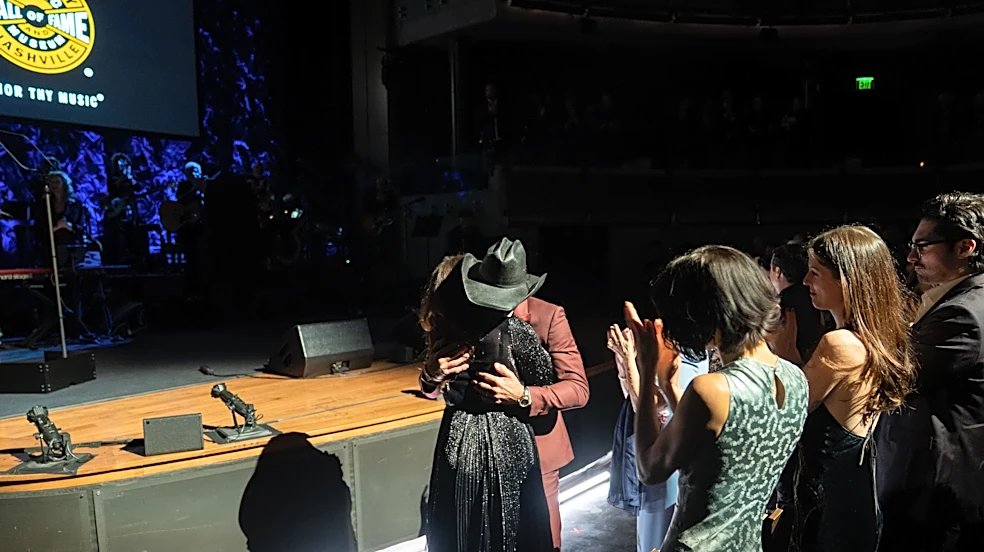





Tim McGraw, Paul Overstreet and The Stanley Brothers entered the Country Music Hall of Fame on Oct. 18, during a special night filled with music, memory and much-deserved recognition.
The annual "Medallion Ceremony" held at Nashville's CMA Theatre featured performances from Billy Strings, Blake Shelton and Lainey Wilson, among others, plus heartfelt speeches about the contributions of each new Hall of Fame member.
McGraw, who recounted the story of arriving in Nashville on a Greyhound bus in 1989 with just one suitcase and a guitar he could barely play, told the crowd he is grateful to his wife, Faith Hill, and hopes his achievements will be remembered as an inspiration.
“Someday I hope some kid pulls into town with everything they own in a suitcase
and dreams too big to fit it in," he said, adding that maybe that kid would hear one of his songs. "Getting here comes with a cost. But standing here tonight in front of all of you, in front of all of my heroes that are on these walls. In this moment tonight, it's worth it."
Hall of Fame CEO Kyle Young explained the enduring impact of each artist during a history-filled three-hour ceremony. He was speaking to a high-profile audience which included influential music industry figures, as well as Hall of Fame members like Randy Travis, John Anderson, members of The Oak Ridge Boys and others.
The Stanley Brothers, Ralph and Carter, were the first to be honored. Known as two of bluegrass’s founding fathers, the Virginia natives began their career in 1946 pairing old-time mountain music with gospel and unmistakable "blood" harmony. Carter died in 1966 but Ralph carried on with The Clinch Mountain Boys, influencing artists from Dwight Yoakam to Bob Dylan and beyond. They were inducted in the Hall's "Veteran Era Artist" category.
Young noted that the "enduring popularity" of bluegrass is thanks in large part to The Stanley Brothers, and that if their songs had a theme, it would be "perseverance." Their legacy was celebrated through performances by jam-grass superstar Billy Strings, as well as Hall of Fame members Ricky Skaggs and Vince Gill and "The First Ladies of Bluegrass," Molly Tuttle, Sierra Hull, Alison Brown, Missy Raines and Becky Buller.
Gill delivered the duo's formal induction, saying "I tried my whole life to sing like Ralph Stanley." The children of Ralph and Carter accepted the honor with Ralph's daughter Lisa Stanley Marshall saying she believed they had "earned it a long time ago."
Songwriter Paul Overstreet entered the Hall of Fame in the "Songwriter" category, honored for a remarkable career which helped shape the sound of the '80s and '90s. The Mississippi native co-wrote 13 No. 1s including country standards like Randy Travis' “Forever and Ever, Amen” and “On the Other Hand," Keith Whitley's “When You Say Nothing at All” and The Judds' “Love Can Build a Bridge.”
Also one of the writers behind fun-loving songs like Kenny Chesney's “She Thinks My Tractor's Sexy” and Blake Shelton's “Some Beach," Young said Overstreet has a knack for music with hope and optimism. Shelton agreed, cracking the audience up as he took the stage and explained his longtime hope to cut one of the Grammy-winning writer's songs. He thought it would be something profound, but when he finally got the chance, it was the lighthearted-but-memorable, "Some Beach."
"But I'm proud of it!" Shelton said just before performing the song. Hall of Fame members Dean Dillon and Tanya Tucker also honored Overstreet, along with Jamey Johnson. Tucker delivered a side-splitting formal induction, saying she put off an E.R. visit to celebrate a loyal friend.
"I got internal bleeding and my lung might be collapsed, but I’m here," she joked. Tucker also said Overstreet's work speaks for itself. "Every line, not just the titles or the hooks, but every well-written line was always straight from that big old heart of his," she explained.
Finally, McGraw was inducted in the Country Music Hall of Fame's "Modern Era Artist" category. He was recognized as a superstar who helped bring country into a new millennium, with 29 No. 1s and 106 million song copies sold from the early '90s on.
The Louisiana native has never been known as a songwriter. Instead, McGraw has proved himself an expert song stylist with an instantly recognizable voice, and the ability to capture both country's feel-good side (like he did with “Where the Green Grass Grows”) and its emotional weight (“Live Like You Were Dying," “Humble and Kind”). McGraw has also recorded some of the most enduring duets in country history with Hill, who was seated alongside her husband and his mother in the front row.

Young called out McGraw's creative fearlessness, citing collaborations with Nelly and Florida Georgia Line. "Over the course of an astounding four-decade career, [McGraw] has broadened the horizons of country music forever, and for the better," he explained.
McGraw has also inspired generations of new country stars, including Parker McCollum, who performed "Don't Take the Girl" as McGraw and Hill looked on. Lady A delivered a rousing rendition of "Live Like You Were Dying," which McGraw recorded just weeks after his biological father, MLB All-Star Tug McGraw, died of cancer. The uplifting anthem had an extra element of meaning since Lady A member Charles Kelley was himself recently diagnosed with a rare type of blood cancer, called multiple myeloma.
Lainey Wilson also had a meaningful performance to share, singing "Just to See You Smile." She grew up near McGraw's hometown in Louisiana and has long counted him a hero.
It was Alabama's Randy Owen who had the honor of welcoming McGraw into the Hall of Fame. Dressed in a dark red tuxedo and black cowboy hat, McGraw stood at the lectern and admitted he would likely cry, as a roar of applause filled the hall. He thanked his fans, his team, and his family, making a special point to call out Hill, his wife of 30 years. He said the only thing sweeter than this moment would be the one which is surely coming, when Hill is inducted into the Hall of Fame, too.
McGraw spoke of the hard work he put in and the help he had along the way, and said he hopes to pay it forward. He also returned to the story of his first night in Nashville, in May of 1989 when he was 22 years old. The hopeful young singer found out the next morning that his hero, Keith Whitley, had died that very night, at a tragic 34 years old.
"Now, some people might call that a bad omen, but I've come to believe it was something else," McGraw said, adding he feels Nashville was telling him that a life in music costs something. "The people who make it give everything that they've got. And if you're lucky enough to make it down the road, you owe it to the ones who didn't and the ones who paved the way for you."
Chris Parton is a music reporter for The Tennessean. Follow him on Facebook and Instagram @partonikusmax.
This article originally appeared on Nashville Tennessean: Tim McGraw, Paul Overstreet and The Stanley Brothers enter Country Music Hall of Fame