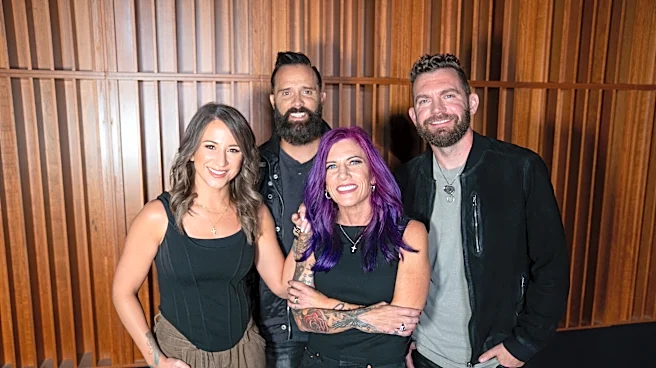






Looking at the four members of Skillet, it may be hard to comprehend that the Thompson's Station-based band has been around for 30 years.
Did they start in middle school?
"Yes, we did," frontman John Cooper joked. "We were very young."
"Good genes," his wife and bandmate Korey Cooper added.
"We got started on the Mickey Mouse Club like Britney Spears," he sarcastically quipped before singing. "Britney, she's so pretty, that just ain't me."
Drummer Jen Ledger jumped in, "That's P!nk."
"It is P!nk," Cooper said.
Guitarist Seth Morrison smiled as the four slipped into the easy banter that comes with years of making music and touring together.
Seated inside the CCM Magazine studio in Nashville, near a faux cave backdrop with highlighter blue and yellow
lights, the setting fit the rock-edge band with staggering growth metrics.
As of 2026, Skillet draws roughly 12 million monthly Spotify listeners three decades after forming in Memphis. The band's 2009 hit "Monster" is certified six-times platinum and has surpassed 1 billion streams on Spotify, making it the first song by a Christian artist to enter the platform's Billions Club. The official music video has been watched more than half a billion times on YouTube. That is roughly 22 times the audience for Taylor Swift's "New Heights" podcast where she announced "The Life of a Showgirl."
"It's unreal," John said. "None of us expected that level of success."

Get Skillet tickets
'After the Storm'
The cover art of Skillet's newest EP, "After the Storm," puts the Christian rock band's faith front and center. A silhouetted figure hangs against a pitch-black background, arms stretched outward in a crucifixion pose as lightning and white light explode from behind the body.
Korey Cooper wanted the artwork to capture death and resurrection. She asked for something cinematic, minimal and symbolic, a departure from the band's typically flashier artwork.
"End of life and beginning of life," she said. "We're getting older, 30 years. You start digging into deep things, the meaning of life. You go through a lot of stuff."
The six-song EP arrives Oct. 9, with Skillet kicking off a nationwide headlining tour days earlier. Produced by Korey Cooper and David Cowell, "After the Storm" marks a return to the band's heavier roots.
The lead single, "Scream," which has already surpassed seven million global streams, opens with exactly that: a piercing scream. Cooper then moves between whispers and shouts, his voice tightening as the narrator struggles to speak before exploding again: "I wanna scream." The song keeps returning to identity, asking, "What have I become?" and whether anyone is listening.
"Lift Me Up" answers that paralysis with muscle. Fear becomes fire and shame becomes something to rise above as Cooper declares, "I'm breathing dragon fire" and "They'll never drag me down."
The title track is less triumphant. The storm has already ripped out the roots and killed the garden. Now the narrator is "picking up the pieces," caught between a past he can't return to and a present he can't stay in. It's one of the EP's clearest distinctions between surviving something and actually recovering from it.
"Grave Stomper" gets aggressive again. Shame becomes something physical, with lies wrapped around a throat and the past dug up like chains. Cooper answers with the song's bluntest battle cry: "Silence the shame / Stomp on the grave."
"I had quite a bit of that negativity in my life," John said of writing the song. "It's like words of death. There are people in your life, or maybe it's a substance in your life, that are trying to just keep you under its boot and in the grave. The message is don't believe the lies."
Then the armor cracks on "Come and Find Me" and "Heaven Help Us." Defiance gives way to vulnerability as Cooper admits he needs help before the EP closes with a plea to "listen harder" and remember that "no one's gotta go it alone."
'Heaven Help Us'
At the Wisconsin Valley Fair in Wausau, Wis., Skillet learned a grieving family was waiting to meet them after the band's Aug. 6 concert.
Their son had died in an accident and was an ardent Skillet fan.
"We went out and met the family," John said. "The mom, she was crying, told us 'After the funeral, we played three and a half hours of Skillet music.'"
For a band whose newest songs wrestle with depression, isolation, addiction and finding hope after devastation, the encounter brought those themes out of the recording studio and into real life.
"That's what keeps you going," John said. "You realize how great this job is and how much music helps people."
At the turn of the millennium, the band began partnering with suicide hotlines and raising awareness around mental health and addiction. Those universal struggles have helped Skillet resonate with an audience far beyond Christian rock, turning songs about feeling broken, isolated or overwhelmed into anthems for listeners who may hear faith in them, or simply hear themselves.
"People always listen to rock music who felt like they were down and out," John said. "They were the outcasts. They were the ones that felt like they didn't have a voice and nobody notices me. I was one of those kids."
He sees another change happening now. Artists are increasingly comfortable talking about spirituality and faith, something John said would have been less accepted even six years ago.
"Maybe this is the era for Skillet to thrive," John said, "and keep doing what we do?"

Generations of Christian music fans
Aside from the dark struggles woven through the band's music, there is another throughline spanning 30 years: several generations of rock music fans.
John recalled looking into the crowd at a recent concert and spotting a young fan singing every word next to an older man doing the same.
"I was like, 'Oh, is that your dad? Y'all rock,'" John said. "He said, 'No, it's my granddad.'"
Korey added that the band's largest demographic still skews toward listeners in their 20s, with platforms like TikTok introducing Skillet's music to fans who weren't alive when the band released its first album in 1996.
"Trying to survive without just being a legacy act is hard to do," Korey said. "It's a lot of work to try to stay on the ground and culturally relevant."
For Morrison, staying relevant hasn't meant putting more pressure on the Tennessee-based band. Lately, it's been the opposite.
"It just feels like a fun, more laid-back season," he said. "There's no pressure. It kind of feels like a return to a time with not as much pressure, and it's fun again."
Bryan West is a music reporter at The Tennessean, part of the USA TODAY Network. Follow him on Instagram, TikTok and X as @BryanWestTV.
This article originally appeared on Nashville Tennessean: How Skillet became a billion-stream Christian rock anomaly
Our editors independently choose our recommendations. Some content is produced with paid support from a third party, however our editorial decisions remain independent. If you buy through our links, the USA TODAY Network may earn a commission. Prices and availability may change.