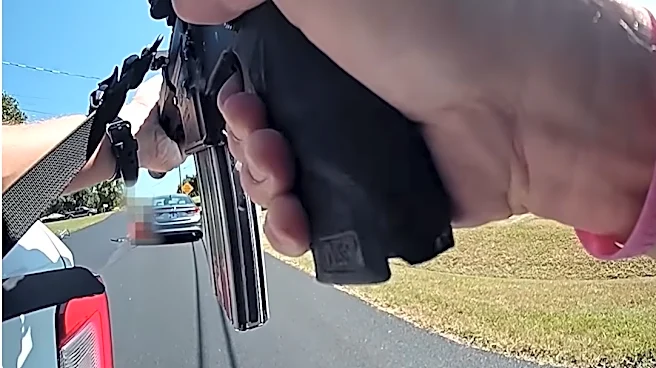







Nashville Police SWAT Officer Joshua Baney slid out of his pickup truck on Cheshire Drive with his rifle in hand, footage shows. He tapped another officer on the shoulder and moved in front, raised the gun and fired, it shows.
A mental health negotiation team was on the way to the scene to try to reason with Jason William Sexton, who'd been on a tear of violent threats while armed with a sword.
Baney gave no commands. He fired two more times, shows the video footage, released by the department.
Sexton was standing between the open driver's side door and the body of his car, holding the sword in his hand when he was hit by Baney's gunfire. He was on the ground when Baney fired
the second and third shots. Sexton died at Skyline Medical Center.
The body camera footage released was only 22 seconds long. Nashville Police said Baney had been instructed to use his truck to block any exit route Sexton might take. It's unclear how long the officer had been on scene.
Baney has been decommissioned, a rare step Nashville Police takes in circumstances where an officer shoots someone. Since 2022, there have been at least 25 police shootings that left someone injured or dead. Only one other officer was decommissioned as a result of the shooting.

When does the Nashville Police Department decommission an officer?
When an officer shoots, either injuring or killing someone, he or she is immediately placed on routine administrative leave. That is not a punishment, but rather a status while an external or internal investigation is underway.
Officers on administrative leave continue to receive their regular pay and benefits and continue to have their full police powers.
A decommissioned officer is stripped of his or her authority and gun. Typically, decommissioning is saved for officers who are charged with crimes.
Since January 2022, at least eight other officers have been decommissioned. Of those eight, two of those officers still work for the police department, according to city data.
Most decommissioning cases stemmed from charges like assault or driving under the influence, with only one other connected to an on-duty shooting.
Brian Murphy was decommissioned while investigators considered his actions the day37-year-old Landon Eastepwas shot and killed on Interstate 65 in January 2022. Nine officers total — six from Nashville Police, two from the Tennessee Highway Patrol and one from the Mt. Juliet Police Department — opened fire on Eastep, who was holding a box cutter.
Murphy was the only one decommissioned. He fired the final two shots at the scene.
Months later, Murphy's police powers were fully reinstated. He faced no chargesin the death of Eastep.

What happens next to Nashville Police officer Joshua Baney?
The Tennessee Bureau of Investigation is handling the investigation into Baney's actions. At the same time, the police department's Office of Professional Accountability is conducting its own investigation.
The state will turn over its case to the Davidson County District Attorney's Office which will determine if Baney should face charges in connection with Sexton's death. The department's investigation could determine a range of outcomes from no finding of fault to termination.
If his police powers are reinstated, the department could decide to keep him in his current position, reassign him or demote him.
The last time a Nashville Police officer was charged after a shooting
The last and only time a Nashville Police officer has been charged in connection with an on-duty shooting was when former officer Andrew Delke shot and killed 25-year-old Daniel Hambrick in July 2018.
Delke shot Hambrick three times in the back during a foot chase in North Nashville. After the shooting, Delke was placed on administrative leave.
Two months after the shooting, District Attorney Glenn Funk decided to pursue a criminal homicide charge against the officer after reviewing evidence collected by the Tennessee Bureau of Investigation, including surveillance footage showing Delke opening fire as Hambrick ran away.
A lower level magistrate initially said prosecutors didn't have enough evidence to prosecute Delke, but a General Sessions judge quickly overruled the magistrate.
By January 2019, Delke was indicted on a charge of first-degree murder. After a series of delays, in part due to the COVID-19 pandemic, Delke accepted a plea deal days before jury selection was to begin in his July 2021 trial.
Delke pleaded guilty to manslaughter and resigned from the department. He was sentenced to serve three years in prison but was released in October 2022 with jail credit.
This article originally appeared on Nashville Tennessean: Nashville Police take rare step to decommission officer after fatal shooting