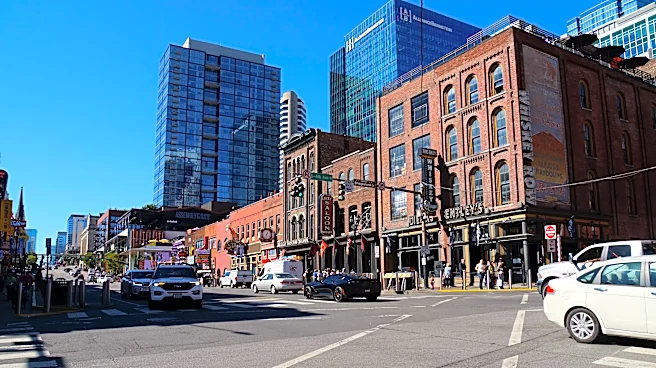



The fight broke out on Broad Street, now called Broadway.
Four apparently drunk men tussled in the flickering gas lights of the Broadway Varieties Theater.
Fortunately, there was a police officer living nearby. John Kennelly, 30, and his wife Mary lived near the corner of Broad and Cherry Street, now called 4th Avenue. They were asleep in bed when Kennelly heard the commotion. He got dressed and went downstairs to stop the fight.
It would be the last night of Kennelly's life. More than 160 years later, the Metro Nashville Police Department plans to memorialize him as the first Nashville police officer killed in the line of duty.
The department previously thought Robert Frazier, shot to death on April 30, 1875, was its first officer slain on the
job. Earlier this year, though, researchers from the nonprofit Officer Down Memorial Page came upon the case and alerted the Nashville department. Nashville Police Sgt. Daniel Cole spent two months tracking down documents and letters and later located Kennelly's headstone.
"I don't know why this case had never been looked at," said Cole, who works for the department's strategic development division. "In 160 years, it was not properly recognized."

The Civil War was over, the fighting wasn't
It was just before midnight on May 29, 1866, when Kennelly and his partner, Pink Dews, confronted the four men in the street below Kennelly's apartment. The lawmen recognized the brawlers as Union soldiers from the 16th Regulars.
Nashville had fallen early in the war, the first Southern capital federal troops occupied. Captured by the North in 1862, it remained a Union stronghold and hub for transportation and supplies. The Battle of Nashville in 1864, a disaster for John Bell Hood's troops following the Battle of Franklin, extinguished any flickering Rebel hopes.
The early Union victory here was an early harbinger of Nashville's status as a place for world-class healthcare. An April 12, 1864, article in The Nashville Daily Unionheralded the care and sanitation practices put in place to thwart the spread of smallpox, for example.
Still, resentments simmered. After the war, most Nashville police officers retained strong allegiances to the South.
The former Union infantrymen, encamped in Nashville to rebuild the city's infrastructure after the war, had crossed paths with Nashville police before the night Kennelly died. A few nights before the fatal encounter, Kennelly and Dews had confronted the men in a state of drunken disorder, and sent them back to their camp.
That final night, Kennelly and Dews responded to what sounded like an encore. In fact, the Union men were as sober as a Sunday morning.
They had raised a ruckus to lure Kennelly and Dews to the scene.
Kennelly was stabbed and his throat was slashed. He died from his injuries. Dews was stabbed in the back but survived.
"Our nation as a whole was super volatile still," said Cole, the Nashville police sergeant who researched the case for months. "The Union folks had the one-up on anyone who had allegiance to the Confederacy."
There is no record of Kennelly fighting for the Confederate army, but even in death, his family didn't want him near the Northerners. He was buried in the City Cemetery just outside Fort Negley, where many Union soldiers were laid to rest.
His family had him exhumed and moved to the Calvary Cemetery on Lebanon Pike, which became the final resting place for many Confederate soldiers.
Kennelly's headstone is in Section 10. He's buried a few yards away from his wife Mary, who, after he died, became a noted dressmaker and shop owner. Mary Kennelly Johnson (she remarried) had some of her fashion work displayed at the Tennessee State Museum in the summer of 2026.
The killer was sentenced to hang
Union veteran Philip Antoni, who was arrested and accused of slicing Kennelly's throat, had been in trouble before. Cole's research found he'd been involved in fistfights in Nashville after the war.
"He had a propensity for that type of behavior," Cole said.
Antoni was convicted for first-degree murder and sentenced to be hanged on March 1, 1867 in Kennelly's death. Two other former Union soldiers, Henry Allen and George Moore, were convicted of second-degree murder and sentenced to 20 years in prison.
The case and subsequent sentence warranted coverage in local newspapers.


The story, however, didn't end there.
Allen, it appears, had a well-connected family. His brother wrote a letter to New York Gov. Reuben Fenton explaining Allen was not yet 21, that his father had died when he was a toddler and that his mother was "hopelessly insane" and confined to an institution.
"Would you be so kind as to ask Governor Brownlow of Tennessee to commute the sentence?" the brother wrote. His signature is not visible in the copy of the letter that has been preserved.
Fenton got in touch with Brownlow and submitted a petition for pardon, accompanied by 11 pages of signatures from men who had fought with Antoni, Allen and Moore in the war.
"They vouched for the character of the defendants," Cole said.
The petition included a letter from U.S. Army Maj. Gen. William P. Carlin, who said Kennelly had instigated the fight. Marlin said Kennelly had fired a pistol and Antoni was acting in self defense. Marlin said Kennelly confronted Antoni, Allen and Moore because he deemed them Northern outsiders.
"I am compelled to believe that if these soldiers had been citizens, Kennelly would not have molested them, Antoni would not have intervened and nobody would have been killed," Marlin wrote.
Brownlow, a fiery Methodist pastor who served from 1865 to 1869, was in charge of making Nashville whole again after the Civil War.
In the pardon case, he sided with the men from the North.
All three men were pardoned.
On Sunday, Feb. 3, 1867, the three men were released.

The Nashville Union and Dispatch was among the papers that ran coverage of the pardon on Feb. 3, 1867.
"... the entire party was on the street as free under the Executive clemency as before their arraignment," the article read. "Upon what principal they were pardoned we ask not."
The North had won again.
This article originally appeared on Nashville Tennessean: Cop killed in 1866 recognized as Nashville’s first officer slain in action