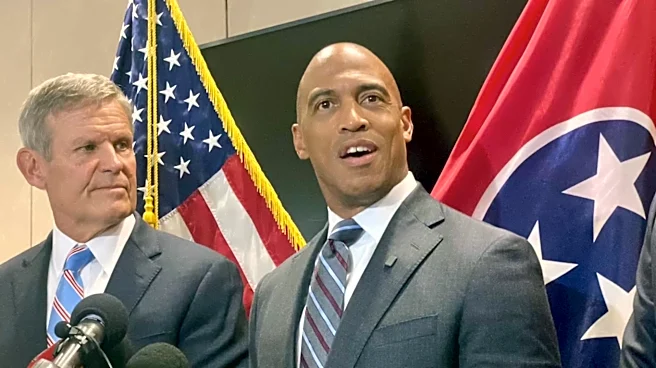








U.S. Housing and Urban Development Secretary Scott Turner says opportunity zones — economically distressed areas where private investors can get tax incentives to invest — have been “transformative” for Tennessee.
Congress established opportunity zones in 2017 through the Tax Cuts and Jobs Act. They were made permanent in the Working Family Tax Cuts bill passed this year.
“We have great anticipation for opportunity zones 2.0 here in Tennessee,” Turner said. He held a roundtable focused on the zones in Nashville with Gov. Bill Lee and local economic development officials on Aug. 19.
According to Turner, opportunity zones have yielded $112 billion dollars of private investment nationwide, resulting in 500,000 new jobs and 400,000 new housing units
over the last nine years. Tennessee currently has 176 census tracts that are qualified opportunity zones, in which 6,000 new homes and 24,000 jobs have been created since 2017, Turner said.
“Opportunity zones have literally transformed some of the most underresourced and underserved communities around our country,” he said.

Nominations opened last month for states to seek new opportunity zone designations. About 1,700 census tracts across nearly all Tennessee counties are eligible to be designated opportunity zones in the new round of federal nominations, according to the U.S. Department of Treasury. Nominations will close in January.
Turner said Lee and his administration have “done a great job” preparing for the second round of opportunity zones.
As Tennessee has grown, the state’s affordable housing stock has not kept up with demand, causing prices to rise and making first-time homebuying challenging.
Lee in 2025 proposed establishing a $60 million housing development fund to incentivize construction of new homes. Lawmakers did not approve his proposal. He said opportunity zones will help increase the state’s workforce housing stock, but the state should continue to work on increasing availability.
“That effort was to create more housing start-ups and more workforce housing across our state,” Lee said of his $60 million proposal. “There are multiple ways to do that. That was one strategy. This is clearly one that has worked, as well.”

Tennessee senators this year passed a proposal championed by Nashville Democrat Charlane Oliver to bar large investors from buying up more than 100 single family homes to rent out. Oliver's Homes Not Hedge Funds Act did not move forward in the House.
A similar policy became federal law with bipartisan support last month without Trump’s signature.
“We should be focused on affordable and workforce housing, and these opportunity zones are going to give us that opportunity,” Lee said.
Sen. Bill Hagerty has sponsored a bill seeking to reduce and streamline regulatory and permitting costs for new home construction. The Trump administration’s Council of Economic Advisers found this year that regulations and permitting could account for as much as $100,000 in the cost of an average home.
“The secretary is working on these policies,” Hagerty said. “They’re looking at opportunities right now at the federal level, and we’re trying to incentivize this on the state and local level as well.”
Vivian Jones covers state government and politics for The Tennessean. Reach her at vjones@tennessean.com.
This article originally appeared on Nashville Tennessean: HUD Secretary Turner calls opportunity zones ‘transformative’ in TN