





There is a simple question I believe every elected official should ask before making a decision:
Who am I here to serve?
The answer should never be a corporation. It should never be a special-interest PAC. It should never be a campaign donor or lobbyist.
It should be the people.
I have spent decades as a public defender and public servant listening to Tennesseans at some of the hardest moments of their lives. I have sat across from families trying to keep their children safe.
I have stood with people who had nowhere else to turn. And I have learned something that no campaign contribution can teach you: There is a human being behind every policy decision.
That is why I worry about a political system in which corporations and powerful industries can
pour money into campaigns while ordinary Tennesseans struggle to make their voices heard.
Far too many politicians receive contributions from corporate and industry PACs. And while a contribution does not, by itself, prove that a politician voted one way or the other because of the donation, it certainly raises questions.
These are questions we should all be asking.
When certain companies and other powerful industries are spending money to influence our politics, who makes sure that the people sitting at their kitchen tables are heard just as loudly?

The human cost of political decisions
I think about the opioid crisis.
Tennessee enacted major legislation addressing opioid prescribing and treatment beginning in 2016, as the state was already experiencing devastating consequences from opioid misuse.
And the crisis did not simply disappear.
Tennessee recorded 1,186 opioid overdose deaths in 2016. By 2019, that number had risen to 1,543. By 2020, the state recorded 2,388 opioid overdose deaths.
Those aren't just numbers. Those are friends, loved ones, Tennesseans who have died.
I remember a woman in Bristol who cried in my arms as she told me about losing her brother to a fentanyl overdose. No political talking point can make that family whole again. And so we should be asking why this policy was enacted, who sponsored it and who donated to make sure it passed.
Who benefits from school vouchers?
The same question applies to our schools.
Tennessee enacted its Education Freedom Scholarship program in 2025, initially creating up to 20,000 scholarships. The program was expanded for the 2026-27 school year to 35,000 scholarships.
I have heard from teachers, like the special education teacher in Lawrenceburg, who tell me they are struggling to give their students the education and individual attention they deserve because they have lost funding to private school vouchers.
And I have heard from people in rural Tennessee who ask a very basic question: What choice does a family have when there isn't a private school anywhere nearby?
That question deserves an answer.
When special interests shape policy
So does the question of who benefits when public policy is shaped around the interests of industries that can afford to hire lobbyists, make political contributions and spend millions influencing elections.
We are seeing another version of this debate with the explosive growth of data centers. There is nothing inherently wrong with technology or economic development. Tennessee should welcome innovation. But development should not mean that some communities bear the costs while somebody else collects the profits.
Data centers and community impact
Across Tennessee, people are asking what enormous data centers mean for their water, electricity, land, air and quality of life. The rapid expansion around Memphis is already drawing national attention; the Washington Post recently reported that xAI's Colossus 2 near Memphis is now the nation's largest data center and noted concerns about the environmental and infrastructure impacts of these enormous facilities.
And when I talk to people in South Memphis, I hear something much more personal. I hear from people experiencing asthma attacks. I hear complaints about noise. I hear people asking whether economic development is still economic development when they are the ones who have to live next to it.
Those voices matter.
They should matter just as much as the voices of the companies building the facilities.
 in Whitehaven in South Memphis, which is powered by a plant over the state line in Southaven, Mississippi, U.S., May 30, 2026." id="90914557007">
The real issue: Who gets heard?
That is ultimately what this conversation about money in politics is about. It isn't about demonizing businesses. It isn't about attacking people who disagree with us politically. And it certainly isn't about saying that every politician who accepts a corporate contribution is corrupt.
It is about something much simpler: Who gets heard?
A business should have a voice. So should a public defender. A company should have a voice. So should a mother in South Memphis. Industry should have a voice. So should a special education teacher.
I believe we can agree on that regardless of whether we are Republicans, Democrats or independents. Most Tennesseans don't want politicians who are beholden to one party, one industry or one wealthy donor. They want leaders who will listen to them.
That means the person who works two jobs should matter. The farmer should matter. The small-business owner should matter. The parent worried about their child's health should matter. The family grieving a loved one lost to addiction should matter. And the person who can only afford to send $5 to a campaign should matter just as much as someone who can write a $10,000 check to attend a dinner with their elected official.
Representation versus influence
Because elections are supposed to be about choosing representatives of the people.
And when an elected official walks into a room to make a decision that will affect thousands, or possibly millions, of Tennesseans, the only question that should matter is this: What is best for the people I was elected to serve?
That is the standard our democracy deserves. And it is the standard every one of us should demand.

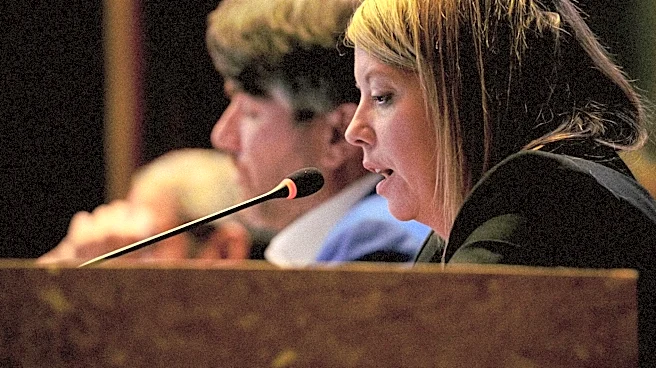
Jerri Green is a mother of three, a Memphis City Council member and a Democrat who recently became the first woman from either major political party to secure a Tennessee gubernatorial nomination. A lifelong Tennessean, she was raised in Memphis, educated in Knoxville and began her career in Nashville. She has championed higher wages for public employees, helped secure the city's first paid family leave policy, advocated for free public transit and flipped her council seat to Democratic control.
This article originally appeared on Nashville Tennessean: Jerri Green wants TN leaders to serve people, not donors | Opinion