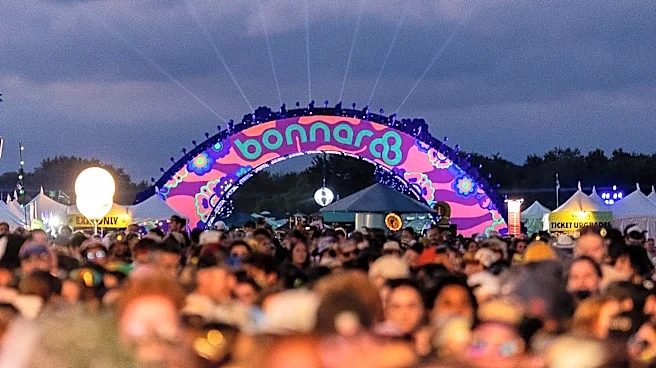



When Bonnaroo Music & Arts Festival announced it would not return in 2027, the reaction from fans rang as loud as the music that usually blares all night on The Farm.
Festivalgoers are now wondering: Is the hiatus simply a one-year break, or a sign of deeper challenges facing the music festival industry?
Organizers for the Manchester, Tennessee, festival owned by Live Nation said The Farm needs time to recover after back-to-back years of severe weather, including a rain-soaked 2026 event and the mid-festival cancellation of Bonnaroo 2025.
"This wasn't an easy decision, and not one we take lightly, but in our hearts, we know this break will only make Bonnaroo better," organizers wrote in a statement.
The pause comes after Bonnaroo spent millions
on infrastructure improvements intended to make the festival grounds more resilient, including enhanced drainage systems, 4.5 miles of new roadways and 135 acres of newly planted grass.
But Bonnaroo's absence in 2027 also arrives at a precarious moment for the music festival business.
Across America, music festival organizers are struggling with rising artist fees, higher production costs, increased weather risks and growing competition for fans' attention and hard-earned dollars.
Dozens of festivals have shuttered, gone on hiatus or completely reimagined themselves in recent years, even as live music remains a booming industry.
Here's what to know.
If live music is booming, then why are festivals struggling?
Bonnaroo's hiatus is not evidence that people have lost interest in live music.
According to Pollstar, a trade publication for the live music industry, the music scene's post-pandemic return has been triumphant.
Stadium tours are setting records. Live music revenues continue to grow globally.
"The climb back to normalcy ... quickly became what Pollstar termed 'The Great Return' with this business reaching unprecedented heights driven by what seemed insatiable consumer demand," wrote Bob Allen for Pollstar's 2025 year-end business analysis.
The top 100 tours generated $8.9 billion in 2025, more than 60% above pre-pandemic levels. But the festival business has proved far less stable.
Pollstar reported that nearly 90 festivals shuttered worldwide the year before in a "volatile" festival market.

While Tennessee is home to some of the most successful long-term music festivals, like CMA Fest and AmericanaFest, a number of its festivals have felt these impacts.
Earlier this summer, EDM festival Deep Tropics announced it would be canceling its ninth annual festival in Nashville, citing "extreme circumstances and funding that didn't come together."
Pilgrimage Music Festival, Franklin, Tennessee's largest music festival, also decided not to hold its annual festival this year.
Years earlier, in 2023, Nashville's free outdoor concert series Live on the Green stopped its events after rising production costs and economic shifts made it difficult to sustain the free public event.
"Putting on a festival costs a lot of money, it requires a lot of human resources and money on the front end, and then you can get hit by weather," Chris Paxton, Live on the Green festival director, told The Tennessean.
"Under good conditions, it can work okay, but it's still a gamble."
Stephen Parker, the executive director of National Independent Venue Association (NIVA), said whether independent or multi-national conglomerates, festivals are now collectively facing rising costs.
Parker explained that costly artist fees have made it increasingly difficult for festival bookers to compete with touring opportunities.
Artists increasingly rely on touring for revenue, according to data platform Statista, pushing their performance fees higher and creating fierce competition among festivals for top talent. Festivals also enforce radius clauses, rules that prevent an artist from playing nearby venues for months before and after the event. This lost market potential can drive up artists' fees, too.

At the same time, music lovers are consuming live entertainment differently, Parker said. They're leaving their homes less and sometimes waiting until the last minute to buy tickets. It's a reflection of the current economy.
"You can't just look at this as a live entertainment problem," he said. "This is an economic problem."
Economic shifts have caused consumer behavior to disproportionally affect music festivals, Parker explained. They're more expensive to attend. Then there's the cost of travel, lodging and food prices, not to mention the multi-day commitment. As people feel financial strain due to high costs and a slowing job market, many live music fans simply can't afford to attend festivals right now, Parker said.
"It's rough out there," Parker said. "Let me just say this: When Live Nation, the largest live entertainment promoter in the world, says it would be hard for us to put on this iconic festival, even with all the resources they have, I think it shows you how seriously in danger the festival market is right now."
Is climate change reshaping the music festival industry?
Bonnaroo's biggest challenge may be one factor it can't control: weather.
Since 2021, the festival has suffered two weather-related cancellations.
Organizers called off Bonnaroo before it began in 2021 when Hurricane Ida flooded campgrounds and made camping conditions unsafe. Bonnaroo 2025 was canceled midway through the festival when heavy rainfall swamped the grounds, damaging infrastructure.
Upgrades to The Farm, designed to better weather-proof the area, helped the festival return in 2026. But weather created setbacks throughout the weekend, including a lightning evacuation, canceled sets and extremely muddy conditions.

Bonnaroo is hardly alone in its weather woes.
Increasing heat, flooding and severe storms have become mounting risks for outdoor entertainment.
In 2023, rare desert rains turned Nevada's Burning Man into a mud pit, leaving 70,000 attendees stranded. That same year, almost 100 people were injured in a Colorado hailstorm during a Louis Tomlinson concert. A fan also died during an extreme heat wave at a Taylor Swift concert in Brazil.
In 2024, severe rain and flooding interrupted Miami's Ultra Music Festival. In 2025, Missouri's Midwest Dreams was postponed after tornadoes struck the St. Louis area. And in recent years, New York's Governors Ball has dealt with repeated weather delays and evacuations.
Research shows climate change is making these kinds of extreme weather events more common, and more severe. According to experts, this could put fans at concerts at higher risk.
Still, some weather experts caution against attributing single festival disruptions directly to climate change.
Will Minkoff, a partner at Nashville Severe Weather, said it's probably "not fair" to say climate change is the direct result Bonnaroo keeps getting storms every year. Minkoff said there's been "no change in rain for last 50 years" in Nashville.
"The bottom line is in May, June and July in Middle Tennessee, you're going to get a crapshoot of Sahara Desert for a couple weeks and a monsoon for a couple weeks," he explained. "And these festivals kind of need to be prepared for all of it."
The financial consequences of extreme weather extend far beyond a single lost weekend.
Climate risks can cause increased insurance costs. Canceling a festival due to weather can trigger ticket refunds and infrastructure repairs.
After Bonnaroo's 2025 cancellation, organizers refunded attendees in full.
Despite the challenges, Bonnaroo has still managed to contribute more than $339 million to Tennessee's economy since its formation. The festival's 2027 hiatus will also cost Manchester businesses their busiest — and most lucrative — week of the year.

But for now, Bonnaroo fans will have to wait until at least 2028 to return to The Farm, spotlighting the growing burdens on festivals across Tennessee and beyond.
The Farm may be able to heal, but the music festival industry is undergoing a painful shakeout.
Reach out to Audrey Gibbs, a music reporter at The Tennessean, at agibbs@tennessean.com. You can also follow her on Instagram at @audreyraegibbs.
Chris Parton is a music reporter at The Tennessean. You can reach him at cparton@nashvill.gannett.com.
This article originally appeared on Nashville Tennessean: Is the music festival economy in crisis? What Bonnaroo's hiatus really means