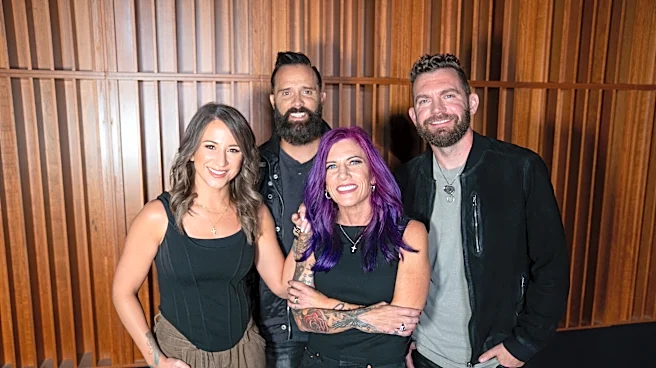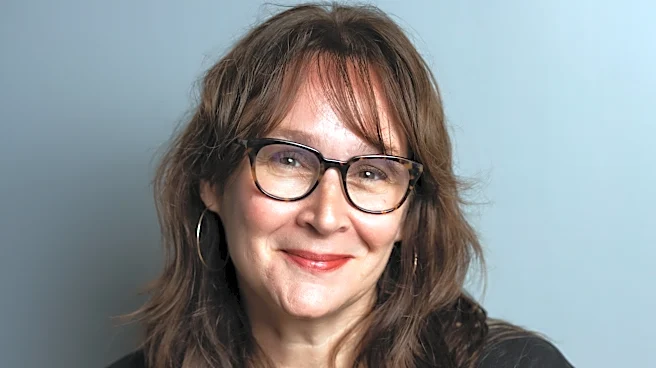

After dedicating decades to cultivating a literary community in Nashville, writer Susannah Felts has stepped into the spotlight with her new novel "The Come Apart."
Felts, artistic director of the nonprofit
literary organization The Porch, is a featured author at Nashville's upcoming Southern Festival of Books.
The Nashville native released her sophomore novel in June, which follows an indie-rocker who moves from Chicago back to her home, Nashville, after her dad dies.
Capturing Music City in vivid color isn't new for Felts, whose 2008 debut novel, "This Will Go Down on Your Permanent Record," captures a teenager's coming-of-age story throughout a lonely summer in Nashville.
Her fiction has already earned her the Tennessee Arts Commission’s Individual Artist Fellowship and the Tennessee Williams Scholarship to the Sewanee Writers’ Conference. She also holds an MFA in writing from the School of the Art Institute of Chicago and has taught writing at Belmont University.

Ahead of the book festival, which runs Oct. 17 and 18 downtown, Felts spoke with The Tennessean about her latest novel, Nashville's growing literary scene and some exciting news for the future of The Porch.
This Q&A has been edited for clarity and length.
Question: Tell me a little bit about your role with the Southern Festival of Books.
Answer: The Porch has been participating in the festival since we began in 2014. We have a table every year, and it's always a big homecoming for us.
In the last three years, we've also partnered with the festival to offer writing workshops with some of the visiting writers on the Friday before the festival. We're doing that again this year, and we have more workshops than ever.
I'm teaching one on writing sense of place. My new book has a really rich sense of place in terms of Chicago and Nashville. I'll also be at "Authors in the Round" fundraiser on Friday evening.

Let's talk about "The Come Apart." What is it about?
Maggie Corbin is a musician in a band in Chicago in 2009. She's an indie rock musician who blows up her life in the wake of her father's unexpected death and moves back to her hometown of Nashville.
The story is a mashup of a rock 'n' roll and prodigal-daughter-comes-home story. You could also classify it as the coming-of-age of an artist, the search for how to be an artist in the world today.
This book is itself a metaphor for the creative life — for anybody trying to make art in the world, grappling with that sense of: I want to make art for myself, but I also wouldn't mind trying to make some money from this. There's the conflict that comes up when art and commerce bump heads.
This book took more than a decade to write. What did that process teach you?
I started working on it probably in 2012. Through the writing process, you're recursively always looking back at what you've got and thinking, 'Where do I need to deepen this?'
I got a draft ready to send to agents around 2020, but it wasn't as finished as I wanted to believe it was. Nobody took it on, so I set it aside for a while, let it marinate, and came back to it.
Book writing is so torturous in that way ... but it's also pretty fun to follow the mystery of the process.
How has it felt finally having the book out in the world?
It can feel complicated and very roller-coastery. One minute you're on cloud nine that this thing you've worked so hard on is out in the world, and the next minute you're wondering how people are perceiving it.
I am just so thankful to have it published and for it to have its own life now. It's been fun to see people respond to all of the East Nashville references. There are a lot of real-life places and things in the book, and then fictional places, too.

Tell me about writing Nashville's music scene.
I'm a music fan — a deep music aficionado from day one. I grew up in a home where my dad would play records on Sunday mornings really loud.
I'm not a musician. Sometimes I think writing this book is a little bit of wish fulfillment, like 'what if I'd ever learned how to play guitar?' I was just always in the audience, listening all the time.
Today, appreciating the local scene and going to see local bands is basically my form of church. It's that important to me.
What can you tell me about the Nashville literary scene?
The city has been growing so quickly. By virtue of that, the literary scene has expanded and diversified.
It's bustling, thriving, better than ever. There is so much going on all the time that it's hard to even keep track. We've got incredible big-name authors right here.
You can't avoid the literary culture intertwining with the music culture and the visual arts. We do a program called 'Art Wire' with OZ Arts, and we send writers to performances and they write new original works based on what they've seen. That program symbolizes for me the way interdisciplinary work is par for the course in Nashville.
What's next for The Porch?
We've been in Berry Hill for the last eight years or so, and we're going to be moving into a bigger space in Wedgewood-Houston in early 2027. It's triple the size.
We're going to have a much bigger community space for events, two classrooms, and potentially some pop-up retail. Very exciting things are on the horizon.
I will forever be an ambassador for the idea of artistic community. No matter what kind of artist you are, you need it to some degree, and it can enrich your practice in ways you never imagined.
Audrey Gibbs is a music reporter at The Tennessean. You can reach her at agibbs@tennessean.com. Follow her on Instagram at @audreyraegibbs.
This article originally appeared on Nashville Tennessean: Author Susannah Felts talks about her new novel and Nashville's lit scene