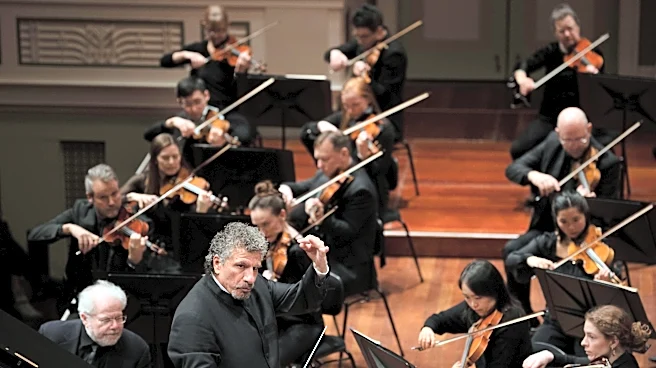









Violinist Dawn Marlowe Gingrich joined the Nashville Symphony in 2024 after beating out more than 100 other musicians for the role, winning a competitive audition process.
After accomplishing the gladiator-like feat, she moved from Germany to Nashville. But her whole career halted only two years later after an orchestra-wide meeting.
On Monday, Sept. 28, Gingrich learned she would be furloughed unexpectedly, along with the 76 other members of the orchestra. The symphony was in financial crisis, they told her, and the 2026-2027 season would be called off effective Oct. 18.
"We had no reason to suspect that this was coming," Gingrich said, sitting with The Tennessean at the Nashville Musicians Association, a union that represents over 2,400 professional
music industry workers in Music City.
The orchestra, many of whom are in the union, chose Gingrich to speak on their behalf for this interview.
"To say that we are blindsided, that the rug has been pulled out from under us, is an understatement."

Orchestra members' health insurance will run out on Oct. 31. Two of the Symphony members have babies on the way. "Those due dates are right around the end of October," Gingrich said.
"We have new hires this season who upended their lives and moved to Nashville at the end of August," she continued, "gave up prestigious fellowships and positions with other orchestras because they believed that the work here was secure."
Some orchestra members recently bought homes, while others are navigating illnesses or caring for dependents. Many even moved internationally, like Gingrich.
Though Gingrich said she doesn't have dependents and hasn't bought property in Nashville herself,"I'm not in a good situation," she explained. "It could be worse."
How the Nashville Symphony got to this point
The same day the orchestra learned of their furloughs, the symphony announced the news publicly, revealing it had also furloughed roughly half of its full-time staff.
The 14-time Grammy Award-winning organization, which was founded in 1946 and connects to 13 million listeners worldwide annually, declared a state of "financial emergency" after reporting a $10 million deficit.
Then-CEO Mark Cantrell, who began his tenure in August, said the organization’s "cost structure and revenue base" have become misaligned over time.
“The Nashville Symphony’s present circumstances demand plain speaking. For years, this institution has operated on a financial foundation that could not sustain it,” Cantrell said, adding that the organization has simply "exhausted its cash" and relied too heavily on one donor, referring to longtime arts patron Martha Ingram, who died in August.
A day after announcing the furloughs, Cantrell resigned. New president Mark Tillinger replaced him.
IRS filings compiled by ProPublica's Nonprofit Explorer show expenses exceeded revenue each year from 2014 through 2019, including an $8 million gap in 2016. After reporting positive results in 2021 and 2022, the symphony again reported expenses exceeding revenue for the next three years.
In the fiscal year 2025, the symphony paid its two top leaders more than $1 million combined, which is comparable to other similar orchestras. According to the Nashville Symphony's website, in 2025 the base salary for a second violin position in the orchestra was $72,000 per year.
Despite the Symphony's gradually worsening finances, Gingrich said the musicians saw no indication such a dramatic move was imminent.
"We truly did not have warning," she said. "We don't understand how this happened."

Could Nashville lose its Symphony Orchestra?
Among members of the Nashville Symphony, many are already planning their departures from Music City.
Gingrich knows of colleagues who will be leaving Nashville shortly after their last concerts on Oct. 16 and 17.
"We believe in this orchestra and we believe in this community, but we're not wealthy people," she said, adding she knows Nashville's community already understands the difficulty of a life in the music industry.
"We will all be doing whatever we have to do for survival. I spent some time this morning sending out resumes to other orchestras across the country," Gingrich said.
As musicians begin searching for new opportunities, they're entering one of the most competitive job markets in the high arts.
"It is a really intense process of multiple rounds of live auditions," Gingrich said of the hiring process for some of these roles.
"We can't do Zoom interviews, and we play those auditions at our own expense because there is no orchestra in the world that can afford to pay to bring musicians to them to audition. So, even the job search itself is extraordinary and costly."
If musicians do secure positions elsewhere, Nashville could permanently lose the talent that helped build the symphony's reputation, which includes world-renowned trumpet player Will Leathers, concertmaster Peter Otto, and flautist Érik Gratton.
"We really have to get the musicians back on stage as soon as possible, or this symphony orchestra simply will not come back as it was," Gingrich said. "I can't sugarcoat that."
At this time, Nashville Symphony music director Leonard Slatkin said he intends to remain the Nashville Symphony’s music director.
“As I process this difficult situation, I am filled with deep gratitude for everyone who has poured their talent, care, and dedication into this orchestra," Slatkin said.
Beyond the players, Gingrich wanted to spotlight what else could be lost.
"We have a community to serve," she said, explaining that the symphony offers free community concerts in Nashville and other Middle Tennessee counties.
One program she said she'll miss most is the annual side-by-side concert with the Curb Youth Orchestra, where student musicians sit alongside professionals and experience the energy of a professional orchestra firsthand.
The students in the symphony's Accelerando initiative are offered free lessons with members of the Nashville Symphony. With that program on hold, many students will lose access to music education because of its cost.
"An entire city block in Nashville will be dark," Gingrich said, "and those economic and human impacts will ripple out."

How can Nashville help the symphony?
Several performances remain on the symphony's calendar before the planned Oct. 18 furloughs take effect.
On Oct. 7, the symphony will perform "Top Gun: Maverick In Concert." "A Close Encounter with the Music of John Williams" will take place on Oct. 8 and 9.
The final concerts fall on Oct. 16 and 17: "The Three Ms: Marsalis, Mozart, and Mendelssohn."
Those looking to support the organization's recovery efforts can donate through the Nashville Symphony's website at nashvillesymphony.org/contribute/donate-now.
Gingrich said musicians are also exploring ways to support furloughed orchestra members directly.
A GoFundMe for symphony member Evan Bish, who plays violin and double bass, has launched at gofundme.com/f/support-evan-after-sudden-symphony-furlough. The funds will go toward his living expenses and possible relocation costs.
Beyond attending performances and donating, Gingrich said one of the most meaningful things supporters can do is continue showing up for the arts.
"We don't want to give up," she said.
Audrey Gibbs is a music reporter at The Tennessean. You can reach her at agibbs@tennessean.com. Follow her on Instagram at @audreyraegibbs.
This article originally appeared on Nashville Tennessean: Nashville Symphony violinist opens up after furloughs: 'We are blindsided'