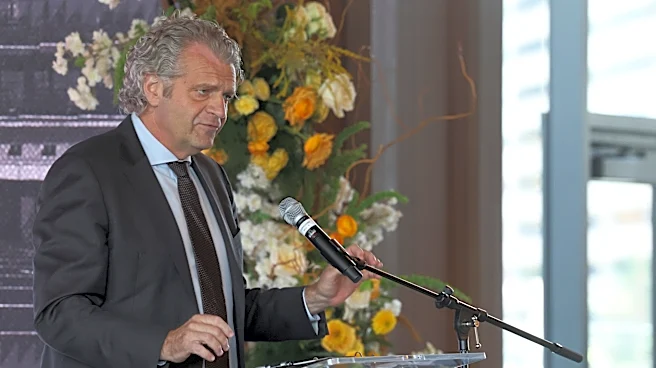








While a guest on a June episode of the Freakonomics podcast, Vanderbilt Chancellor Daniel Diermeier provided, as an example of the leftward political drift of American universities, the argument that “mass incarceration after the war on drugs basically was intended and had the consequence of suppressing African-American communities.”
It's a position described by Diermeier as both “controversial” and “radical.”
The following exchange then took place:
INTERVIEWER: There are a lot of academics who would argue that that’s not an ideological position they’re taking, it’s just a factual one, that racial discrimination in policing and law enforcement in America has a long and deep history, and it’s a bad thing, and therefore people need to be educated
about it, and we don’t necessarily need to spend time defending the previous status quo, or looking at modern critiques of the current argument.
DIERMEIER: But that’s an assertion, right? That’s an assertion about facts, and our job is to now kick the tires on that and see is that true, and to what extent, are there mitigating factors, and once you do a proper statistical model and you control for other factors, do these things still stand up? I mean, that’s what real work means, right?

Where does Chancellor Diermeier stand on other issues of racism?
After listening, I now have my own questions for the chancellor.
Which of the interviewer's statements does Diermeier acknowledge as factual, and which does he consider assertions? Is the statement, “Racial discrimination in policing and law enforcement in America has a long and deep history,” a fact or assertion?
The interviewers remaining statements are, of course, definitionally opinion: whether something is good or bad, how we should or should not spend our time. At a certain point, however, certain types of “opinions” are accorded the respect of something like fact, while others are no longer viewed as worthy of serious consideration.
For example, as a society, we no longer kick the tires on whether Black people are sub-human. But perhaps Diermeier has a different view: Might this be a “mitigating factor” for racially discriminatory policing?
Perhaps we ought to do the “real work” on rejecting the argument that slavery was, in fact, a benevolent practice necessary to police the otherwise ungovernable behavior of the “bucks” and “does” sold on the auction block.
Do we need to revisit the question of Harriet Tubman’s relationship with law enforcement? Was Tubman a fierce and courageous hero? Or a lazy and disobedient thief of (sub)human property – a repeat offender, no less?
Do we need to run a “proper statistical model” on Selma’s Bloody Sunday? Perhaps, with a properly controlled model, we would find that state troopers were justified in fracturing John Lewis’s skull – and grievously injuring 57 other peaceful marchers – with clubs, bull whips and tear gas.
Do we need to consider “mitigating factors” in the public lynching of George Floyd at the hands of four police officers?
Restoring trust in higher education starts with telling the truth
In the wake of the Floyd murder, in July 2020, Diermeier issued the following statement:
“The Vanderbilt community continues to process the horrific news of the past few weeks, as our nation has once again grappled with tragic killings and racial injustice… Vanderbilt has a responsibility, indeed, an obligation, to continuously do the work to combat racism and racial injustice – both on our campus and throughout our Nashville community.”
Are we now kicking the tires on Vanderbilt’s obligation? On the reality of racism? On the pros and cons of racial injustice?
Censorship of the original Vanderbilt news article in which this statement appeared would seem to suggest that, at a minimum, Diermeier does not consider “commitment” or “obligation” as binding terms. One can simply apply boot to tire whenever past promises no longer serve political endpoints.
Which brings me to my final question: Chancellor Diermeier, in your alleged effort to restore public trust in higher education, do you ever tell the truth?
Lynne Berry is a former research Assistant Professor, biostatistics, at Vanderbilt.
This article originally appeared on Nashville Tennessean: Vandy chancellor says colleges suffer from 'political drift' | Opinion