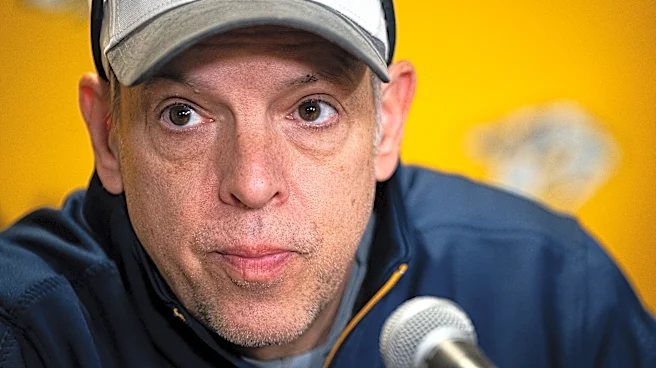




Chris MacFarland's first love was baseball.
The Nashville Predators' new president of hockey operations and general manager, hired by majority owner Bill Haslam on June 2, even remembers the moment he fell in love.
"Bucky Dent, that big home run in Fenway Park," MacFarland told The Tennessean in an exclusive interview on Sept. 10. "That was my first, 'Oh my God, I love this team' moment."
His love for hockey came not long after, when the United States beat the Soviets at Lake Placid in the 1980 Winter Olympics, then again when the New York Rangers won Game 7 in the 1994 Stanley Cup Final.
Three decades later, MacFarland is still miffed about attending Game 5, which the Rangers lost, instead of Game 7.
"Me and my buddies were crushed," he said. "We
thought we might have a chance to see history tonight . . . then, of course, they made it hard on all the Ranger fans."
Growing up a New York sports fan, MacFarland was witness to countless championship moments. Now, after 26 years of front office experience with the Columbus Blue Jackets (2000-15) and Colorado Avalanche (2015-26), he's ready to bring one to Nashville, which opens the regular season Oct. 1 against the Minnesota Wild at Bridgestone Arena.
How Chris MacFarland became obsessed with team building
MacFarland doesn't tell his life story in a series of flowery anecdotes. The most you'll get is facts: He grew up in Nanuet, New York, a bedroom community north of Manhattan. His father was a guidance counselor at a local high school. His mother took care of the home, which included him and his two younger sisters.
There's a guardedness with MacFarland. His emotions don't pour out easily, but ask him about his early sports fandom — especially Graig Nettles, his favorite player — and his defenses lower.
"Nettles was my guy," MacFarland said. "I gravitated to (Nettles' uniform) No. 9 when I played Little League."
His NHL heart belonged to the New York Rangers, but he also kept an eye on the New York Islanders and New Jersey Devils, who had relocated from Colorado in 1982. It was around this time when his career aspirations materialized.
Maybe it was watching the Islanders' dynasty, winners of four straight Stanley Cups in the early '80s. Maybe it was watching the Devils struggle before winning a few Cups of their own. Maybe it was watching the Rangers finally win the big game, a dramatic Game 7 at Madison Square Garden in 1994.

"For me, it was the scouting piece," he explained. "There was just something about watching hockey and team building and strategizing that I gravitated towards."
Brian Burke's advice and the best day of MacFarland's life
MacFarland, 56, went to law school, though he never wanted to be a lawyer. After graduating from Pace University and landing an internship with the NHL, he didn't even consider law school until Brian Burke suggested it.
Burke, a career hockey executive and the NHL's executive vice president at the time, sensed that MacFarland could work in a front office one day, but he'd need a law degree to go with on-the-job experience. MacFarland thought it sounded like good advice, even if it meant extra work.
But experience was more important, so MacFarland started writing letters. Lou Lamoriello, Al Arbour, Ken Holland, Larry Pleau, Doug MacLean — he reached out to countless executives.
One day it paid off. The league was looking to expand, and added teams in Columbus and Minnesota. The letter he'd sent to Pleau, then an amateur scout for the Blue Jackets franchise, ended up in the hands of Don Boyd, its director of scouting. The team called and offered him a job as hockey operations coordinator.
"It was one of the best days of my life," as MacFarland describes it. "I was in at my wife's place in Wisconsin when (Columbus) called me and changed the direction of my life. I'd never been to Ohio, and I didn't care. A couple of days later, I was in my car driving to Columbus."
The early years there were difficult. The Blue Jackets finished at or near the bottom the league, churning through lottery draft picks and head coaches. Team building, MacFarland was learning, had mitigating factors.
"We were always trying to to climb, trying to start the ascent, to build something," he said. "But we were always a young team that was trying to learn how to win and climb the mountain."

While in Columbus, MacFarland learned to navigate the league's post-2005 lockout salary structure. That skill set, along with being an early adopter of hockey's analytics movement in the 2000s, set him up for his next stop: Colorado.
In 2015, Avalanche general manager Joe Sakic was intrigued by MacFarland's penchant for data-driven decisions, so he hired him as an assistant. Seven years later, the Avs won the Stanley Cup, Sakic became president of hockey operations, and MacFarland was elevated to general manager.
MacFarland's analytics-driven perspective helped him maneuver around some dicey situations in Colorado. In 2025, he traded Mikko Rantanen, who was not going to re-sign with the Avs, to the Carolina Hurricanes for Martin Necas, Jack Drury and two picks. It was a "Moneyball"-esque moment from MacFarland to replace Rantanen's production in the aggregate, and Necas made him look brilliant with a career-best 100 points the next season.
Haslam, following the retirement announcement of general manager Barry Trotz, made MacFarland his No. 1 target during the hiring process. Haslam knew he didn't just need a new leader, he needed to improve their hockey operations.

Once hired, MacFarland added Rob Blake, Jamie Langenbrunner and Vukie Mpofu to the front office, plus two data analysts: Dawson Sprigings, who had spent seven years in Colorado, and Hayden Speak.
"For me, analytics is a massive part of the decision making," MacFarland told The Tennessean in June. "It will be a piece of the decision-making puzzle in everything we do."
With MacFarland, data, not emotions, will guide Predators
Data and analytics have opened up new possibilities in all sports, but especially in hockey. They've challenged old rules about team building. They've leveled the playing field, even in a salary-capped league like the NHL. You can't just sign big names to big contracts and expect wins to follow — the Predators learned that lesson the hard way two years ago.
MacFarland is objective. He's organized. He knows what data points to pay attention to and how to find inefficiencies in the market.
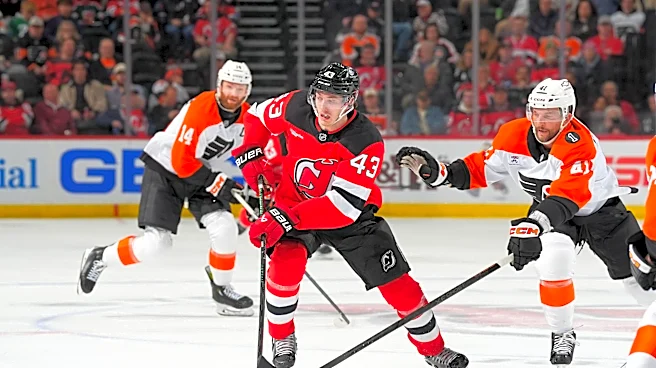
He's also never going to let emotions get in the way. Don't believe it? He just traded Luke Evangelista, an undeniable fan favorite, to the Devils. Apparently he saw something in Evangelista's future that made him prefer two 2028 draft picks.
"We have a road map as to how we think we're going to get there," MacFarland said. "There will be zigs and zags in that path. There will be things that you might go, 'Hmm, what's that all about?' Why that move at this time? But it is not done in a vacuum."
MacFarland is not someone who prefers the spotlight. He won't be shaking hands and taking selfies in the concourse or tossing T-shirts into the crowd during intermission. None of those things will help make the roster better.

For Nashville to make a return to the playoffs after a two-year disappearance, it's going to take an unbiased approach. A hard look at the numbers and a process that demands results.
"I'm not a big buzzword guy. I'm not a big slogan guy. What I am is a big results guy and a big process guy," he said.
Alex Daugherty is the Predators beat writer for The Tennessean. Contact Alex at jdaugherty@gannett.com, follow him on X at @alexdaugherty1 or check out our Predators exclusive Instagram page @tennessean_preds.
This article originally appeared on Nashville Tennessean: How Chris MacFarland's team-building obsession led him to Predators | Exclusive